
The realm of theoretical physics is a vast and intricate landscape, where the fundamental laws governing the universe are explored and challenged. At the heart of this exploration lies the concept of the “ultimate limit,” a term that encapsulates the boundaries of human understanding in the quest to decipher the cosmos. This ultimate limit represents not only the edge of current scientific knowledge but also the philosophical implications of what it means to comprehend the universe.
As physicists delve deeper into the fabric of reality, they confront profound questions about existence, causality, and the very nature of time and space. The pursuit of understanding these ultimate limits has driven some of the most brilliant minds in history to grapple with concepts that often defy intuition. From the early musings of ancient philosophers to the groundbreaking theories of modern scientists, the journey has been marked by both triumphs and setbacks.
The quest for a unified theory that can seamlessly integrate all known forces and particles remains one of the most ambitious goals in theoretical physics. As researchers continue to push the boundaries of knowledge, they are compelled to confront not only the mathematical complexities involved but also the philosophical ramifications of their findings.
Key Takeaways
- The ultimate limit in theoretical physics seeks a unified framework combining quantum mechanics and general relativity.
- Understanding dark matter and dark energy remains a major challenge in explaining the universe’s composition.
- String theory and M-theory offer promising approaches toward a Theory of Everything.
- Singularities and black holes highlight fundamental constraints on space, time, and the universe’s structure.
- Advances in quantum field theory and particle physics continue to shape the future boundaries of theoretical physics.
The Search for a Unified Theory
The search for a unified theory is often regarded as the Holy Grail of theoretical physics. This endeavor seeks to reconcile the four fundamental forces of nature: gravity, electromagnetism, the weak nuclear force, and the strong nuclear force. Historically, these forces have been described by separate theories, each with its own set of principles and equations.
However, physicists aspire to develop a single framework that can elegantly unify these disparate forces into a coherent whole. Such a theory would not only enhance our understanding of the universe but also provide insights into phenomena that remain elusive. One of the most significant milestones in this quest was Albert Einstein’s theory of general relativity, which elegantly described gravity as the curvature of spacetime.
However, while general relativity successfully explains large-scale cosmic phenomena, it does not account for quantum mechanics, which governs the behavior of particles at the smallest scales. The challenge lies in merging these two pillars of physics into a single theoretical framework that can accurately describe both the macroscopic and microscopic realms. This endeavor has led to various approaches, including string theory and loop quantum gravity, each offering unique perspectives on how to achieve this unification.
The Role of Quantum Mechanics and General Relativity

Quantum mechanics and general relativity stand as two towering pillars in the edifice of modern physics, yet they operate under fundamentally different principles. Quantum mechanics introduces a probabilistic nature to physical phenomena, where particles exist in superpositions and exhibit wave-particle duality. In contrast, general relativity presents a deterministic view of gravity as a geometric property of spacetime.
The challenge for physicists lies in reconciling these two frameworks, as they often yield conflicting predictions when applied to extreme conditions, such as those found near black holes or during the Big Bang. The incompatibility between quantum mechanics and general relativity has led to significant theoretical challenges. For instance, while general relativity predicts that spacetime is smooth and continuous, quantum mechanics suggests that at very small scales, spacetime may be discrete or subject to fluctuations.
This discrepancy raises profound questions about the nature of reality itself and has prompted physicists to explore various avenues for unification. The development of quantum gravity theories aims to bridge this gap, offering potential insights into how these two seemingly disparate realms can coexist harmoniously.
The Challenge of Understanding Dark Matter and Dark Energy
| Metric | Value/Estimate | Description |
|---|---|---|
| Dark Matter Composition | ~27% | Percentage of the total mass-energy content of the universe attributed to dark matter |
| Dark Energy Composition | ~68% | Percentage of the total mass-energy content of the universe attributed to dark energy |
| Ordinary Matter Composition | ~5% | Percentage of the total mass-energy content of the universe made up of ordinary (baryonic) matter |
| Dark Matter Detection Status | Not yet directly detected | Current status of direct detection experiments for dark matter particles |
| Dark Energy Equation of State Parameter (w) | Approximately -1 | Parameter describing the pressure to density ratio of dark energy, consistent with a cosmological constant |
| Galaxy Rotation Curves | Flat at large radii | Observed velocity profiles of stars in galaxies indicating presence of dark matter |
| Cosmic Microwave Background (CMB) Anisotropies | Measured with precision | Fluctuations in the CMB providing constraints on dark matter and dark energy densities |
| Accelerating Expansion of Universe | Confirmed | Observations of distant supernovae indicating the universe’s expansion is accelerating due to dark energy |
In recent decades, astrophysicists have uncovered compelling evidence for the existence of dark matter and dark energy—two enigmatic components that constitute a significant portion of the universe’s total mass-energy content. Dark matter, which does not emit or interact with electromagnetic radiation, is inferred from its gravitational effects on visible matter. Conversely, dark energy is thought to be responsible for the accelerated expansion of the universe.
Despite their prevalence, both dark matter and dark energy remain poorly understood, posing a formidable challenge for theoretical physicists. The quest to comprehend these elusive entities has sparked numerous hypotheses and models. Some researchers propose that dark matter could be composed of exotic particles that have yet to be detected, while others explore modifications to existing theories of gravity.
Dark energy, on the other hand, raises questions about the fundamental nature of space itself—whether it is a constant force or a dynamic field that evolves over time. As physicists grapple with these mysteries, they are compelled to reconsider established notions about the universe’s composition and behavior.
Theoretical Constraints on the Nature of Space and Time
The nature of space and time has long been a subject of fascination for philosophers and scientists alike. In theoretical physics, space and time are not merely passive backdrops against which events unfold; rather, they are dynamic entities that interact with matter and energy. Theoretical constraints on space and time arise from various frameworks, including general relativity and quantum mechanics, each imposing its own limitations on how these dimensions can be understood.
One significant constraint is the concept of causality—the principle that cause precedes effect. In classical physics, this notion is straightforward; however, in quantum mechanics, phenomena such as entanglement challenge traditional views of causality. Additionally, general relativity introduces complexities related to spacetime curvature and gravitational effects on time dilation.
These theoretical constraints compel physicists to rethink fundamental assumptions about how space and time operate at both cosmic and quantum scales.
The Quest for a Theory of Everything
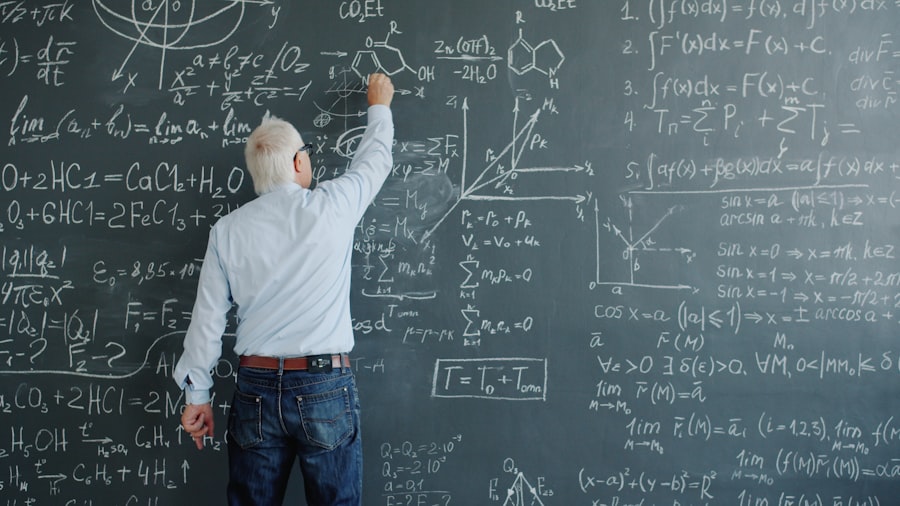
The quest for a Theory of Everything (ToE) represents an ambitious endeavor to formulate a comprehensive framework that encompasses all known physical phenomena. A successful ToE would unify all fundamental forces and particles into a single theoretical construct, providing profound insights into the workings of the universe. This pursuit has captivated generations of physicists, inspiring groundbreaking research and innovative ideas.
Various approaches have emerged in this quest for unification. String theory posits that fundamental particles are not point-like objects but rather one-dimensional strings vibrating at different frequencies. M-theory extends this idea further by suggesting that multiple dimensions exist beyond our familiar three-dimensional space.
While these theories offer tantalizing possibilities for unification, they also face challenges related to experimental validation and mathematical consistency. The search for a ToE continues to drive research in theoretical physics as scientists strive to uncover deeper truths about reality.
The Role of String Theory and M-Theory
String theory has emerged as one of the leading candidates in the quest for a unified theory in theoretical physics. By proposing that fundamental particles are composed of tiny vibrating strings rather than point-like entities, string theory offers a framework that naturally incorporates gravity alongside other fundamental forces. This elegant approach has garnered significant attention due to its potential to resolve inconsistencies between quantum mechanics and general relativity.
M-theory represents an extension of string theory that introduces additional dimensions beyond those proposed in traditional string models. It suggests that our universe may be just one slice of a higher-dimensional reality where various physical phenomena can be understood more comprehensively. While string theory and M-theory have provided valuable insights into unification, they also present challenges related to empirical verification.
As researchers continue to explore these theories’ implications, they remain hopeful that advancements in experimental techniques will eventually shed light on their validity.
Theoretical Limits on the Size and Structure of the Universe
Theoretical physics grapples with profound questions regarding the size and structure of the universe itself. Current cosmological models suggest that the observable universe is vast—spanning billions of light-years—but what lies beyond this observable horizon remains uncertain. Theoretical limits arise from various considerations, including cosmic inflation, which posits that the universe underwent rapid expansion shortly after the Big Bang.
Additionally, concepts such as cosmic topology explore whether the universe is finite or infinite in extent. Some theories propose that our universe may be part of a multiverse—a collection of multiple universes with varying physical laws and constants. These theoretical limits challenge conventional notions about reality and compel physicists to consider possibilities beyond our immediate observational capabilities.
The Concept of Singularities and Black Holes
Singularities represent one of the most intriguing yet perplexing aspects of theoretical physics. These points in spacetime are characterized by infinite density and curvature, where conventional laws of physics break down.
They serve as focal points for exploring fundamental questions about gravity, spacetime, and information loss. The study of black holes has revealed profound insights into the nature of reality itself. For instance, Stephen Hawking’s work on black hole thermodynamics introduced concepts such as Hawking radiation—suggesting that black holes can emit particles and eventually evaporate over time.
These revelations challenge traditional views about information conservation in physics and raise philosophical questions about what happens to information when it falls into a black hole.
The Influence of Quantum Field Theory and Particle Physics
Quantum field theory (QFT) has revolutionized our understanding of particle physics by providing a framework for describing how particles interact through fields. This theoretical approach has led to remarkable successes in predicting particle behavior and has been instrumental in developing the Standard Model—a comprehensive theory that describes three of the four fundamental forces (excluding gravity) and classifies elementary particles. The influence of QFT extends beyond particle interactions; it also shapes our understanding of fundamental concepts such as symmetry and conservation laws.
As physicists explore deeper layers within QFT, they encounter intriguing phenomena such as spontaneous symmetry breaking—where symmetries are not reflected in observable states—and gauge theories that underpin our understanding of fundamental forces. These insights continue to inform ongoing research in theoretical physics as scientists seek to unravel more profound truths about matter and energy.
The Future of Theoretical Physics and the Ultimate Limit
As theoretical physics continues its relentless pursuit toward understanding the ultimate limits of knowledge, researchers remain optimistic about future breakthroughs that may reshape our comprehension of reality.
Moreover, interdisciplinary collaborations between physicists, mathematicians, and philosophers are becoming increasingly vital in addressing complex questions surrounding existence and reality itself.
As new discoveries emerge from both experimental observations and theoretical explorations, humanity’s understanding of its place within the cosmos may evolve dramatically. In conclusion, while theoretical physics grapples with profound challenges related to unification, dark matter, dark energy, and more, it remains an ever-evolving field driven by curiosity and innovation. The quest for an ultimate limit may never reach a definitive conclusion; however, each step taken along this journey brings humanity closer to unraveling the mysteries that govern existence itself.
In the quest to understand the hardest limits in theoretical physics, one intriguing aspect is the concept of black holes and their implications for our understanding of space and time. For a deeper exploration of these ideas, you can read more in the article available at My Cosmic Ventures, which delves into the mysteries surrounding black holes and their role in the fabric of the universe.
WATCH THIS! The Paradox That Broke Physics: Quantum vs. Black Holes
FAQs
What is considered the hardest limit in theoretical physics?
The hardest limit in theoretical physics often refers to the Planck scale, where the effects of quantum mechanics and gravity converge, and current physical theories break down or require unification.
Why is the Planck scale important in theoretical physics?
The Planck scale represents the smallest meaningful length and highest energy scale, beyond which classical concepts of space and time cease to apply, making it crucial for understanding quantum gravity.
What challenges do physicists face at the hardest limit?
At the hardest limit, such as the Planck scale, existing theories like general relativity and quantum mechanics are incompatible, posing significant challenges in developing a unified theory of quantum gravity.
Are there any experimental methods to study the hardest limit?
Currently, direct experimental access to the Planck scale is beyond technological capabilities due to the extremely high energies required, so physicists rely on indirect observations and theoretical models.
How does the hardest limit relate to black holes?
Black holes, especially at their singularities, approach conditions near the hardest limit, where quantum gravitational effects become significant, highlighting the need for a theory that unifies gravity and quantum mechanics.
What theories attempt to address the hardest limit?
Theories such as string theory, loop quantum gravity, and other approaches to quantum gravity aim to describe physics at the hardest limit, providing frameworks to reconcile quantum mechanics with general relativity.
Is the hardest limit a physical boundary or a theoretical concept?
The hardest limit is primarily a theoretical concept indicating where current physical laws cease to be valid or complete, suggesting the need for new physics beyond established theories.