Black holes have long captivated the imagination of scientists and the general public alike. These enigmatic cosmic entities, formed from the remnants of massive stars that have undergone gravitational collapse, possess gravitational fields so intense that nothing, not even light, can escape their grasp. The concept of a black hole challenges the very foundations of physics, particularly our understanding of space, time, and the fundamental laws governing the universe.
As researchers delve deeper into the mysteries surrounding black holes, they uncover layers of complexity that not only enhance our comprehension of these phenomena but also raise profound questions about the nature of reality itself. The study of black holes has evolved significantly since their theoretical inception in the early 20th century. Initially dismissed as mere mathematical curiosities, black holes are now recognized as critical components of the cosmos.
They are believed to exist at the centers of most galaxies, including our own Milky Way, where they exert a powerful influence on surrounding matter and light. As scientists continue to explore the properties and behaviors of black holes, they confront a series of paradoxes that challenge established theories in physics, particularly in the realms of quantum mechanics and general relativity. This exploration not only sheds light on the nature of black holes but also opens up new avenues for understanding the universe at its most fundamental level.
Key Takeaways
- Black holes challenge our understanding of information preservation due to the paradox of information loss during Hawking radiation.
- The firewall paradox questions the smoothness of the event horizon, suggesting potential conflicts between quantum mechanics and general relativity.
- Quantum entanglement and the holographic principle offer promising frameworks to resolve the black hole information paradox.
- Recent advances, including insights from string theory, have deepened our understanding of how information might be retrieved from black holes.
- Resolving the black hole information paradox could have profound implications for the future of physics and practical technologies.
The Paradox of Black Hole Information Retrieval
One of the most intriguing dilemmas in modern physics is the black hole information paradox. This paradox arises from the apparent conflict between quantum mechanics and general relativity regarding the fate of information that falls into a black hole. According to quantum theory, information cannot be destroyed; it can only change forms.
However, when matter crosses the event horizon of a black hole, it seems to vanish from the observable universe, leading to the unsettling conclusion that information is lost forever. This contradiction poses significant challenges for physicists attempting to reconcile these two foundational theories. The implications of this paradox are profound.
If information is indeed lost within black holes, it would violate one of the core principles of quantum mechanics, leading to a breakdown in our understanding of physical laws. This dilemma has prompted extensive debate among physicists, with some proposing that information is somehow preserved at the event horizon or encoded in Hawking radiation, while others suggest that new physics may be required to resolve the issue. The quest to understand how information behaves in relation to black holes not only deepens our knowledge of these cosmic giants but also raises fundamental questions about the nature of reality itself.
Hawking Radiation and Information Loss
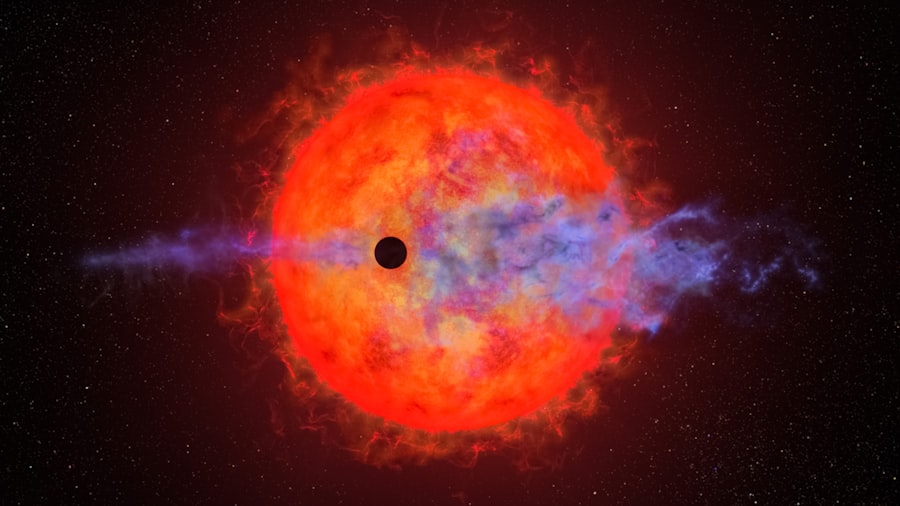
In 1974, physicist Stephen Hawking introduced a groundbreaking concept known as Hawking radiation, which further complicates the black hole information paradox. According to Hawking’s theory, black holes are not entirely black; they emit radiation due to quantum effects near the event horizon. This radiation arises from virtual particle pairs that spontaneously form in empty space.
When one particle falls into the black hole while the other escapes, it results in a net loss of mass for the black hole, leading to its gradual evaporation over time. The existence of Hawking radiation raises critical questions about information loss. If a black hole eventually evaporates completely through this process, what happens to the information contained within it?
Some physicists argue that as a black hole emits Hawking radiation, it may encode information about its contents in this radiation, allowing for potential retrieval of information over time. However, this idea remains contentious and has not been definitively proven. The debate surrounding Hawking radiation and its implications for information retrieval continues to be a focal point in theoretical physics.
The Firewall Paradox
| Metric | Description | Value | Unit |
|---|---|---|---|
| Firewall Thickness | Estimated thickness of the firewall at the event horizon | Planck length | ~1.6 x 10^-35 meters |
| Black Hole Entropy | Entropy associated with the black hole horizon | ~10^77 | Boltzmann units |
| Information Paradox Resolution Attempts | Number of theoretical models proposed to resolve the firewall paradox | 5+ | Models |
| Hawking Radiation Temperature | Temperature of radiation emitted by a black hole | ~10^-8 | Kelvin (for solar mass black hole) |
| Firewall Hypothesis Publication Year | Year when the firewall paradox was first proposed | 2012 | Year |
The firewall paradox presents yet another layer of complexity in understanding black holes and their relationship with information. Proposed by physicists Almheiri, Marolf, Polchinski, and Sully in 2012, this paradox suggests that an observer falling into a black hole would encounter a searing wall of high-energy particles at the event horizon—essentially a “firewall.” This idea contradicts previous notions that an observer would experience a smooth passage through the event horizon without any dramatic effects. The firewall paradox arises from attempts to reconcile quantum mechanics with general relativity while preserving the principle of unitarity—the idea that information is conserved in quantum processes.
If an observer were to fall into a black hole and encounter a firewall, it would imply that information is not preserved in a way consistent with quantum mechanics. This contradiction has sparked intense debate among physicists, leading to various proposed resolutions ranging from modifications to our understanding of spacetime to entirely new theories about gravity and quantum mechanics. The firewall paradox exemplifies the ongoing struggle to unify these two pillars of modern physics.
Quantum Entanglement and Black Hole Information
Quantum entanglement plays a crucial role in discussions surrounding black hole information retrieval. This phenomenon occurs when two or more particles become interconnected in such a way that the state of one particle instantaneously influences the state of another, regardless of the distance separating them. Entanglement raises intriguing questions about how information might be preserved or transmitted in relation to black holes.
Some researchers propose that entangled particles could provide insights into how information is encoded within black holes. For instance, if particles falling into a black hole are entangled with particles outside its event horizon, it may be possible for information about those particles to be retained even after they cross into the black hole’s interior. This idea suggests that entanglement could serve as a bridge between the interior and exterior of a black hole, potentially allowing for information retrieval despite the apparent loss associated with crossing the event horizon.
However, this concept remains speculative and requires further investigation to determine its validity.
The Holographic Principle
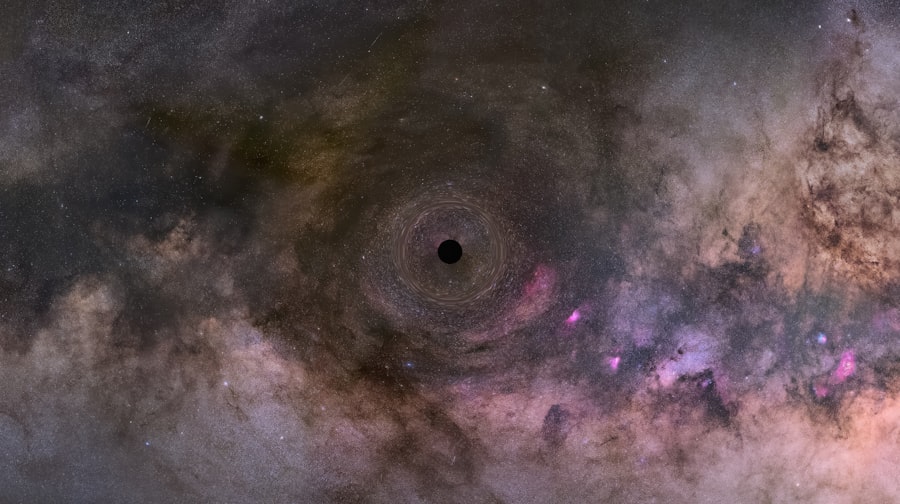
The holographic principle offers a compelling framework for understanding black hole information retrieval and its implications for our understanding of reality. Proposed by theorists such as Gerard ‘t Hooft and Leonard Susskind, this principle posits that all information contained within a volume of space can be represented as a two-dimensional surface surrounding that volume. In essence, it suggests that our three-dimensional perception of space may be an illusion, with all physical phenomena encoded on a lower-dimensional boundary.
In relation to black holes, the holographic principle implies that information falling into a black hole may not be lost but rather encoded on its event horizon. This perspective aligns with ideas surrounding Hawking radiation and quantum entanglement, suggesting that information could be preserved even as matter crosses into a black hole’s interior. The holographic principle has gained traction in theoretical physics as researchers explore its implications for understanding gravity, quantum mechanics, and the fundamental nature of reality itself.
Recent Advances in Black Hole Information Retrieval
Recent advancements in theoretical physics have shed new light on the complexities surrounding black hole information retrieval. Researchers have made significant strides in developing models that incorporate elements from quantum mechanics and general relativity to address longstanding questions about information loss. For instance, studies exploring the interplay between entanglement and black hole dynamics have provided valuable insights into how information might be preserved or retrieved.
Additionally, advancements in computational techniques have allowed physicists to simulate black hole behavior more accurately than ever before. These simulations enable researchers to explore various scenarios involving Hawking radiation, entanglement, and other phenomena associated with black holes. As new data emerges from observational astronomy—such as gravitational wave detections and imaging of black holes—scientists are better equipped to test theoretical predictions and refine their understanding of these enigmatic objects.
The Role of String Theory in Understanding Black Hole Information
String theory has emerged as a promising framework for addressing some of the challenges posed by black hole information retrieval. This theoretical approach posits that fundamental particles are not point-like objects but rather one-dimensional “strings” vibrating at different frequencies.
In particular, string theory provides insights into how information might be encoded within black holes. Researchers have explored concepts such as “black hole entropy,” which relates to the number of microstates corresponding to a given macrostate within a black hole. By examining these microstates through the lens of string theory, scientists hope to uncover mechanisms by which information is preserved even as matter crosses into a black hole’s interior.
While string theory remains an area of active research with many unanswered questions, its potential contributions to understanding black holes cannot be overlooked.
The Black Hole Information Paradox and the Future of Physics
The black hole information paradox represents one of the most profound challenges facing modern physics. As scientists grapple with questions surrounding information loss and retrieval, they are compelled to reconsider fundamental assumptions about space, time, and reality itself. The ongoing exploration of this paradox has far-reaching implications for our understanding of quantum mechanics and general relativity.
As researchers continue to investigate potential resolutions to the paradox—whether through advancements in string theory, holography, or other theoretical frameworks—they are likely to uncover new insights that could reshape our understanding of the universe. The quest for answers may lead to breakthroughs not only in theoretical physics but also in related fields such as cosmology and quantum computing.
Practical Implications of Black Hole Information Retrieval
While discussions surrounding black holes often seem abstract or esoteric, there are practical implications associated with understanding information retrieval from these cosmic entities. Insights gained from studying black holes could inform advancements in quantum computing and cryptography by providing new perspectives on how information is stored and transmitted at fundamental levels. Moreover, unraveling the mysteries surrounding black holes may lead to technological innovations inspired by principles derived from their study.
For instance, concepts related to entanglement and holography could influence developments in communication technologies or data storage methods. As researchers continue to explore these connections between theoretical physics and practical applications, they may uncover novel solutions to contemporary challenges.
Conclusion and Future Directions in Black Hole Research
In conclusion, the study of black holes remains one of the most exciting frontiers in modern physics. The complexities surrounding their nature—particularly regarding information retrieval—pose significant challenges that continue to inspire inquiry and debate among scientists worldwide. As researchers explore concepts such as Hawking radiation, entanglement, and holography, they inch closer to unraveling some of the universe’s most profound mysteries.
Looking ahead, future directions in black hole research will likely involve interdisciplinary collaboration across fields such as astrophysics, quantum mechanics, and string theory. As observational technologies advance and theoretical frameworks evolve, scientists will be better equipped to tackle longstanding questions about black holes and their role in shaping our understanding of reality itself. The journey toward comprehending these enigmatic cosmic entities promises not only to deepen humanity’s knowledge but also to inspire future generations of physicists and thinkers alike.
A related article that delves into this topic can be found on My Cosmic Ventures, where various theories and perspectives are examined. For more insights, you can read the article here: My Cosmic Ventures.
WATCH THIS! The Paradox That Broke Physics: Quantum vs. Black Holes
FAQs
What is black hole information retrieval?
Black hole information retrieval refers to the theoretical process of recovering information that falls into a black hole. It addresses the question of whether information about matter and energy that enters a black hole is lost forever or can be retrieved.
Why is information retrieval from black holes important?
Information retrieval from black holes is important because it relates to fundamental principles of physics, such as the conservation of information and the laws of quantum mechanics. Resolving this issue helps reconcile general relativity with quantum theory.
What is the black hole information paradox?
The black hole information paradox arises from the conflict between quantum mechanics, which states information cannot be destroyed, and classical black hole theory, which suggests information that falls into a black hole is lost when the black hole evaporates via Hawking radiation.
What role does Hawking radiation play in information retrieval?
Hawking radiation is thermal radiation predicted to be emitted by black holes due to quantum effects near the event horizon. It is central to the information paradox because it suggests black holes can evaporate, potentially destroying information unless the radiation somehow encodes it.
Have scientists proposed solutions to the information paradox?
Yes, several solutions have been proposed, including the idea that information is encoded in Hawking radiation, the holographic principle suggesting information is stored on the event horizon, and the concept of black hole complementarity. Research is ongoing.
What is the holographic principle?
The holographic principle is a theoretical framework proposing that all the information contained within a volume of space can be represented as encoded data on the boundary of that space, such as the event horizon of a black hole.
Can information actually escape a black hole?
According to current theories, information does not escape the black hole in the classical sense but may be preserved and encoded in subtle correlations within Hawking radiation or on the event horizon, allowing for theoretical retrieval.
Is black hole information retrieval experimentally verified?
No, black hole information retrieval remains a theoretical concept. Direct experimental verification is currently beyond our technological capabilities due to the extreme conditions near black holes.
How does black hole information retrieval impact physics?
Resolving how information is preserved or retrieved from black holes could unify quantum mechanics and general relativity, leading to a deeper understanding of gravity, quantum theory, and the fundamental nature of the universe.