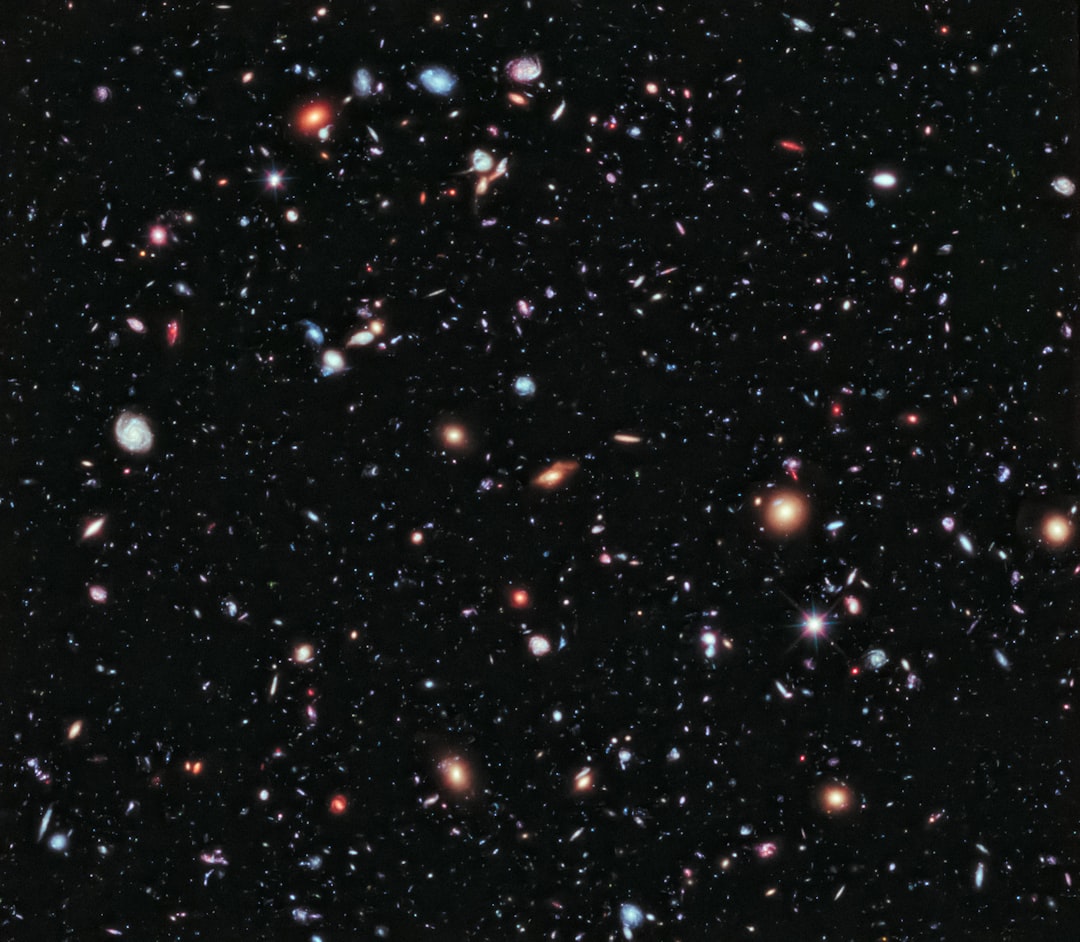
The universe, vast and enigmatic, is often perceived as a grand tapestry woven from the threads of matter, energy, and time. However, an equally compelling perspective is that the universe can be understood as a colossal repository of information. This notion posits that every particle, every wave, and every interaction carries with it a piece of data that contributes to the overall narrative of existence.
The concept of the universe’s information transcends mere physicality; it encompasses the laws of physics, the constants that govern them, and the intricate relationships between all entities within the cosmos. As scientists and philosophers delve deeper into this idea, they uncover layers of complexity that challenge traditional notions of reality. Understanding the universe as an information system invites a multitude of questions about the nature of reality itself.
What does it mean for something to exist if it can be reduced to information? How do the laws of physics encode the behavior of matter and energy? These inquiries not only stimulate scientific exploration but also provoke philosophical debates about existence, knowledge, and the very fabric of reality.
As humanity stands on the precipice of new discoveries, the quest to decode the universe’s information becomes increasingly vital, promising insights that could reshape our understanding of everything from quantum mechanics to cosmology.
Key Takeaways
- The universe’s information is fundamentally linked to quantum mechanics and entropy concepts.
- There are theoretical and practical limits to how much information the universe can contain.
- The debate continues over whether the universe’s information is finite or infinite.
- Information conservation and the universe’s expansion play key roles in understanding cosmic information.
- Technological advances drive deeper insights, raising philosophical questions about the nature of the universe.
Theoretical and practical limits of information in the universe
The exploration of information within the universe is not without its boundaries. Theoretical limits arise from fundamental principles in physics, particularly those articulated by quantum mechanics and thermodynamics. For instance, the Bekenstein bound suggests that there is a maximum amount of information that can be contained within a given volume of space, directly related to its energy content.
This principle implies that as one attempts to gather more information about a system, they inevitably encounter constraints dictated by the laws of physics. Such limitations challenge researchers to rethink how they approach the study of cosmic phenomena. On a practical level, the limits of information are further complicated by technological constraints.
The tools and methodologies available to scientists impose restrictions on their ability to gather and process data. For example, while telescopes can capture light from distant galaxies, they cannot reveal every detail about those celestial bodies due to interference from cosmic dust or the finite speed of light. Similarly, particle accelerators can probe subatomic particles but are limited by energy thresholds and the inherent uncertainty in quantum measurements.
These practical limitations underscore the complexity of understanding the universe’s information and highlight the need for innovative approaches in both theoretical and experimental physics.
The role of quantum mechanics in understanding the universe’s information
Quantum mechanics plays a pivotal role in shaping contemporary understandings of information within the universe. At its core, quantum theory introduces concepts such as superposition and entanglement, which challenge classical notions of locality and determinism. In this framework, particles can exist in multiple states simultaneously until measured, suggesting that information is not merely a static entity but a dynamic interplay of possibilities.
This perspective has profound implications for how scientists conceptualize information at both micro and macro scales. Moreover, quantum entanglement reveals that particles can become interconnected in ways that transcend classical communication channels. When two particles are entangled, the state of one instantaneously influences the state of another, regardless of distance.
This phenomenon raises intriguing questions about the nature of information transfer in the universe. If entangled particles can share information instantaneously, what does this imply for our understanding of causality and communication across vast cosmic distances? As researchers continue to explore these quantum phenomena, they uncover new dimensions of information that challenge existing paradigms and open avenues for future inquiry.
The concept of entropy and its relationship to the universe’s information
| Metric | Description | Relation to Entropy | Implication for Universe’s Information |
|---|---|---|---|
| Entropy (S) | Measure of disorder or randomness in a system | Higher entropy means higher disorder | Represents the amount of missing information about the microstates of the universe |
| Boltzmann’s Constant (k) | Physical constant relating entropy to probability | Used in formula S = k ln(W), where W is number of microstates | Links microscopic configurations to macroscopic entropy, quantifying information content |
| Number of Microstates (W) | Possible configurations of a system’s components | Entropy increases with the logarithm of W | More microstates mean more uncertainty and less information about exact state |
| Shannon Entropy (H) | Measure of information content or uncertainty in information theory | Analogous to thermodynamic entropy but applied to information | Quantifies the information needed to describe the state of the universe |
| Second Law of Thermodynamics | Entropy of an isolated system never decreases | Entropy tends to increase over time | Indicates that the universe’s information about its exact state becomes more uncertain |
| Black Hole Entropy | Entropy proportional to the surface area of the event horizon | Represents maximum entropy/information content in a given volume | Suggests limits on information storage and links entropy to information theory |
| Cosmic Microwave Background (CMB) Entropy | Entropy associated with radiation left over from the Big Bang | Represents a baseline entropy level of the universe | Provides clues about the initial information state of the universe |
Entropy, often associated with disorder or randomness, is a fundamental concept in thermodynamics that has significant implications for understanding information in the universe. In essence, entropy quantifies the amount of uncertainty or lack of information about a system’s microstates.
The second law of thermodynamics posits that in an isolated system, entropy will never decrease; it can only remain constant or increase. This principle has profound implications for cosmology and our understanding of the universe’s fate.
As stars burn out and galaxies drift apart, the universe may approach a state known as “heat death,” where entropy reaches its maximum and usable energy dissipates. In this scenario, the amount of meaningful information about cosmic events diminishes over time. Thus, entropy serves as a crucial link between thermodynamic processes and informational content, shaping how scientists interpret the evolution of the cosmos.
The potential implications of a finite universe in information
The notion of a finite universe carries significant implications for our understanding of information. If the universe is indeed finite in size and resources, it suggests that there exists a limit to the amount of information that can be encoded within it. This perspective raises questions about the nature of knowledge itself: if there are finite resources for gathering and processing information, what does this mean for humanity’s quest for understanding?
It implies that there may be ultimate truths or fundamental laws that remain forever beyond reach. Furthermore, a finite universe could lead to considerations about conservation and sustainability in scientific inquiry. As researchers strive to uncover new knowledge about cosmic phenomena, they must grapple with the reality that their resources—both intellectual and material—are limited.
This awareness may foster a more responsible approach to scientific exploration, encouraging collaboration across disciplines and emphasizing interdisciplinary research as a means to maximize understanding within finite constraints.
The debate between finite and infinite information in the universe
The debate surrounding finite versus infinite information in the universe is a rich tapestry woven from scientific inquiry and philosophical speculation. Proponents of a finite universe argue that physical laws impose limits on what can be known or understood. They point to concepts such as black holes and singularities as evidence that certain regions may harbor mysteries beyond human comprehension.
In contrast, advocates for infinite information suggest that while our current understanding may be limited, there exists an infinite reservoir of knowledge waiting to be discovered. This dichotomy raises profound questions about human cognition and perception. If the universe is infinite in its informational potential, what does this imply for humanity’s capacity to comprehend it?
Are there truths that lie beyond human understanding? Conversely, if the universe is finite, does this mean that all knowledge is ultimately attainable? These questions not only challenge scientists but also philosophers who ponder the implications for existence itself.
The ongoing discourse between these two perspectives reflects humanity’s enduring quest for meaning in an ever-expanding cosmos.
The concept of information conservation in the universe
Information conservation is a principle that resonates deeply within both physics and philosophy. It suggests that while forms and states may change over time, the underlying information remains intact. This idea aligns with certain interpretations of quantum mechanics, where information is never truly lost but rather transformed or encoded differently as systems evolve.
The conservation of information has profound implications for understanding processes such as black hole evaporation or quantum state collapse. In practical terms, this principle challenges researchers to rethink how they approach data collection and analysis. If information is conserved even in seemingly chaotic systems, then there may be hidden patterns or structures waiting to be uncovered.
This perspective encourages scientists to adopt innovative methodologies that seek to reveal underlying order amidst apparent randomness. By embracing this concept, researchers can enhance their understanding of complex systems across various domains—from cosmology to biology—ultimately enriching humanity’s grasp of the universe’s intricate informational landscape.
The relationship between information and the expansion of the universe
The expansion of the universe introduces another layer to the intricate relationship between information and cosmic phenomena. As galaxies drift apart due to cosmic expansion, signals from distant sources become increasingly redshifted, leading to potential loss or distortion of information over vast distances. This phenomenon raises questions about how much we can truly know about regions beyond our observable horizon.
If light takes billions of years to reach Earth from distant galaxies, what does this mean for our understanding of their current states? Moreover, as space expands, so too does the potential for new forms of information to emerge. The dynamic nature of cosmic expansion suggests that new structures—such as galaxies or stars—are continually forming while others fade away into obscurity.
This ongoing process creates a constantly evolving informational landscape where knowledge is both gained and lost over time. Understanding this relationship between expansion and information is crucial for cosmologists seeking to piece together the history and future trajectory of the universe.
The impact of technological advancements on our understanding of the universe’s information
Technological advancements have revolutionized humanity’s ability to gather and interpret information about the universe. From powerful telescopes capable of peering into distant galaxies to sophisticated particle accelerators probing subatomic particles, these innovations have expanded our horizons beyond what was once thought possible. Each leap in technology not only enhances data collection but also transforms theoretical frameworks by providing empirical evidence that challenges existing paradigms.
For instance, advancements in computational power have enabled scientists to simulate complex systems with unprecedented accuracy. These simulations allow researchers to explore scenarios that would be impossible to replicate in laboratory settings or through direct observation alone. As technology continues to evolve—such as through developments in artificial intelligence—scientists are poised to unlock new dimensions of understanding regarding cosmic phenomena and their underlying informational structures.
The philosophical implications of a finite or infinite universe in information
The philosophical implications surrounding whether the universe contains finite or infinite information are profound and far-reaching. If one subscribes to a finite view, it raises existential questions about humanity’s place within this limited framework: What does it mean for knowledge if there are ultimate boundaries? Conversely, an infinite perspective invites contemplation about human cognition’s limitations: Are there truths forever beyond reach?
These inquiries challenge individuals to reflect on their beliefs regarding existence itself. Moreover, these philosophical debates extend into ethical considerations regarding scientific exploration and knowledge acquisition. If knowledge is finite, how should humanity prioritize its pursuit?
Should efforts focus on uncovering fundamental truths or addressing pressing global challenges? Alternatively, if knowledge is infinite, what responsibilities do individuals bear in their quest for understanding? These questions underscore not only humanity’s intellectual aspirations but also its ethical obligations toward future generations.
The ongoing quest to understand the universe’s information
The quest to understand the universe’s information is an enduring journey marked by curiosity, innovation, and philosophical reflection. As scientists grapple with theoretical limits imposed by physics while navigating practical constraints inherent in data collection methods, they continue pushing boundaries toward deeper insights into cosmic phenomena. Quantum mechanics offers tantalizing glimpses into how information operates at fundamental levels while concepts like entropy remind us that knowledge evolves alongside universal processes.
As technological advancements pave new pathways for exploration—transforming our ability to gather data—the interplay between finite versus infinite perspectives remains central to ongoing discourse within both scientific communities and philosophical circles alike. Ultimately, humanity’s pursuit of knowledge reflects not only an insatiable desire for understanding but also an acknowledgment that each discovery brings forth new questions waiting patiently on horizons yet unseen—a testament to our collective journey through time and space toward unraveling nature’s most profound mysteries.
The question of whether the universe is finite in information has intrigued scientists and philosophers alike, leading to various theories and discussions. For a deeper exploration of this topic, you can read a related article on the subject at My Cosmic Ventures, which delves into the implications of information theory in the context of the cosmos.
WATCH THIS! Scientists Say The Universe Is A Quantum Computer (And We Are The Output)
FAQs
What does it mean for the universe to be finite in information?
A universe finite in information means that the total amount of information needed to describe the entire state of the universe is limited and countable, rather than infinite. This concept relates to the idea that the universe’s physical properties and configurations can be fully described using a finite set of data.
Is the universe considered finite or infinite in size?
Current scientific understanding does not definitively conclude whether the universe is finite or infinite in size. Observations suggest the observable universe is finite, but the entire universe could be either finite or infinite beyond what we can observe.
How does the concept of information relate to physics and cosmology?
In physics and cosmology, information refers to the data required to describe the state of a physical system. Theories like quantum mechanics and black hole thermodynamics suggest that information plays a fundamental role in understanding the universe’s structure and behavior.
What role does the holographic principle play in the idea of finite information?
The holographic principle proposes that all the information contained within a volume of space can be represented on the boundary of that space, implying that the universe’s information content might be finite and encoded on a lower-dimensional surface.
Can the universe’s information content be measured or estimated?
Scientists estimate the universe’s information content using concepts like entropy and the Bekenstein bound, which provide theoretical limits on the amount of information or entropy that can be contained within a given region of space.
Does a finite amount of information imply the universe is deterministic?
Not necessarily. A finite amount of information means the universe’s state can be described with limited data, but it does not imply determinism. Quantum mechanics introduces inherent probabilistic elements that affect predictability.
How does the concept of finite information impact our understanding of the universe?
If the universe has finite information, it suggests limits to complexity and may influence theories about the universe’s origin, evolution, and ultimate fate. It also impacts how we understand physical laws and the nature of reality.
Are there any scientific theories that support the universe having finite information?
Yes, theories such as the holographic principle and certain interpretations of quantum gravity support the idea that the universe’s information content is finite. These theories are still under active research and debate.
What is the difference between the observable universe and the entire universe in terms of information?
The observable universe is the portion of the universe we can see and measure, limited by the speed of light and the universe’s age. Its information content is finite and estimable. The entire universe may be much larger or infinite, and its total information content is unknown.
Why is the question of whether the universe is finite in information important?
Understanding whether the universe is finite in information helps physicists develop accurate models of reality, informs the limits of computation and knowledge, and addresses fundamental questions about the nature of existence and the universe’s structure.