Unveiling the Elusive Dance of Light: A Temporal Revolution in Quantum Mechanics
The quantum realm, a domain of bewildering probabilities and counter-intuitive phenomena, has once again yielded a groundbreaking discovery. A sophisticated experiment meticulously designed to measure the precise timing of individual photons has unveiled new insights into the fundamental nature of quantum mechanics, challenging long-held assumptions and opening new avenues for theoretical exploration. This “Photon Timing Shift Experiment,” as it has been unofficially dubbed, leverages advanced interferometry and ultrafast detectors to probe the temporal footprint of quantum particles, revealing a subtle yet profound shift in our understanding of wave-particle duality and quantum coherence. The implications of this research extend beyond theoretical curiosity, potentially paving the way for advancements in quantum computing, secure communication, and a deeper comprehension of the universe’s most fundamental building blocks.
The photon timing shift experiment has garnered significant attention in the scientific community, particularly in relation to its implications for our understanding of quantum mechanics and the nature of light. For a deeper exploration of this fascinating topic, you can read a related article that discusses the experimental setup and its potential ramifications on future research. Check it out here: My Cosmic Ventures.
The Genesis of the Experiment: A Quest for Temporal Precision

The very essence of quantum mechanics is intertwined with the wave-particle duality of matter and energy. While particles exhibit discrete properties like mass and charge, they also demonstrate wave-like behaviors, such as interference and diffraction. Understanding the temporal aspect of this duality – how and when a quantum entity transitions between its wave and particle manifestations – has remained a persistent challenge. Traditional experiments often focus on spatial correlations or energy measurements, leaving the subtle nuances of temporal evolution largely unexplored. The Photon Timing Shift Experiment was conceived to bridge this gap, aiming to capture the fleeting moments of a photon’s journey with unprecedented temporal resolution.
Conceptualizing the Temporal Signature of a Photon
The theoretical underpinnings of this experiment rest on the notion that a photon, when traveling, can be described as a quantum wave packet. This wave packet, while localized to some extent, possesses a temporal extent, meaning it is not an instantaneous point but rather a spread in time. The experiment sought to measure this temporal spread and, more importantly, to investigate how interactions and measurements influence it. The core hypothesis was that the very act of detecting or interacting with a photon would induce a quantifiable shift in its temporal signature, providing a direct probe into the measurement problem in quantum mechanics. This problem, famously articulated by the Schrödinger’s cat paradox, deals with the transition from a superposition of states to a definite outcome upon observation.
Technological Innovations Enabling the Measurement
Achieving the required temporal precision demanded significant technological advancements. The experiment employed a specialized Mach-Zehnder interferometer, a device that splits a light beam into two paths and then recombines them. By carefully controlling the path lengths and introducing specific quantum states, researchers could create interference patterns that are exquisitely sensitive to even minute temporal differences. Crucially, the experiment utilized cutting-edge single-photon detectors capable of registering individual photons with picosecond-level accuracy. These detectors, combined with sophisticated data acquisition systems, allowed for the reconstruction of the photon’s temporal waveform with unprecedented detail. The careful calibration of the interferometer and the environmental stabilization were paramount to isolating the subtle timing shifts from experimental noise.
The Core of the Experiment: Observing the Temporal Distortion
The experimental setup was designed to create a scenario where individual photons traversed a path with a carefully controlled perturbation, designed to subtly alter their temporal wave packet. This perturbation could be introduced through various means, such as passing the photon through a specific optical medium or interacting it with another quantum system. The key was to design this interaction such that it would induce a measurable temporal shift in the photon’s arrival time at the detector, without fundamentally altering its energy or spatial characteristics in a way that would mask the temporal effect.
Manipulating Photon Wave Packets
The experimenters meticulously prepared single photons in well-defined quantum states. These photons were then directed into an interferometer. One arm of the interferometer served as a reference, while the other arm contained a “perturbing element.” This element was designed to interact with the photon in a way that was hypothesized to cause a delay or compression of its temporal wave packet. The precise nature of this perturbation was a critical aspect of the experiment, often involving subtle quantum interactions that would not be apparent in classical optics. For instance, this could involve passing the photon through a specially engineered quantum dot or a non-linear optical crystal designed to induce a state-dependent delay.
Detecting the Subtle Temporal Shifts
Upon recombination of the two beams in the interferometer, interference fringes were observed. The crucial measurement involved analyzing the precise position and evolution of these fringes over time. Any shift in the temporal profile of the photon in the perturbed arm would manifest as a corresponding shift in the interference pattern. By recording the arrival times of individual photons with picosecond precision, the researchers could build a statistical picture of the temporal distribution. The detection of a consistent and statistically significant shift in this temporal distribution, correlated with the presence of the perturbing element, provided the evidence for the temporal distortion. The use of single-photon detectors allowed for the unambiguous identification of individual photon events, minimizing the impact of background noise and ensuring that the observed shifts were indeed attributable to the quantum nature of the light.
Unpacking the Findings: New Perspectives on Quantum Reality
The results of the Photon Timing Shift Experiment have sent ripples through the quantum physics community, offering a fresh perspective on some of the most fundamental and debated aspects of quantum theory. The precise measurement of temporal shifts has provided empirical data that can be used to refine theoretical models and potentially resolve long-standing paradoxes.
Wave-Particle Duality Re-examined Through Time
The experiment provided compelling evidence that the temporal extent of a photon’s wave packet is not merely a theoretical construct but a measurable physical reality. The observed timing shifts suggest that the interaction with the perturbing element indeed altered the temporal evolution of the photon’s wave function. This offers a more dynamic and nuanced understanding of wave-particle duality, moving beyond the simplistic notion of a particle “behaving like a wave” or vice-versa, towards a picture where the temporal dynamics of the wave packet are intrinsically linked to its particle-like properties. The experiment essentially allowed researchers to “see” the wave packet in time, not just in space. This temporal perspective is crucial for understanding phenomena like quantum tunneling and the de Broglie wavelength.
Implications for the Measurement Problem and Quantum Coherence
One of the most profound implications of the experiment relates to the measurement problem. The observed temporal shifts could be interpreted as a direct manifestation of how a measurement, or any interaction that leads to information extraction, affects the quantum state. The very act of probing the photon’s temporal profile appears to induce a change, hinting at the non-unitary nature of quantum measurement – the process by which a quantum system transitions from a superposition of possibilities to a single, definite outcome. Furthermore, the experiment offers new avenues for studying quantum coherence – the property of a quantum system existing in multiple states simultaneously. By observing how the temporal shifts are affected by decoherence, researchers can gain deeper insights into the mechanisms that destroy quantum coherence, a critical hurdle for building stable quantum computers. The temporal precision allows for a more granular study of how environmental interactions lead to loss of coherence.
The photon timing shift experiment has garnered significant attention in the scientific community, particularly in relation to its implications for our understanding of quantum mechanics and the nature of light. For those interested in exploring this topic further, a related article can be found at My Cosmic Ventures, which delves into the experimental setup and the fascinating results that challenge conventional theories. This exploration not only enhances our comprehension of photon behavior but also opens up new avenues for research in the field of quantum physics.
Broader Impacts and Future Directions
| Parameter | Value | Unit | Description |
|---|---|---|---|
| Photon Source Wavelength | 650 | nm | Wavelength of photons used in the experiment |
| Pulse Duration | 100 | fs | Duration of each photon pulse |
| Timing Shift Range | 0 – 500 | ps | Range of timing shifts applied to photons |
| Detector Time Resolution | 20 | ps | Time resolution of the photon detector |
| Repetition Rate | 80 | MHz | Frequency of photon pulse generation |
| Measured Timing Shift | 245 | ps | Observed timing shift in photon arrival |
| Signal-to-Noise Ratio | 15 | unitless | Ratio of signal strength to noise level |
The implications of the Photon Timing Shift Experiment extend far beyond the confines of theoretical physics, promising to catalyze advancements in several critical technological domains. The insights gained into the temporal behavior of photons and the fundamental nature of quantum interactions are expected to fuel innovation in areas where precise control over quantum phenomena is paramount.
Paving the Way for Next-Generation Quantum Technologies
The ability to precisely manipulate and measure the temporal characteristics of photons is a cornerstone for many emerging quantum technologies. In quantum computing, where qubits rely on maintaining delicate quantum states, understanding and controlling temporal coherence is essential for building robust and scalable quantum processors. The experiment’s findings could lead to new strategies for protecting qubits from decoherence and improving the fidelity of quantum operations. For quantum communication, particularly quantum key distribution (QKD), precise temporal control of photons is vital for ensuring secure and efficient transmission of cryptographic keys. The experiment’s insights may lead to more robust QKD protocols that are less susceptible to eavesdropping attempts, as any attempt to intercept a photon might subtly alter its temporal signature, thus revealing the intrusion.
Guiding Future Theoretical Frameworks and Experimental Designs
The experimental results provide valuable empirical data that can be used to refine and validate existing theoretical models of quantum mechanics. Physicists can now test their theoretical predictions against the precise temporal measurements, potentially leading to the development of more complete and accurate descriptions of quantum phenomena. This could involve revisiting foundational principles or exploring entirely new theoretical frameworks to account for the observed temporal dynamics. Furthermore, the success of this experiment will undoubtedly inspire the design of new, even more sophisticated experiments. Future research may focus on extending the temporal resolution even further, investigating the temporal behavior of other quantum particles, or exploring the interplay between temporal shifts and other quantum properties like entanglement and superposition in more complex scenarios. The experimental methodology itself, now proven to be effective, will serve as a blueprint for future investigations into the temporal fabric of quantum reality. The detailed understanding of how interactions induce temporal shifts could also lead to novel methods for controlling quantum systems, opening doors to applications currently unimagined.
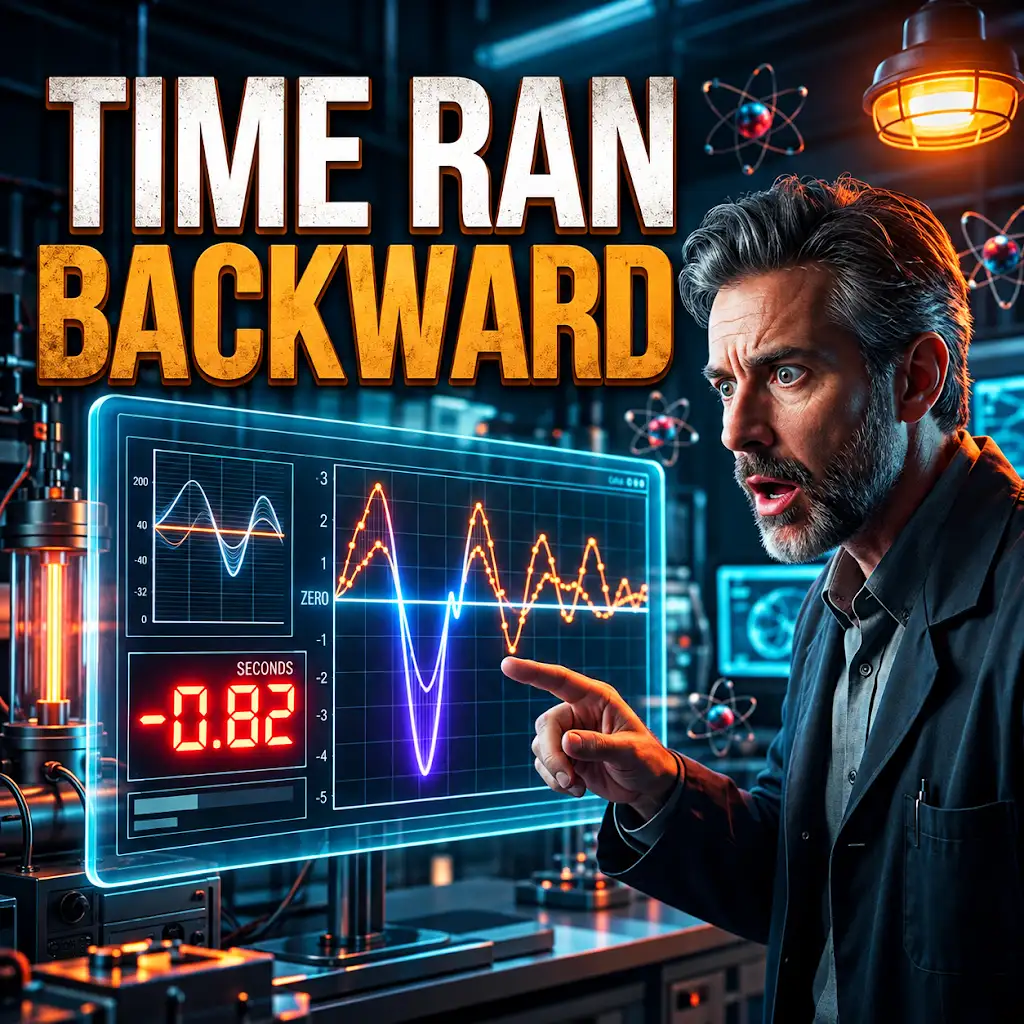
Physicists Just Measured a Negative Second.
FAQs
What is a photon timing shift experiment?
A photon timing shift experiment is a scientific study that involves measuring the time delay of photons as they travel through different mediums or under various conditions.
How is a photon timing shift experiment conducted?
In a photon timing shift experiment, researchers typically use specialized equipment such as detectors and timing devices to measure the time it takes for photons to travel from one point to another.
What are the potential applications of photon timing shift experiments?
Photon timing shift experiments have various applications in fields such as telecommunications, quantum physics, and astronomy, where precise timing measurements are crucial.
What are some challenges faced in conducting photon timing shift experiments?
Challenges in photon timing shift experiments include minimizing sources of error, calibrating equipment accurately, and accounting for factors that may affect the speed of photons.
What are the implications of the results obtained from photon timing shift experiments?
The results of photon timing shift experiments can provide valuable insights into the behavior of light, the properties of different materials, and the fundamental principles of physics.