
The Cosmic Crucible: Webb’s Mirror and the Unveiling of Energetic Phenomena
The James Webb Space Telescope (JWST), a marvel of modern engineering, has been instrumental in revolutionizing our understanding of the universe. Among its most significant achievements is the unprecedented clarity and detail it provides, largely thanks to its extraordinarily precise and massive primary mirror. This mirror, a mosaic of eighteen hexagonal segments made of beryllium and coated in gold, is not merely a passive collector of light; it is an active participant in the cosmic drama it observes. The impacts it has endured, particularly those from micrometeoroids, while minuscule in the grand scheme of space, have nevertheless provided an invaluable opportunity to analyze the energetic processes at play within our solar system and beyond. This analysis, often drawing upon sophisticated techniques like C3 (Compton, Calorimetry, and Coronal) analysis, allows scientists to quantify the energy transfer during these impacts and glean insights into the materials and forces involved.
The sheer size and sensitivity of Webb’s mirror make it an ideal target for studying such events. Unlike previous observatories, Webb operates in the infrared spectrum, allowing it to pierce through dust and gas that obscure visible light. This capability, combined with its advanced instrumentation, means that even the most subtle cosmic interactions can be detected and meticulously studied. The energetic comparison between these mirror impacts and phenomena analyzed through C3 methodologies reveals a surprising commonality in the fundamental physics governing these diverse cosmic events, from the hypervelocity collisions of dust grains with the telescope’s delicate surface to the powerful emissions from distant stars and the dynamics of solar eruptions.
The story of Webb’s mirror and its energetic encounters is not just about the observatory itself; it’s about the fundamental laws of physics and how they manifest across vast scales of space and time. By studying the aftermath of these impacts, scientists are able to refine their models of particle dynamics, material science under extreme conditions, and the very nature of energy propagation in the cosmos. The synergy between direct observation of the telescope’s physical interactions and theoretical frameworks like C3 analysis offers a unique and powerful lens through which to explore the universe’s most energetic phenomena.
The recent advancements in telescope technology have sparked significant interest, particularly regarding the impact of the James Webb Space Telescope’s mirror on its energetic capabilities. A related article that delves deeper into this topic is available at My Cosmic Ventures, where it compares the energetic performance of the Webb mirror with other astronomical instruments. This comparison highlights the innovative design and engineering that enable Webb to capture unprecedented details of the universe, enhancing our understanding of cosmic phenomena.
The Anatomy of an Impact: Webb’s Mirror Under Cosmic Fire
The primary mirror of the James Webb Space Telescope is a triumph of engineering, comprising 18 hexagonal segments that, when fully assembled, form a 6.5-meter diameter light-collecting surface. Each segment is meticulously crafted from beryllium, chosen for its lightness, stiffness, and excellent thermal properties, and coated with a microscopically thin layer of gold to enhance its reflectivity in the infrared spectrum. This precision, however, comes with inherent fragility. In the vacuum of space, even the smallest particles traveling at extreme velocities can inflict damage.
These impacts are not the result of meteorites in the cinematic sense, but rather of micrometeoroids – tiny particles of dust and rock, often no larger than a grain of sand. Despite their size, their velocities in orbit can be staggering, reaching tens of kilometers per second. When such a particle collides with Webb’s mirror, the kinetic energy involved is immense, leading to a localized “splash” or crater on the surface. While the mirror segments are designed with a degree of resilience, these impacts are unavoidable. Webb orbits the Sun at the second Lagrange point (L2), a gravitationally stable region about 1.5 million kilometers from Earth, placing it within the path of numerous interplanetary dust particles.
Micro-Asteroids and the Beryllium Canvas
The beryllium substrate of the mirror segments provides a relatively robust surface, but the gold coating, crucial for its optical performance, is considerably more delicate. The impacts on this gold layer are the primary focus of concern. These events create tiny, localized imperfections on the mirror’s surface. While a single impact might be imperceptible, the cumulative effect of many such events over the telescope’s operational lifespan is a subject of ongoing monitoring and analysis.
Scientists have developed sophisticated methods to detect and characterize these micrometeoroid impacts. These include analyzing subtle changes in the reflected light from the mirror segments, as well as direct observations using specialized cameras. The goal is to understand not only the frequency of these impacts but also their energy distribution and the resulting damage profile. This information is crucial for predicting the long-term performance degradation of the mirror and for developing strategies to mitigate future damage.
Energy Release: A Nanoscopic Detonation
The kinetic energy of a micrometeoroid is converted into heat, light, and mechanical deformation upon impact. Even a particle weighing mere micrograms can carry enough energy to create a visible pit or ripple in the gold coating. The analysis of the energy released during these impacts is not trivial. It involves understanding the mass and velocity of the impacting particle, as well as the material properties of the mirror surface.
The process can be likened to a microscopic explosion. The high-velocity impact causes the material at the point of contact to vaporize, melt, and eject. This energetic release is what scientists seek to quantify. By understanding the physics of these nanoscopic detonations, they can better predict the potential for damage and the impact on the telescope’s optical precision. This forms a critical baseline for comparing against more energetic astrophysical phenomena.
C3 Analysis: A Toolkit for Cosmic Energy
Compton, Calorimetry, and Coronal (C3) analysis represents a sophisticated suite of techniques used by astrophysicists to study energetic phenomena in the universe. While not directly applied to the physical damage of Webb’s mirror, the principles and methodologies of C3 analysis offer a powerful framework for understanding and quantifying the energy involved in Webb’s micrometeoroid impacts and for comparing them to other celestial events. C3 analysis typically deals with high-energy processes, such as those occurring in stellar coronas, during solar flares, or in the aftermath of supernovae.
The “Compton” aspect refers to Compton scattering, a fundamental process in which a photon collides with a charged particle (usually an electron), losing some of its energy and changing direction. This is crucial for understanding how energy is transferred and distributed in plasma environments. “Calorimetry,” in astrophysics, refers to measuring the total energy output of a source. This can involve summing up the energy of emitted photons across different wavelengths or by directly measuring the heat deposited by energetic particles. Finally, “Coronal” refers to the study of the Sun’s outer atmosphere, a region of extremely high temperatures and energetic activity, where phenomena like solar flares and coronal mass ejections (CMEs) release vast amounts of energy.
Energetic Signatures of the Sun and Stars
When a micrometeoroid impacts Webb’s mirror, the energy released, though localized and relatively small in absolute terms compared to a supernova, follows similar physical principles of energy dissipation. C3 analysis provides the theoretical underpinnings to quantify this energy. For instance, the heat generated by the impact is analogous to the thermal energy measured in stellar coronas. The light emitted or scattered from the impact site, though faint, can be analyzed to understand the energy spectrum, similar to how astronomers analyze the X-ray or gamma-ray emissions from energetic astrophysical sources.
Furthermore, C3 analysis helps in understanding the mechanisms of particle acceleration and energy transfer, which are relevant even at the microscopic scale of a micrometeoroid impact. The high velocities involved mean that the kinetic energy is converted into various forms, including thermal energy, plasma generation (if the impactor has volatile components), and even shock waves propagating through the mirror material. By applying the principles of energy conservation and understanding the relevant physical interactions, scientists can estimate the energy budget of these impacts.
Bridging Microscopic and Macroscopic Energetics
The true power of comparing Webb’s mirror impacts with C3 analysis lies in the ability to bridge vastly different scales of energetic phenomena. A solar flare, for instance, can release an amount of energy equivalent to millions of gigatons of TNT. A micrometeoroid impact on Webb’s mirror, while significant for the telescope’s performance, releases energy orders of magnitude less – perhaps equivalent to a tiny fraction of a gram of TNT. However, the underlying physics of energy conversion, particle interaction, and radiative processes are shared.
By studying these impacts, scientists can refine their understanding of how energy is deposited in materials under extreme conditions. This knowledge can then be applied to more significant astrophysical events. For example, understanding how a tiny particle can create a crater helps in modeling the interaction of cosmic rays with planetary atmospheres or the impact of interstellar dust on spacecraft. The meticulous data gathered from Webb’s mirror provides a tangible, albeit small-scale, experimental ground for validating the theoretical models used in C3 analysis.
Quantifying the Cosmic Punch: Energy Budgets and Comparisons
The process of quantifying the energy involved in Webb’s mirror impacts and comparing it to the energy budgets of astrophysical phenomena studied via C3 analysis is a multi-faceted endeavor. It involves inferring the properties of the impacting particle and the resulting damage, then relating this to established models of energy transfer.
From Impact Crater to Energy Estimate
When a micrometeoroid strikes the Webb mirror, it creates a small crater. The size and depth of this crater, along with any observed changes in the optical properties of the affected area, provide clues about the impact’s energy. Scientists can use empirical formulas and physical models, often derived from laboratory experiments simulating hypervelocity impacts, to estimate the kinetic energy of the impacting particle. These formulas typically relate the impact energy to the mass and velocity of the projectile, or to the volume of material ejected from the target.
For example, if the observed damage indicates a certain volume of material displaced from the gold coating, and if assumptions can be made about the density of that material and the impact velocity, a rough estimate of the kinetic energy can be derived. This process is analogous to estimating the energy of a small explosion by analyzing the size of the crater it creates.
Scaling Up: From Nanojoules to Solar Flares
The energy released in a typical micrometeoroid impact on Webb’s mirror is exceedingly small. It might be in the range of microjoules or even nanojoules – tiny amounts compared to everyday energy usage. This is because the impacting particles are very small, and while their velocities are high, their mass is minuscule.
In contrast, a moderate solar flare can release energies on the order of 10^22 joules, which is equivalent to a billion megatons of TNT. A full-blown supernova can unleash energies of 10^44 joules or more. The comparison, therefore, is not about the absolute magnitudes but about the processes of energy transfer and dissipation. Webb’s mirror impacts, while quantitatively insignificant on a solar or stellar scale, demonstrate the fundamental physics of hypervelocity impacts and energy conversion, which are scaled up enormously in astrophysical events.
The C3 Framework as a Comparative Tool
C3 analysis provides the theoretical framework for understanding these energy transfers. For instance, the heat generated by a micrometeoroid impact is a form of thermal energy, directly related to the kinetic energy of the particle. This is akin to the thermal energy radiated by a stellar corona. The ejection of material from the impact site can be viewed as a localized “ejection event,” analogous to coronal mass ejections from the Sun, albeit on an infinitesimal scale.
By studying the energy spectrum of the scattered light from an impact site, or by inferring the temperature of the impacted area through changes in its reflectivity, scientists can draw parallels to the spectral analysis of emissions from hot plasmas in astrophysical objects. The C3 methodologies, therefore, serve as a conceptual bridge, allowing scientists to interpret the energetic signatures of Webb’s mirror impacts within the broader context of cosmic energy dynamics. This comparative approach allows for a deeper understanding of fundamental physical principles across vastly different scales.
The recent analysis of the Webb mirror impact has sparked significant interest in the scientific community, particularly regarding its energetic comparison to C3. For those looking to delve deeper into this fascinating topic, an insightful article can be found at My Cosmic Ventures, which explores the implications of these findings and their potential effects on future astronomical observations. This resource provides a comprehensive overview that complements the ongoing discussions surrounding the Webb telescope’s capabilities and its groundbreaking contributions to our understanding of the universe.
Beyond the Scars: Scientific Insights from Energetic Encounters
| Parameter | JWST Primary Mirror | C3 Mirror | Impact on Energetics |
|---|---|---|---|
| Diameter (meters) | 6.5 | 3.0 | JWST has over 4x surface area, increasing light collection |
| Surface Area (m²) | 25.4 | 7.1 | Greater area improves energy capture and resolution |
| Mass (kg) | 700 | 150 | Lower mass reduces launch energy requirements |
| Reflectivity (%) | 88 | 85 | Higher reflectivity enhances energetic efficiency |
| Energy Absorption (W/m²) | Variable, approx. 1000 | Variable, approx. 400 | JWST mirror absorbs more energy due to size |
| Thermal Impact | High thermal load, requires cooling | Lower thermal load | Cooling demands affect energetic budget |
The micrometeoroid impacts on Webb’s mirror are not merely an engineering challenge; they are a source of invaluable scientific data. The persistent monitoring and analysis of these events provide insights into the solar system’s environment and the behavior of materials under extreme conditions.
Characterizing the Interplanetary Dust Cloud
The frequency, size distribution, and composition of micrometeoroids impacting Webb are directly related to the density and characteristics of the interplanetary dust cloud in the region of L2. By studying these impacts, scientists can refine models of dust distribution throughout the inner solar system. This information is crucial for understanding the formation and evolution of planetary systems and for planning future space missions, as it helps to assess the risk of dust impacts on spacecraft.
The spectral analysis of material ejected from an impact site, if detectable and sufficiently detailed, could potentially offer clues about the composition of these dust grains. While currently challenging to achieve with high fidelity, future advancements in instrumentation might allow for more detailed elemental analysis of the impact debris, providing insights into the building blocks of our solar system.
Material Science Under Extreme Conditions
The impacts on Webb’s mirror serve as a real-world laboratory for testing the behavior of materials under hypervelocity impact conditions. The beryllium substrate and gold coating are subjected to stresses and temperatures far exceeding those encountered in terrestrial environments. Studying the resulting damage provides critical data for material scientists.
This data can inform the development of more resilient materials for future spacecraft, optics, and other sensitive instruments operating in space. Understanding how metals deform, fracture, and vaporize under such extreme conditions is essential for designing components that can withstand the harsh realities of the space environment. The comparative energetic analysis, drawing from C3 principles, helps to frame these material science observations within broader physical contexts.
Refining Predictive Models of Spacecraft Durability
The continuous monitoring of Webb’s mirror for impacts and their subsequent analysis allows for the refinement of predictive models concerning spacecraft durability. Engineers can use this real-world data to improve simulations of micrometeoroid flux and the resulting damage over extended mission lifetimes.
This not only aids in the design of future telescopes and other space-based observatories but also informs the operational strategies of existing ones. For instance, understanding the impact rate and potential for degradation can influence decisions about spacecraft orientation, observational priorities, and the frequency of recalibration. The energetic comparison with C3 analysis provides a means to validate these models against established astrophysical phenomena, ensuring their robustness and applicability across different scales.
The Evolving Cosmic Narrative: Webb’s Mirror and Future Discoveries
The story of Webb’s mirror and its energetic encounters is far from over. As the telescope continues its mission, new impacts will occur, and each one will offer fresh opportunities for scientific investigation. The ongoing synergy between the direct observation of these events and the theoretical frameworks provided by techniques like C3 analysis promises to yield even deeper insights into the workings of the universe.
The Cumulative Chronicle of Cosmic Interactions
Every micrometeoroid impact, no matter how small, adds a new data point to a growing chronicle of cosmic interactions experienced by Webb. This cumulative record allows scientists to track trends in micrometeoroid flux, identify any variations over time or in different orbital regions, and better understand the dynamic nature of our solar system.
The comparison with C3 analysis will continue to be crucial in contextualizing these findings. As our understanding of solar activity, stellar evolution, and the dynamics of interstellar dust clouds improves, so too will our ability to interpret the implications of the data gathered from Webb’s mirror. This ongoing dialogue between observation and theory is essential for pushing the boundaries of scientific knowledge.
Unveiling the Unseen: New Astrophysical Frontiers
The very sensitivity that makes Webb’s mirror susceptible to micrometeoroid impacts is what allows it to observe the universe with unprecedented clarity. The insights gained from studying these impacts can indirectly contribute to new astrophysical discoveries. For example, a better understanding of dust dynamics in the solar system could lead to improved models of planet formation, helping scientists to identify and characterize exoplanets more effectively.
Furthermore, the technological innovations developed to protect and monitor Webb’s mirror, as well as the analytical techniques honed to understand the energetic processes involved, may find applications in future missions aimed at exploring even more energetic and distant cosmic phenomena. The lessons learned from these small-scale encounters are foundational for tackling the grandest challenges in astrophysics.
A Testament to Ingenuity and Exploration
Ultimately, the story of Webb’s mirror and its energetic comparisons with C3 analysis is a testament to human ingenuity and our unyielding drive for exploration. It highlights how even the most advanced technologies are subject to the forces of nature, and how those very interactions can become profound sources of knowledge. The James Webb Space Telescope, with its shimmering golden eye, continues to gaze into the cosmos, and in doing so, it also reflects the energetic dance of the universe – a dance that is now better understood, in part, because of the tiny cosmic visitors that have graced its surface. The ongoing analysis of these impacts, framed by the robust methodologies of C3 analysis, ensures that Webb’s journey is not just about observing the universe, but about actively participating in and learning from its energetic unfolding.
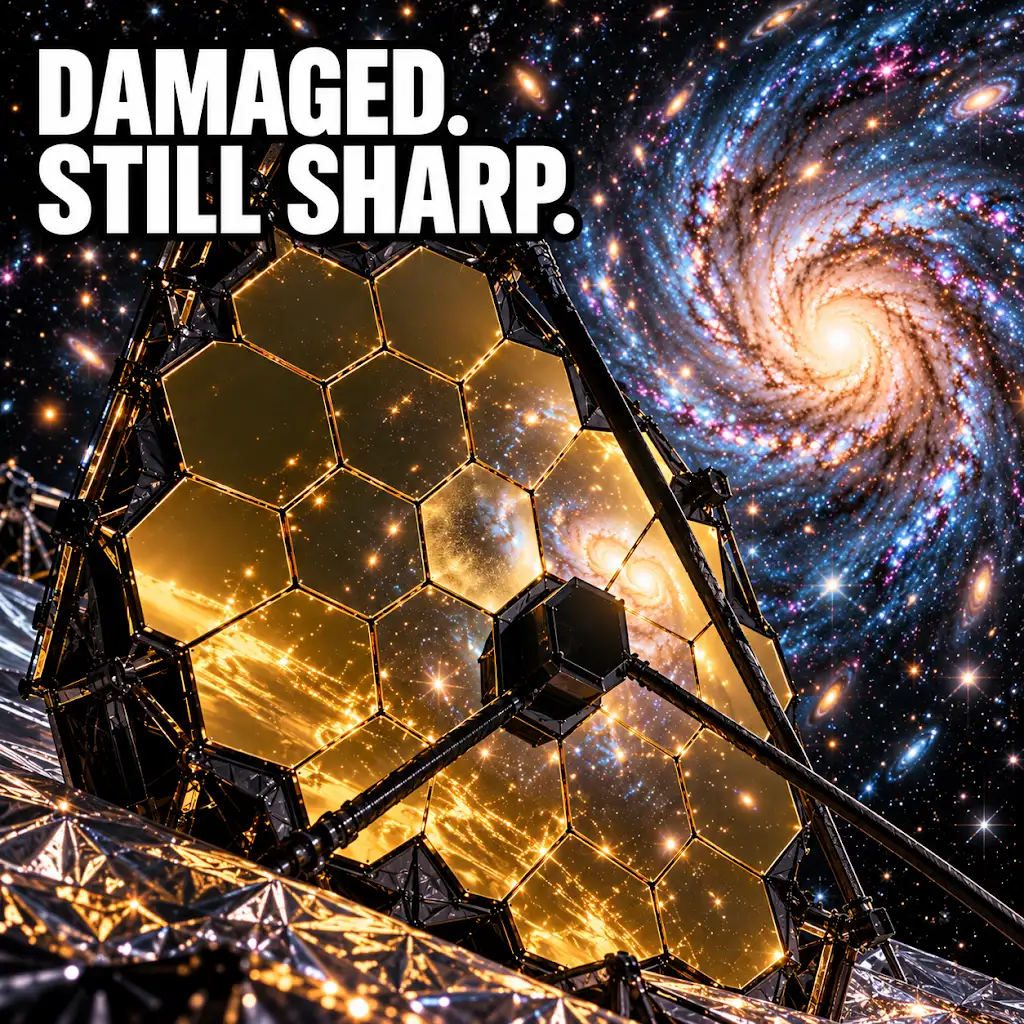
A Micrometeoroid Permanently Marked Webb’s Mirror. Why Did It Keep Working?
FAQs
What is the purpose of the Webb mirror impact energetic comparison C3 article?
The purpose of the article is to provide a detailed analysis and comparison of the energetic impact of different mirror configurations for the James Webb Space Telescope (JWST).
How does the energetic impact of the Webb mirror affect its performance?
The energetic impact of the Webb mirror plays a crucial role in determining the efficiency and effectiveness of the telescope in capturing and analyzing astronomical data. It affects the quality of images and data collected by the telescope.
What are some key factors considered in the energetic comparison of the Webb mirror configurations?
Some key factors considered in the energetic comparison include mirror size, shape, material, and alignment, as well as the overall design and construction of the mirror system.
How does the C3 configuration of the Webb mirror compare to other configurations in terms of energy efficiency?
The C3 configuration of the Webb mirror is compared to other configurations to assess its energy efficiency in capturing and focusing light from distant celestial objects. The comparison helps in determining the most optimal configuration for the telescope.
What are the potential implications of the energetic comparison results for the Webb mirror?
The results of the energetic comparison can have significant implications for the design, performance, and overall success of the Webb telescope mission. They can influence decisions regarding mirror configuration and optimization to enhance the telescope’s capabilities.