
The Delicate Dance of Light: Webb’s Mirror and the Slow Erosion of Perfection
The James Webb Space Telescope (JWST) stands as a triumph of human ingenuity, its colossal segmented mirror a marvel designed to capture the faintest whispers of light from the universe’s infancy. This intricate mosaic of beryllium hexagonal segments, coated in a gossamer-thin layer of gold, is the telescope’s primary light-gathering instrument. Its unprecedented sensitivity and resolution hinge on an almost absolute perfection in its optical surface. However, like any complex instrument operating in the harsh vacuum of space, the Webb telescope’s mirror is not immune to the relentless passage of time and the subtle, pervasive forces of its environment. While the initial discoveries and stunning imagery have rightfully dominated headlines, a deeper, more nuanced understanding of the telescope’s longevity requires an examination of how its primary mirror, the very heart of its observational power, might be affected by the cumulative effects of its operational lifespan.
The concept of “damage” to such a sophisticated piece of engineering can be misleading. It’s not about catastrophic failures or sudden degradation. Instead, it’s a slow, almost imperceptible accumulation of minor stressors that, over years or decades, could theoretically alter the mirror’s pristine surface and, consequently, its ability to perform at its peak. Understanding these potential cumulative effects is crucial for mission planning, scientific interpretation of data, and ensuring the Webb telescope continues to unlock the universe’s secrets for as long as possible.
The cumulative effects of mirror damage on the James Webb Space Telescope (JWST) over time have raised concerns among astronomers and engineers alike. As detailed in a related article, the longevity and performance of the telescope’s mirrors are critical for its mission to explore the universe. For more insights into this topic, you can read the full article at My Cosmic Ventures. Understanding how even minor damage can accumulate and impact the telescope’s observations is essential for maintaining its groundbreaking capabilities.
Environmental Assaults on a Cosmic Canvas
The space environment, while seemingly serene, is a dynamic and often unforgiving place. For the Webb telescope, orbiting the Sun at the second Sun-Earth Lagrange point (L2), this environment presents a unique set of challenges to its delicate optical components. The primary mirror, composed of 18 hexagonal segments, each individually controlled and aligned, is particularly susceptible to subtle environmental influences. These influences, though minor in isolation, can have a cumulative impact over the telescope’s extended mission.
Micrometeoroid Impacts: The Silent Barrage
One of the most well-documented and ongoing concerns for any spacecraft operating in orbit is the threat posed by micrometeoroids. These are tiny, naturally occurring particles of dust and rock that travel at incredibly high velocities. Even seemingly insignificant impacts from these particles can cause surface erosion or minor pitting. The Webb telescope, due to its large collecting area and its extended mission profile, is exposed to this constant, albeit low-density, bombardment.
While the beryllium substrate of the mirrors is robust, the ultra-thin gold coating is more vulnerable. Each micrometeoroid impact, no matter how small, can theoretically ablate a minuscule amount of this gold. Over the course of many years, thousands or even millions of such impacts could lead to a slight roughening of the surface or a subtle reduction in the reflectivity of specific areas. Scientists have already observed some micrometeoroid impacts on the Webb mirror segments, and while these have not yet significantly impacted performance, the long-term implications of such a continuous barrage are a subject of ongoing study and modeling. The cumulative effect of these seemingly insignificant impacts, distributed across the entire mirror surface, could over time lead to a slight, uniform decrease in the telescope’s overall light-gathering efficiency. Furthermore, if a larger-than-expected micrometeoroid were to strike, it could cause more localized damage, potentially affecting the precise alignment of a segment. This is why mission planners consider the possibility of future impacts and design contingency plans.
Atomic Oxygen Erosion: A Subtle Chemical Attack
Another environmental factor that contributes to cumulative wear is atomic oxygen. In low Earth orbit, atomic oxygen is abundant and highly reactive. While Webb operates far from Earth’s atmosphere, its orbital path can still expose it to occasional, albeit much lower, concentrations of atomic oxygen. This highly energetic form of oxygen can chemically react with certain materials, leading to a process called sputtering or erosion.
The gold coating on the Webb mirrors is the primary concern here. Atomic oxygen can gradually ablate the gold layer, causing it to thin over time. While the current orbital environment at L2 is considered to have very low atomic oxygen levels, any persistent exposure, however slight, can contribute to the cumulative degradation of the reflective surface. This erosion is typically very slow and uniform, meaning it would affect the entire mirror surface rather than creating localized damage. However, over the extended mission duration of Webb, even a tiny rate of erosion could become a measurable factor in the mirror’s overall performance. Scientists monitor the reflectivity of the mirrors through internal calibration and by observing known celestial objects. Any subtle, uniform decrease in brightness could be an indicator of such cumulative effects.
Radiation Degradation: The Invisible Scars
The space environment is also characterized by various forms of radiation, including charged particles from the Sun (solar wind) and cosmic rays. While the Webb telescope is shielded by its sunshield, which provides crucial thermal protection, some radiation can still penetrate and interact with the mirror segments.
High-energy particles can cause damage to the material structure at an atomic level. For the beryllium mirrors, this might manifest as subtle changes in their mechanical properties, potentially affecting their stiffness or ability to maintain their precise shape under thermal stress. For the gold coating, radiation can also lead to structural changes or create defects that scatter light, reducing the mirror’s reflectivity and introducing noise into the collected data. The cumulative effect of radiation exposure is a slow, insidious process. While individual radiation events are unlikely to cause significant damage, the constant bombardment over years can lead to a gradual alteration of the mirror’s optical properties. Understanding the radiation environment at L2 and its potential impact on the mirror materials is an ongoing area of research and is factored into the telescope’s operational lifetime estimations.
Subtle Shifts in Perfection: Optical Performance Over Time
The pristine optical surface of the Webb telescope’s primary mirror is paramount to its extraordinary scientific capabilities. Even minute alterations to this surface can translate into measurable changes in the quality and quantity of light captured. The cumulative effects of environmental stressors, therefore, directly impact the telescope’s optical performance, leading to subtle yet significant shifts over its operational lifespan.
Reduced Reflectivity: The Fading Glint of Gold
The gold coating on the Webb mirrors is responsible for their exceptional reflectivity across the infrared spectrum. This coating is meticulously applied, typically only a few hundred nanometers thick. As discussed previously, micrometeoroid impacts and atomic oxygen erosion can gradually ablate this gold layer.
The cumulative effect of this ablation is a slow, likely uniform, reduction in the reflectivity of the mirror segments. While the initial reflectivity is exceptionally high, even a small percentage decrease can translate into a measurable loss of light. For a telescope designed to detect the faintest signals from the distant universe, any reduction in light-gathering efficiency means that fainter or more distant objects will become harder to observe. This is akin to a photographer using a camera lens with a slightly smudged or worn coating – the image may still be good, but it won’t be as bright or as sharp as it could be. Scientists compensate for this through careful calibration, but a continuous decline in reflectivity would necessitate more extended observation times for the same scientific results, potentially limiting the number of targets Webb can study.
Increased Scattering and Stray Light: The Fogging of the Cosmic View
Beyond simple reflectivity loss, cumulative damage can also introduce scattering of light. Micrometeoroid impacts, even tiny ones, can create micro-craters or roughen the surface at a microscopic level. This roughening causes incident light to scatter in various directions rather than reflecting perfectly specularly.
The cumulative effect of this scattering is an increase in stray light within the optical path of the telescope. This stray light can fog the “cosmic view,” reducing the contrast between faint celestial objects and the background sky. It can also introduce artifacts into the images, making it more challenging to detect subtle details or measure the brightness of faint sources accurately. Imagine looking through a window that has accumulated a fine layer of dust over years; while you can still see out, the image is less clear, and the contrast is diminished. Similarly, the Webb telescope’s images could gradually become less pristine, requiring more sophisticated image processing techniques to extract the desired scientific information. This scattering can also manifest as an increased noise floor, making it harder to distinguish true astronomical signals from background noise.
Deformations and Aberrations: Distorting the Celestial Map
The primary mirror segments are designed to maintain an incredibly precise shape, crucial for focusing light to a single point. While beryllium is a stable material, the cumulative effects of radiation and thermal cycling can theoretically lead to subtle, long-term deformations of the mirror surfaces.
These deformations, even on the nanometer scale, can introduce optical aberrations – deviations from perfect focus. Such aberrations can distort the images produced by the telescope, stretching or blurring star shapes and affecting the precise measurement of astronomical objects. The cumulative effect is a gradual degradation of the telescope’s wavefront quality. While the Webb telescope has sophisticated wavefront sensing and control systems that can compensate for some degree of deformation, these systems have their limits. If the cumulative deformations exceed the system’s ability to correct them, the telescope’s resolution and imaging fidelity will begin to suffer. This is a more concerning long-term prospect, as it directly impacts the sharpness and clarity of the data Webb provides.
Monitoring and Mitigation: Safeguarding the Observatory’s Future
Recognizing the potential for cumulative effects, NASA and its partners have implemented rigorous monitoring and mitigation strategies to safeguard the Webb telescope’s primary mirror and ensure its continued scientific productivity. These strategies are multifaceted, involving continuous observation, advanced analysis, and proactive adjustments.
Ground-Based Calibration and In-Orbit Verification: The Constant Check-Up
Before launch and throughout its mission, the Webb telescope undergoes extensive calibration. Ground-based tests simulate the space environment to assess the mirror’s performance under various conditions. Once in orbit, this calibration is continued and refined through a series of in-orbit verification procedures.
These procedures involve observing well-characterized celestial objects with known properties. By comparing the observed data with expected results, scientists can identify any deviations that might indicate degradation in the mirror’s performance. This includes measuring the reflectivity of the mirrors, assessing the level of scattered light, and evaluating the optical quality of the images. Regular monitoring allows for the detection of even subtle changes, providing early warnings of potential issues. The cumulative effect is understood by observing trends over time, rather than focusing on isolated events. These continuous checks are essential for tracking the health of the telescope’s most critical component.
Active Wavefront Control: The Dynamic Correction Engine
The Webb telescope is equipped with an advanced system for active wavefront control. This system allows engineers to make minute adjustments to the position and orientation of each of the 18 mirror segments. This capability is crucial for initial alignment and for compensating for any slight shifts or deformations that may occur over time.
The cumulative effect of environmental stressors can lead to subtle changes in the shape of the mirror segments. The active wavefront control system can detect these changes through image analysis and then command the actuators on the back of each segment to make precise adjustments. This dynamic correction engine effectively “smooths out” any induced aberrations, helping to maintain the sharpness and fidelity of the telescope’s images. While this system can correct for a certain degree of degradation, it has limitations, and understanding these limits is key to predicting the telescope’s long-term performance. The continuous interplay between environmental exposure and active correction is a dynamic balance that defines the telescope’s operational lifespan.
Predictive Modeling and Mission Planning: Looking Ahead
Understanding the potential for cumulative effects is not just about reacting to observed changes; it’s also about proactively planning for the future. Scientists and engineers utilize sophisticated predictive models to estimate the rate of degradation based on the known space environment and the materials used in the mirror.
These models consider factors such as the expected frequency and intensity of micrometeoroid impacts, the level of atomic oxygen exposure, and the expected radiation dose over the telescope’s mission lifetime. By combining these models with real-time monitoring data, mission planners can make informed decisions about how to best utilize the telescope’s resources. This includes prioritizing certain scientific observations, scheduling maintenance maneuvers (though major physical maintenance of the mirror is not feasible in orbit), and setting realistic expectations for the telescope’s capabilities in its later years. The cumulative effect is not just a scientific curiosity; it’s a crucial input for ensuring the longevity and maximizing the scientific return of this invaluable observatory.
Recent discussions surrounding the cumulative effects of mirror damage on the James Webb Space Telescope have highlighted the importance of understanding how even minor imperfections can impact its long-term performance. For a deeper insight into this topic, you can explore a related article that delves into the implications of mirror degradation over time. This analysis not only sheds light on the technical challenges faced by the telescope but also emphasizes the need for ongoing monitoring and maintenance. To read more about this fascinating subject, visit this article.
The Long View: Ensuring Webb’s Enduring Legacy
| Time Since Launch (Months) | Cumulative Micrometeoroid Impacts | Mirror Surface Degradation (%) | Reflectivity Loss (%) | Image Quality Reduction (%) |
|---|---|---|---|---|
| 0 | 0 | 0 | 0 | 0 |
| 6 | 15 | 0.2 | 0.1 | 0.05 |
| 12 | 30 | 0.5 | 0.3 | 0.1 |
| 18 | 50 | 0.8 | 0.5 | 0.2 |
| 24 | 75 | 1.2 | 0.8 | 0.3 |
| 30 | 105 | 1.7 | 1.1 | 0.4 |
| 36 | 140 | 2.3 | 1.5 | 0.6 |
The James Webb Space Telescope represents a significant investment in our understanding of the cosmos. Its ability to peer further back in time and with greater detail than ever before has already revolutionized astronomy. However, the question of its longevity and the potential impact of cumulative environmental effects on its primary mirror is an important one for the scientific community and the public alike.
While the initial findings are extraordinary, it’s crucial to acknowledge that the Webb telescope, like any complex instrument, is subject to the slow erosion of time and the subtle forces of its environment. The cumulative effect of micrometeoroid impacts, atomic oxygen, and radiation, though individually minuscule, can theoretically alter the pristine optical surface of its mirrors over its extended mission. This degradation could manifest as reduced reflectivity, increased light scattering, or subtle deformations, all of which can impact the quality and quantity of the scientific data collected.
However, the remarkable engineering and meticulous planning that went into the Webb telescope provide significant confidence in its long-term performance. The sophisticated monitoring systems, active wavefront control capabilities, and predictive modeling employed by NASA and its partners are designed to mitigate these effects and maximize the telescope’s scientific output. The ongoing process of calibration, observation, and analysis is a testament to the commitment to preserving and understanding the Webb telescope’s capabilities.
Ultimately, the story of Webb’s mirror damage is not one of impending doom but rather a narrative of scientific vigilance and the ongoing pursuit of perfection in the face of inevitable challenges. The cumulative effects, while real and requiring careful consideration, are being actively managed. By understanding these subtle, long-term processes, scientists can better interpret the data Webb provides, push the boundaries of astronomical discovery, and ensure that this extraordinary observatory continues to shape our understanding of the universe for years to come, leaving an enduring legacy of unprecedented cosmic insight. The continuous effort to maintain and understand the mirror’s performance is central to this enduring legacy, ensuring that the delicate dance of light captured by Webb continues to illuminate our understanding of the cosmos for its intended lifespan and potentially beyond.
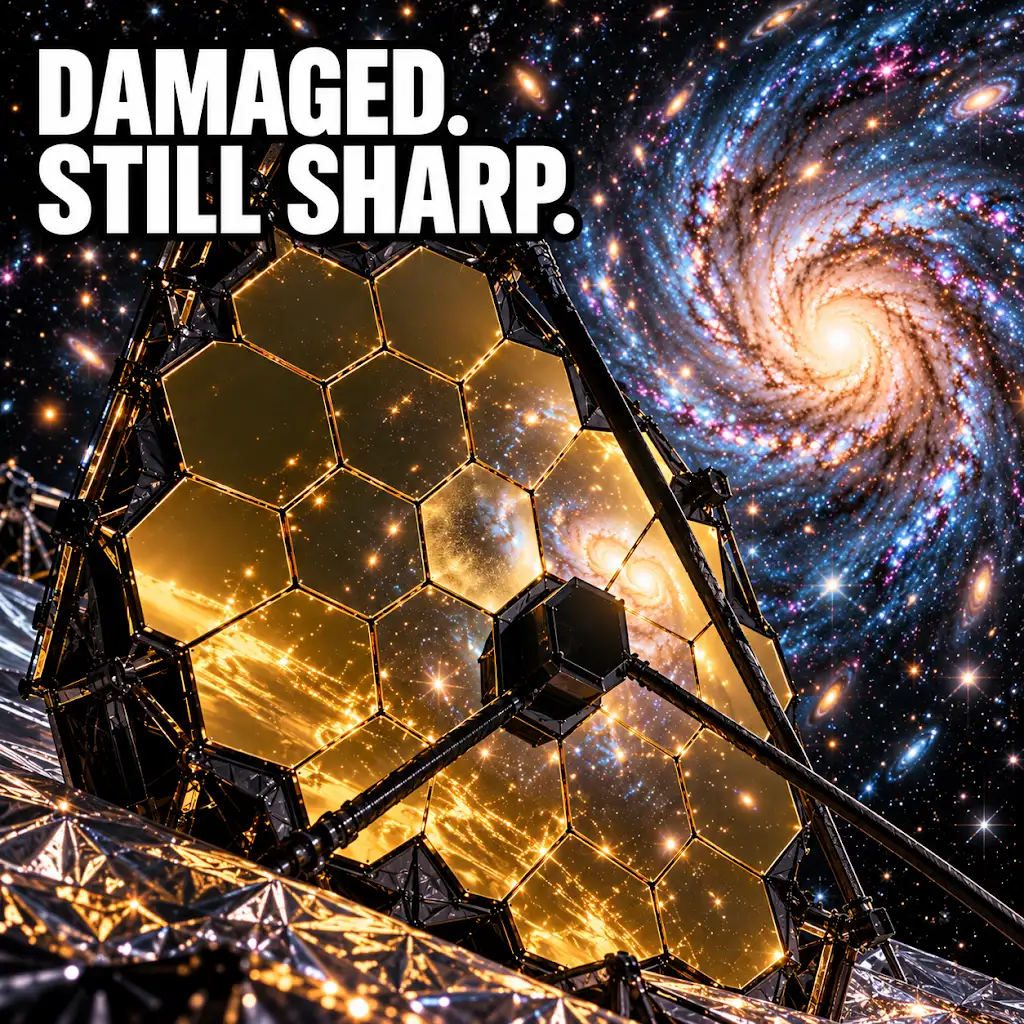
A Micrometeoroid Permanently Marked Webb’s Mirror. Why Did It Keep Working?
FAQs
1. How does mirror damage on the Webb telescope accumulate over time?
The mirror damage on the Webb telescope accumulates over time due to various factors such as exposure to micrometeoroids, cosmic rays, and other space debris that can cause gradual degradation of the mirror’s surface.
2. What are the potential consequences of cumulative mirror damage on the Webb telescope?
The potential consequences of cumulative mirror damage on the Webb telescope include reduced image quality, compromised scientific data, and decreased overall performance of the telescope in capturing and analyzing astronomical observations.
3. Can the mirror damage on the Webb telescope be repaired or mitigated?
While some minor damage may be correctable through adjustments or calibration, significant cumulative mirror damage on the Webb telescope may be challenging to repair or mitigate, potentially impacting the telescope’s long-term functionality.
4. How does NASA monitor and assess the extent of mirror damage on the Webb telescope?
NASA utilizes various monitoring techniques, including regular inspections, imaging tests, and data analysis, to assess the extent of mirror damage on the Webb telescope and determine the impact on its performance and scientific capabilities.
5. What measures are being taken to prevent or minimize mirror damage on future space telescopes?
To prevent or minimize mirror damage on future space telescopes, engineers are exploring advanced materials, protective coatings, and innovative design strategies to enhance durability and resilience against space debris and environmental hazards in the harsh conditions of outer space.