
The icy frontiers of our solar system, a realm far beyond the familiar orbits of the inner planets, beckon with an allure of profound mystery. This is the domain of the outer solar system, a vast and frigid expanse populated by colossal gas giants, their retinues of moons, and the enigmatic remnants of planetary formation. For centuries, humanity’s gaze was limited to the celestial ballet observable with the naked eye. Then came the telescope, and with it, the gradual unveiling of Jupiter’s Great Red Spot, Saturn’s majestic rings, and the whispers of Uranus and Neptune. Today, thanks to sophisticated spacecraft and an insatiable curiosity, our understanding of these distant worlds is rapidly expanding, yet the outer solar system continues to guard secrets that challenge our very definition of a planet and the processes that forge planetary systems.
The sheer scale of Jupiter and Saturn is breathtaking. These titans are not rocky planets like Earth or Mars; instead, they are behemoths composed primarily of hydrogen and helium, their atmospheres swirling with tempestuous storms and their interiors a churning abyss. Their presence profoundly influences the dynamics of the entire solar system, acting as gravitational anchors and shields, deflecting comets and asteroids that might otherwise pose a threat to inner worlds.
Jupiter: King of the Planets
Jupiter, the undisputed king, is a world of superlativistic scale and unparalleled atmospheric activity. Its most iconic feature, the Great Red Spot, is a colossal anticyclonic storm that has raged for centuries, larger than Earth itself. Missions like Voyager, Galileo, and Juno have provided unprecedented insights into the planet’s complex atmospheric layers, its powerful magnetic field – the strongest of any planet in the solar system – and the composition of its swirling cloud bands.
The Great Red Spot: A Storm of Ages
The Great Red Spot’s longevity and sheer size have long captivated scientists. While its exact origins remain a subject of ongoing research, it is believed to be a stable atmospheric phenomenon, perhaps fueled by energy from Jupiter’s interior or interactions with other atmospheric currents. Juno’s instruments have penetrated deeper into Jupiter’s atmosphere than ever before, revealing that the storm extends much further down than previously thought, suggesting a deeper, more complex root to this colossal vortex. Understanding the Red Spot’s dynamics is crucial for comprehending atmospheric physics on gas giants.
Jupiter’s Magnetosphere: A Shield and a Source of Wonder
Jupiter’s magnetic field is an astonishingly powerful entity, extending millions of kilometers into space and creating a vast magnetosphere. This magnetosphere traps charged particles, forming intense radiation belts that would be lethal to any unprotected spacecraft or human. However, it also generates spectacular auroras, far more powerful and extensive than those seen on Earth, illuminating the planet’s poles with vibrant displays of light. The interaction of Jupiter’s magnetosphere with its moons, particularly Io, creates unique electrical currents and phenomena.
The Galilean Moons: A Miniature Solar System
Jupiter’s four largest moons – Io, Europa, Ganymede, and Callisto – collectively known as the Galilean moons, form a miniature solar system in their own right. Each presents a distinct and fascinating world. Io is the most volcanically active body in the solar system, its surface constantly reshaped by molten rock spewing from hundreds of volcanoes. This intense volcanic activity is driven by tidal forces from Jupiter.
Europa, on the other hand, is a tantalizing prospect for the search for extraterrestrial life. Beneath its cracked and icy shell, scientists strongly suspect the existence of a vast, salty ocean of liquid water. The gravitational tug-of-war between Jupiter and the other Galilean moons is thought to generate enough internal heat to keep this subsurface ocean from freezing solid. Future missions are being designed to investigate this potential ocean, searching for the chemical ingredients and energy sources necessary for life.
Ganymede, the largest moon in the solar system, is even bigger than the planet Mercury. It is unique in possessing its own intrinsic magnetic field, which creates its own mini-magnetosphere within Jupiter’s. Its surface is a complex tapestry of older, heavily cratered terrain and younger, grooved regions, hinting at periods of geological activity in its past.
Callisto, the outermost of the Galilean moons, is heavily cratered and appears to be a geologically inert body. However, recent data suggests it might also harbor a subsurface ocean, albeit one likely much deeper and less accessible than Europa’s.
Saturn: The Jewel of the Solar System
Saturn, with its iconic rings, is often considered the most visually stunning planet in our solar system. But beyond its ethereal beauty lies a world of complex atmospheric dynamics and a moon system that rivals Jupiter’s in its diversity.
The Rings: An Astronomical Spectacle
Saturn’s rings, famously discovered by Galileo Galilei (though he misinterpreted them), are not solid structures but rather vast collections of countless ice particles and rocky debris, ranging in size from dust grains to boulders. They are incredibly thin relative to their width, stretching for hundreds of thousands of kilometers. The precise origin of the rings remains a subject of debate, with theories suggesting they are the remnants of a shattered moon or cometary debris that became trapped in Saturn’s gravitational pull.
The intricate patterns and gaps within the rings, such as the Cassini Division, are shaped by the gravitational influence of Saturn’s moons, particularly its shepherd moons which carve out and maintain the edges of the ringlets. Missions like Cassini-Huygens have provided incredibly detailed images and data, revealing the complex dynamics and composition of these celestial adornments.
A World of Storms and Auroras
Like Jupiter, Saturn also experiences powerful storms and auroras. The Cassini mission observed a massive, planet-encircling storm in 2010, nicknamed the “Great White Spot,” which periodically erupts on Saturn. The planet’s magnetic field, though weaker than Jupiter’s, still creates spectacular auroral displays at its poles.
Titan: A Hazy Enigma
Saturn’s largest moon, Titan, is arguably one of the most intriguing celestial bodies in the solar system. It is the only moon in our solar system with a dense atmosphere, composed primarily of nitrogen with a significant amount of methane. This thick, hazy atmosphere obscures its surface, making direct observation challenging.
The Huygens probe, which landed on Titan in 2005, revealed a landscape sculpted by liquid methane. Titan has a hydrological cycle analogous to Earth’s, with methane acting as its “water.” Lakes and rivers of liquid methane and ethane dot its surface, and methane rain falls from its clouds. The presence of organic molecules in its atmosphere and on its surface makes Titan a prime candidate for studying prebiotic chemistry, the conditions that may have led to the origin of life on Earth. Scientists are eager to explore Titan’s subsurface ocean, which is also believed to exist, potentially containing liquid water and dissolved chemicals.
Other Notable Moons: Enceladus and Mimas
Beyond Titan, Saturn boasts a collection of other fascinating moons. Enceladus, a small, icy moon, has become a focal point of astrobiological interest due to its geysers. Plumes of water ice and vapor erupt from its south polar region, indicating the presence of a subsurface ocean of liquid water. These geysers are thought to be a window into this hidden ocean, offering tantalizing clues about its composition and potential habitability.
Mimas, another of Saturn’s moons, is famous for its striking resemblance to the Death Star from Star Wars, due to its massive Herschel Crater. This impact event likely occurred relatively early in its history and has profoundly shaped its appearance.
The outer solar system has long been a source of intrigue for astronomers and scientists alike, with many mysteries waiting to be unraveled. For those interested in exploring these enigmatic regions further, a related article can be found at this link, which delves into the latest discoveries and theories surrounding the icy bodies and distant planets that inhabit this fascinating part of our solar system.
The Ice Giants: Exploring Uranus and Neptune
Further out, where sunlight is a dim, distant glow, lie the ice giants, Uranus and Neptune. These planets, unlike their gas giant cousins, possess a higher proportion of “ices” – volatile compounds like water, ammonia, and methane – in their interiors, giving them their distinctive blue-green hues. Their atmospheres are frigid, and their magnetospheres are unusually tilted, adding to their enigmatic nature.
Uranus: The Tilted World
Uranus is perhaps the most peculiar planet in the solar system, notable for its extreme axial tilt. It rotates on its side, with its axis of rotation pointing almost directly towards the Sun for prolonged periods. This bizarre orientation is thought to be the result of a cataclysmic collision with a Mars-sized protoplanet early in the solar system’s history.
A Realm of Icy Mysteries
Uranus’s atmosphere is dominated by methane, which absorbs red light and reflects blue and green light, giving the planet its characteristic color. The planet exhibits faint cloud bands and occasional storms, but its atmospheric activity is far less dynamic than that of Jupiter or Saturn. Its magnetic field is also highly unusual, being significantly offset from the planet’s center and tilted at a large angle relative to its rotation axis.
The Ring System and Moons of Uranus
Uranus possesses a system of narrow, dark rings, discovered long after the planet itself. It also has a diverse collection of moons, named after characters from Shakespeare and Alexander Pope. Miranda, one of its inner moons, displays a strikingly chaotic and fractured surface, suggesting a violent geological past, possibly involving a partial breakup and reassembly.
Neptune: The Deep Blue Wanderer
Neptune, the outermost planet, is a world of intense winds and a deep, vibrant blue. Its atmosphere is the coldest in the solar system, yet it hosts the fastest winds, reaching speeds of over 2,000 kilometers per hour.
Atmospheric Dynamics and the Great Dark Spot
The Voyager 2 mission provided our most detailed glimpse of Neptune, revealing a dynamic atmosphere with striking cloud features. Notably, it observed a transient storm known as the Great Dark Spot, similar in nature to Jupiter’s Great Red Spot, though it has since disappeared, only to be replaced by others. This suggests a more dynamic and episodic atmospheric activity on Neptune than initially perceived.
Triton: A Captured Moon
Neptune’s largest moon, Triton, is a world of extreme fascination. Its retrograde orbit – meaning it orbits Neptune in the opposite direction of the planet’s rotation – strongly suggests it is a captured Kuiper Belt Object. Triton’s surface is surprisingly young and geologically active, with cryovolcanism – eruptions of icy materials – observed by Voyager 2. This ongoing activity, despite its extreme distance from the Sun, is a puzzle that scientists are still working to unravel.
The Kuiper Belt: A Reservoir of Icy Worlds
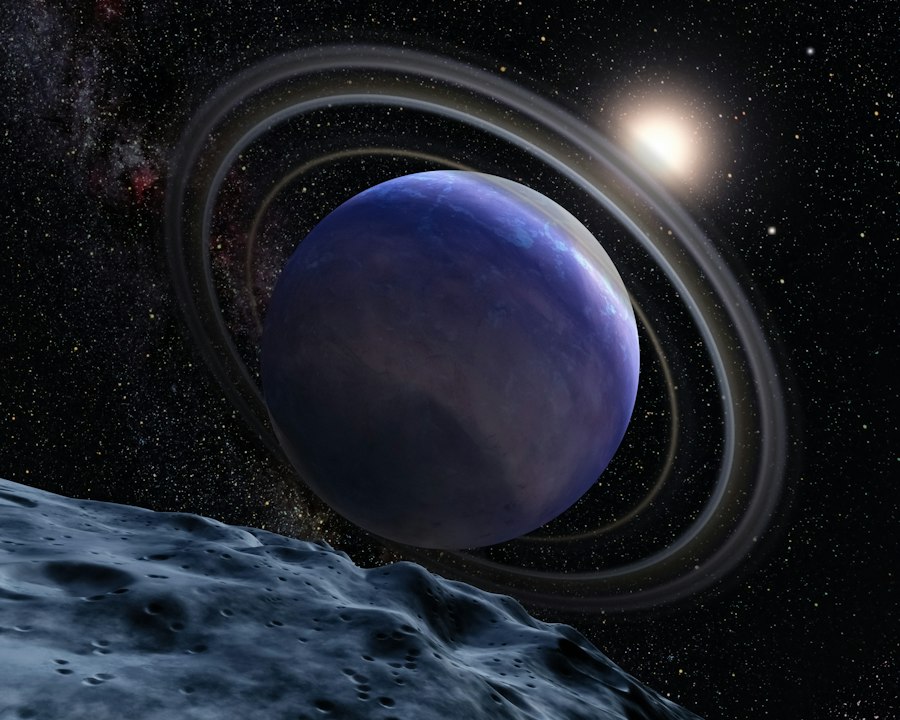
Beyond Neptune lies the Kuiper Belt, a vast, donut-shaped region populated by countless icy bodies – the remnants of the solar system’s formation. This celestial debris field is home to dwarf planets like Pluto, Eris, Makemake, and Haumea, as well as countless smaller comets and icy planetesimals.
Pluto: A Reclassified World
For decades, Pluto held the status of the ninth planet. However, the discovery of other similarly sized objects in the Kuiper Belt led to its reclassification as a dwarf planet in 2006. Despite this change in status, Pluto remains a world of immense scientific interest, especially after the New Horizons mission’s groundbreaking flyby in 2015.
New Horizons and the Revelation of Pluto
The New Horizons spacecraft revealed a surprisingly complex and geologically active surface on Pluto, featuring vast plains of nitrogen ice, towering mountains of water ice, and evidence of past cryovolcanism. This activity challenges earlier assumptions about the nature of these distant, frigid bodies. Pluto also possesses a thin atmosphere and a system of moons, the largest being Charon, with which it shares a complex gravitational dance. The discovery of active geological processes on Pluto has revolutionized our understanding of dwarf planets and the potential for dynamic processes in the outer solar system.
The Diversity of Kuiper Belt Objects
The Kuiper Belt is not a monolithic entity. It harbors a diverse population of objects, each with its unique composition and history. These objects are believed to be pristine remnants from the early solar system, offering invaluable insights into the materials and conditions present during planetary formation. Studying their orbits and compositions helps us piece together the story of how our solar system came to be.
The Scattered Disk: An Even More Distant Realm
Even further out than the main Kuiper Belt lies the scattered disk, a region populated by objects with highly eccentric and inclined orbits. These objects are thought to have been gravitationally perturbed by Neptune billions of years ago, scattering them into their current, more distant and unpredictable trajectories. This region is believed to contain some of the most distant and enigmatic bodies in our solar system, offering clues about the outer boundaries of planetary influence.
The Oort Cloud: The Solar System’s Distant Frontier
Beyond the Kuiper Belt and the scattered disk lies the Oort Cloud, a hypothetical spherical shell of icy bodies that is thought to surround our solar system at distances of up to 100,000 astronomical units (AU). This is the ultimate reservoir of long-period comets, whose infrequent appearances in the inner solar system offer fleeting glimpses into this incredibly distant and largely unexplored realm.
The Birthplace of Comets
The Oort Cloud is believed to be the origin of long-period comets, those cosmic wanderers that can take thousands or even millions of years to complete a single orbit around the Sun. Gravitational perturbations, perhaps from passing stars or giant molecular clouds, can dislodge these icy bodies from the Oort Cloud, sending them on a journey towards the inner solar system. Studying the composition of these comets provides vital information about the chemical makeup of the early solar system.
The Challenge of Observation
The sheer distance of the Oort Cloud makes direct observation incredibly challenging, if not impossible with current technology. Its existence is inferred from the orbits of long-period comets. However, understanding the Oort Cloud is crucial for a complete picture of our solar system’s structure and evolution. It represents the outermost boundary of the Sun’s gravitational influence.
Recent discoveries in the outer solar system have sparked intrigue among astronomers, leading to numerous theories about the enigmatic celestial bodies that reside beyond Neptune. For those interested in delving deeper into these outer solar system mysteries, a fascinating article can be found at My Cosmic Ventures, which explores the latest findings and ongoing research that aim to unravel the secrets of this distant region.
The Search for Life Beyond Earth: A New Frontier
| Mystery | Description | Key Data / Metrics | Current Hypotheses |
|---|---|---|---|
| Planet Nine | Hypothetical large planet influencing orbits of distant Kuiper Belt objects | Estimated mass: 5-10 Earth masses Distance: 400-800 AU from Sun Orbital period: 10,000-20,000 years |
Existence inferred from clustering of trans-Neptunian objects’ orbits |
| Kuiper Belt Object Composition | Unusual surface compositions and colors of Kuiper Belt objects | Surface ices: methane, nitrogen, water ice Color range: neutral to very red Size range: 10 km to 2400 km (Pluto) |
Varied formation locations and space weathering effects |
| Origin of Irregular Moons | Moons with eccentric, inclined orbits around outer planets | Orbital eccentricity: 0.1 to 0.7 Inclination: up to 180° (retrograde) Sizes: 1 km to 150 km |
Captured objects from Kuiper Belt or asteroid populations |
| Neptune’s Internal Heat | Neptune emits more heat than it receives from the Sun | Heat emission: ~2.6 times solar input Surface temperature: ~55 K |
Possible ongoing gravitational contraction or unknown internal processes |
| Origin of Cometary Activity in Outer Solar System | Comets showing activity far beyond the frost line | Activity observed at distances > 5 AU Outgassing of CO, CO2, and other volatiles |
Volatile sublimation triggered by solar radiation or internal heat |
The exploration of the outer solar system has profoundly shifted our perspective on the possibility of life beyond Earth. While the gas and ice giants themselves are unlikely hosts, their moons, particularly Europa and Titan, have emerged as compelling candidates for harboring life.
Astrobiological Potential of Icy Moons
The discovery of subsurface liquid water oceans on Europa, Enceladus, and possibly Ganymede and Callisto, has ignited intense scientific interest. These oceans, shielded from the harsh radiation of space by thick ice shells, could provide stable environments for life to emerge and evolve. The presence of key ingredients for life – water, essential elements, and energy sources – makes these moons prime targets for future astrobiological missions.
The Search for Biosignatures
Future missions to these icy worlds will focus on searching for biosignatures – indicators of past or present life. This could involve analyzing the composition of plumes erupting from Enceladus, or eventually drilling through the ice shells of Europa to directly sample its ocean. Understanding the unique geochemical environments of these moons is crucial for designing effective biosignature detection strategies.
Titan: A Different Kind of Habitable Zone?
Titan, with its methane-based hydrology and rich organic chemistry, presents a unique astrobiological puzzle. While life as we know it might not thrive in its frigid, hydrocarbon environment, it is conceivable that life could have evolved to utilize different chemical pathways. The study of Titan offers the possibility of discovering entirely new forms of biochemistry.
The outer solar system, once a dark and distant enigma, is now a vibrant frontier of scientific discovery. Each new mission, each refined observation, peels back another layer of mystery, revealing a universe far more complex and wondrous than we could have ever imagined. From the swirling storms of Jupiter to the icy plains of Pluto, these distant worlds are not just celestial bodies; they are testaments to the incredible diversity and dynamic history of our solar system, and they hold tantalizing clues to the ultimate question: are we alone? The unraveling of these mysteries continues, promising to redefine our place in the cosmos.

Did We Photograph Planet Nine 23 Years Apart?
FAQs
What are some of the mysteries of the outer solar system?
Some mysteries of the outer solar system include the origin of the Kuiper Belt objects, the composition of the moons of gas giants, the existence of Planet Nine, the nature of the dark spots on Neptune, and the formation of the rings around gas giants.
Why is the origin of the Kuiper Belt objects a mystery?
The origin of the Kuiper Belt objects is a mystery because scientists are still unsure how these icy bodies beyond Neptune’s orbit formed and how they ended up in their current locations.
What do we know about the composition of the moons of gas giants?
The composition of the moons of gas giants varies, with some moons being rocky and others being icy. Some moons, like Europa and Enceladus, are believed to have subsurface oceans that could potentially harbor life.
What is Planet Nine and why is its existence a mystery?
Planet Nine is a hypothetical planet located beyond Neptune’s orbit that has not yet been directly observed. Its existence is a mystery because its gravitational influence is believed to be affecting the orbits of other objects in the outer solar system.
How do the dark spots on Neptune contribute to the mysteries of the outer solar system?
The dark spots on Neptune are large storms in the planet’s atmosphere that are still not fully understood. Scientists are studying these storms to learn more about the dynamics of Neptune’s atmosphere and how it differs from the other gas giants in the outer solar system.