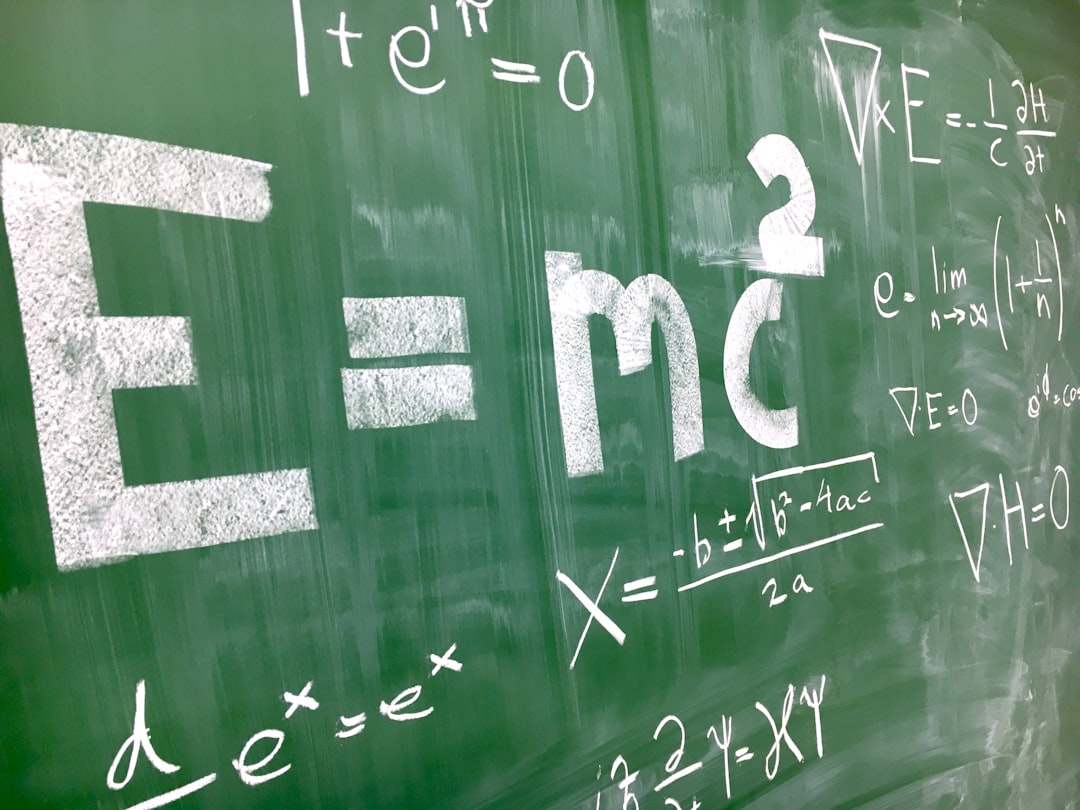
The human experience of time is undeniably linear, a relentless march from past to present to future. Yet, beneath this familiar flow lies a profound mystery, a realm where the very fabric of time might be something far stranger and more intricate than our intuition suggests. Physicists, armed with the enigmatic tools of quantum mechanics, are beginning to unravel this cosmic enigma, exploring the possibility that time itself possesses a quantum nature. This journey takes them to the very edges of our understanding, where causality blurs, and the arrow of time might not be so straight after all.
Before delving into the quantum realm, it is essential to acknowledge the classical edifice upon which our everyday perception of time is built. This framework, largely established by Isaac Newton, paints time as an absolute, universal constant, an immutable backdrop against which events unfold.
Time as a Universal Clockwork
Newton’s conception of time posited a cosmic clock, ticking at the same rate for everyone, everywhere. This idea permeated our understanding of the universe for centuries, forming the bedrock of classical physics. Events were seen as occurring sequentially, with a clear and unambiguous order.
The Arrow of Time: A One-Way Street
The macroscopic world we inhabit is characterized by the undeniable directionality of time, often referred to as the “arrow of time.” We remember the past but not the future; broken objects do not spontaneously reassemble. This asymmetry is a fundamental aspect of our experience, deeply rooted in the second law of thermodynamics and the concept of increasing entropy.
Einstein’s Revolution: Time Becomes Relative
While Newton envisioned an absolute time, Albert Einstein’s theories of special and general relativity fundamentally altered this perspective. Relativity revealed that time is not an independent entity but is intimately intertwined with space, forming a four-dimensional spacetime.
Time Dilation: The Pace of Time is Not Uniform
Special relativity introduced the concept of time dilation, demonstrating that time passes slower for an observer moving at a high velocity relative to another. This means time is not absolute but relative to the observer’s frame of reference.
Gravity’s Influence: Spacetime Curvature and Gravitational Time Dilation
General relativity further elaborated on this relativity, showing that gravity itself warps spacetime. Massive objects create gravitational wells, and time runs slower in stronger gravitational fields. This gravitational time dilation has been experimentally verified and has significant implications for technologies like GPS. Despite these profound insights, both Newton’s and Einstein’s descriptions of time remain largely classical, treating time as a continuous, smooth variable.
For those interested in exploring the intriguing relationship between quantum mechanics and the nature of time, a fascinating article can be found at My Cosmic Ventures. This piece delves into how quantum theories challenge our conventional understanding of time, suggesting that time may not be as linear as we perceive it. By examining the implications of quantum entanglement and superposition, the article invites readers to reconsider their notions of causality and the flow of time, making it a compelling read for anyone curious about the intersection of physics and philosophy.
The Quantum Quandary: Time at its Smallest Scales
The realm of quantum mechanics, which governs the behavior of the universe at its most fundamental level, presents a starkly different picture. Here, the familiar, continuous nature of time begins to fray, suggesting that it might be quantized, discrete, or even an emergent phenomenon.
The Problem of Time in Quantum Gravity
One of the most significant challenges in modern physics is the unification of quantum mechanics and general relativity – the quest for a theory of quantum gravity. This endeavor immediately confronts a fundamental conceptual hurdle: the “problem of time.”
Wheeler-DeWitt Equation: Time’s Apparent Absence
In canonical quantum gravity, attempting to quantize Einstein’s field equations leads to the Wheeler-DeWitt equation. This equation famously lacks an explicit time variable, leading some to suggest that time, as we understand it, might not exist at the most fundamental level of reality.
Emergent Time: A Collective Phenomenon?
This apparent absence of time has fueled theories proposing that time might not be a fundamental ingredient of the universe but rather an emergent property. Just as temperature emerges from the collective motion of atoms, time might arise from the interactions and relationships between quantum entities.
Granularity of Time: Is Time Made of “Ticks”?
A central question in the quantum nature of time is whether time itself is continuous or discrete, meaning it exists in tiny, indivisible packets, or “chronons.”
Planck Time: The Smallest Possible Unit of Time
Theoretical physics suggests a minimum possible duration for time, known as the Planck time, approximately $10^{-43}$ seconds. It is hypothesized that at this scale, our current understanding of spacetime breaks down, and time may become granular, if it exists at all.
Experimental Signatures of Quantized Time
Detecting such minuscule time intervals is a monumental challenge. However, scientists are exploring potential experimental signatures that could hint at the granular nature of time. These might include subtle deviations in the arrival times of photons from distant astrophysical events or the analysis of high-energy particle collisions.
Quantum Entanglement and Non-Locality: Challenging Causality
Quantum entanglement, a phenomenon where two or more particles become linked in such a way that they share the same fate, regardless of the distance separating them, has profound implications for our understanding of time and causality.
Instantaneous Correlations: Spooky Action at a Distance
When entangled particles are measured, their properties are found to be correlated instantaneously, defying classical notions of locality. This “spooky action at a distance,” as Einstein famously called it, raises questions about whether information can truly be transmitted faster than the speed of light, potentially blurring the lines of cause and effect.
Entanglement as a Clock Mechanism
Some theoretical frameworks propose that entanglement itself could play a role in the emergence of time. The correlations within entangled systems might provide a kind of internal “clock” that defines the progression of events.
Theories of Quantum Time: Exploring the Possibilities

The questions surrounding the quantum nature of time have spurred the development of various theoretical frameworks, each offering a unique perspective on this profound mystery.
Loop Quantum Gravity: Spacetime as a Network
Loop Quantum Gravity (LQG) is one prominent candidate for a theory of quantum gravity that attempts to quantize spacetime itself.
Quantized Geometry: Discrete Building Blocks
In LQG, spacetime is not a smooth continuum but is composed of discrete, fundamental units. This quantization of geometry extends to time, suggesting that the fabric of spacetime, and thus time, is built from tiny, interconnected loops.
Background Independence: Time Without a Predefined Stage
A key feature of LQG is its background independence, meaning it does not assume a fixed spacetime background on which quantum events occur. This allows for a more holistic approach where spacetime and matter are treated dynamically, and time might emerge from the dynamics of the quantum geometry.
String Theory: Vibrating Strings and Higher Dimensions
String theory, another leading candidate for a unified theory of everything, offers a different approach to understanding the fundamental constituents of the universe, including time.
Vibrating Strings as Fundamental Entities
In string theory, fundamental particles are not point-like but are instead tiny, vibrating strings. The different vibration modes of these strings correspond to different particles and forces, including those that govern spacetime.
Extra Dimensions and the Nature of Time
String theory often requires the existence of extra spatial dimensions beyond the three we perceive. The nature of time within these higher-dimensional frameworks is complex and remains an active area of research, with implications for how time might behave and be perceived in different dimensional scenarios.
Causal Set Theory: A Discrete, Ordered Universe
Causal set theory proposes that the fundamental structure of spacetime is not continuous but is a discrete set of points, with a strict causal ordering between them.
Fundamental Causality: The Ordering of Events
In this framework, the most fundamental aspect of reality is the causal relationship between events. The “closeness” of events in time is determined by the number of causal links between them, providing a discrete and ordered structure for spacetime.
Emergence of Spacetime and Time from Causality
The continuum of spacetime and the smooth flow of time are then seen as emergent properties that arise from the underlying causal structure, much like a macroscopic object emerges from the collective behavior of its constituent atoms.
The Implications of Quantum Time: Reshaping Our Reality
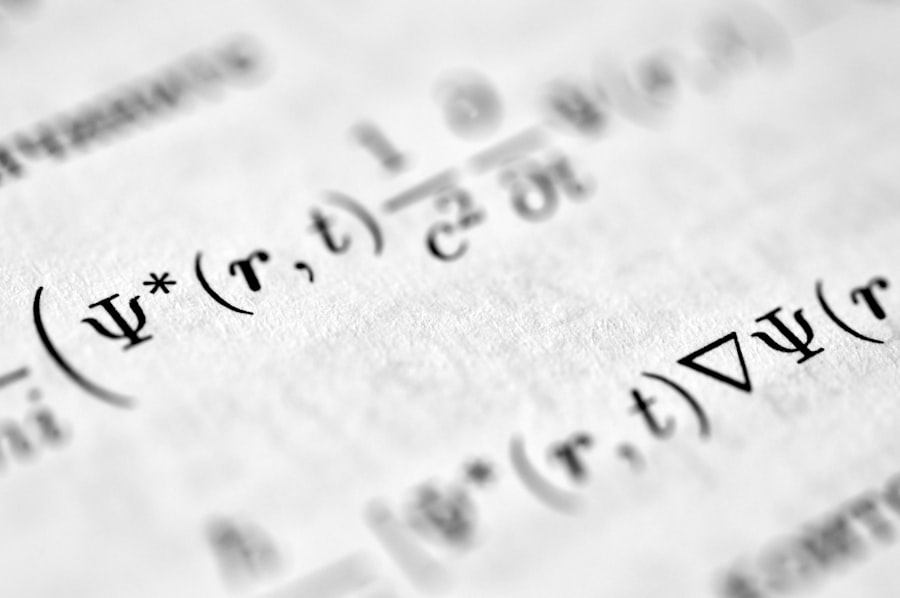
If time is indeed quantized or emergent, the implications for our understanding of the universe and our place within it are profound, challenging many of our most deeply held assumptions.
Rethinking Causality and Determinism
The possibility of a granular or non-linear time raises fundamental questions about causality. If time is not a smooth flow, can cause and effect still be as clearly defined?
Non-Local Effects and Retrocausality
Quantum entanglement’s apparent instantaneous correlations, coupled with potential breakdowns in classical causality at the quantum level, open the door to discussions about non-local effects and even the speculative notion of retrocausality, where future events might somehow influence the past.
Determinism vs. Indeterminism at the Quantum Level
The quantum realm is inherently probabilistic, suggesting a level of indeterminism. If time itself is quantum, this indeterminism might be even more deeply embedded in the fabric of reality, challenging deterministic views of the universe.
The Universe’s Beginning and End: A Quantum Perspective
Our understanding of the universe’s origin and its ultimate fate is intrinsically linked to the nature of time.
The Big Bang and the Initial State of Time
If time is emergent, what was the state of the universe before the Big Bang, or even at the very instant of its creation? Did time exist then, or did it come into being alongside spacetime?
The Future of Time: Decay or Transformation?
The ultimate fate of the universe, whether it expands forever, collapses, or undergoes some other transformation, is also tied to the behavior of time. A quantum understanding of time might offer new insights into these cosmological scenarios.
Consciousness and the Subjective Experience of Time
Our subjective experience of time – how it seems to speed up when we’re enjoying ourselves and drag when we’re bored – is a puzzle in itself. Could a quantum understanding of time shed light on this?
The Mind-Time Connection
Some speculative ideas explore a potential connection between the quantum nature of time and the processes of consciousness. Could our brains, as complex quantum systems, interact with or even influence the emergent properties of time?
Time Perception as a Quantum Phenomenon
While currently in the realm of conjecture, it is conceivable that our perception of time is not simply a passive reception of an objective flow but is an active, quantum process shaped by our cognitive and biological makeup.
Recent discussions in the field of quantum mechanics have led to intriguing insights about the nature of time, suggesting that our understanding of temporal flow may be more complex than previously thought. For those interested in exploring this fascinating intersection further, a related article can be found at this link, which delves into how quantum theories challenge traditional notions of time and reality.
The Ongoing Quest: Unanswered Questions and Future Directions
| Concept | Definition |
|---|---|
| Quantum Mechanics | A fundamental theory in physics that describes the behavior of matter and energy at the atomic and subatomic levels. |
| Nature of Time | The philosophical and scientific exploration of the nature of time, including its passage, direction, and existence. |
| Quantum Entanglement | A phenomenon in quantum mechanics where particles become correlated in such a way that the state of one particle can instantly affect the state of another, regardless of the distance between them. |
| Time Dilation | A concept in the theory of relativity where time appears to pass at different rates for observers who are moving relative to one another, leading to the idea that time is not absolute. |
The journey to unravel the quantum nature of time is far from over. It is a frontier of physics brimming with unanswered questions, demanding innovative theoretical frameworks and ingenious experimental approaches.
The Search for Experimental Evidence
The primary challenge remains the development of experiments that can directly probe the quantum nature of time.
Precision Measurements and Astrophysical Observations
Scientists are pushing the boundaries of precision measurements in particle physics and are meticulously analyzing data from astrophysical observations, searching for subtle anomalies that might betray the granular or emergent nature of time.
New Detection Methods and Theoretical Predictions
The development of entirely new detection methods and the refinement of theoretical predictions are crucial for guiding experimentalists in their quest for evidence.
The Role of Information and Computation
Emerging fields of physics suggest a deep connection between information, computation, and the fabric of reality.
Time as a Computational Process
Could time be, in some fundamental sense, a computational process? The universe, in this view, might be a colossal computer, and time its execution.
The Information Paradox and Time
The information paradox in black holes, where information seems to be lost upon entering, also has implications for the nature of time and its relationship with information conservation.
Unifying Our Understanding: The Road Ahead
The ultimate goal is to integrate our understanding of quantum time with the macroscopic reality we experience, bridging the gap between the quantum and the classical.
A Complete Theory of Everything
A truly complete theory of everything must provide a coherent explanation for the nature of time, from the smallest Planck scale to the vastness of the cosmos, and encompassing our subjective experience.
The Philosophical and Scientific Synthesis
The unraveling of the quantum nature of time promises not only a revolution in physics but also a profound philosophical re-evaluation of our place in the universe and the very essence of existence. The quest continues, pushing the boundaries of human knowledge and our perception of reality itself.
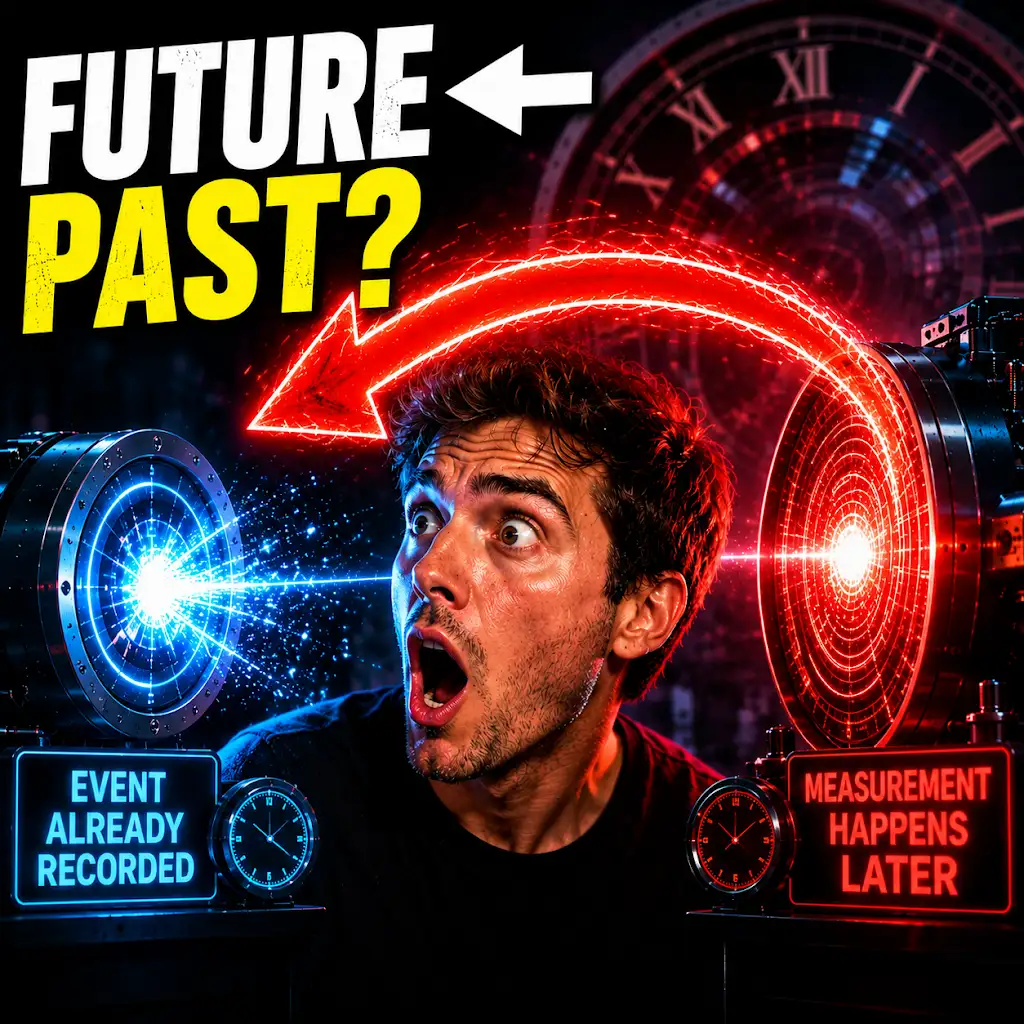
The Quantum Experiment That Looks Like It Changed the Past
FAQs
What is quantum mechanics?
Quantum mechanics is a fundamental theory in physics that describes the behavior of matter and energy at the atomic and subatomic levels. It provides a mathematical framework for understanding the dual particle-wave nature of particles and the probabilistic nature of their behavior.
How does quantum mechanics relate to the nature of time?
In quantum mechanics, time is treated as a parameter that evolves the state of a system. The theory allows for the possibility of time being non-linear or even reversible at the quantum level, challenging our classical understanding of time as a linear and irreversible concept.
What are some key concepts in quantum mechanics that impact our understanding of time?
Some key concepts in quantum mechanics that impact our understanding of time include superposition, entanglement, and the uncertainty principle. These concepts suggest that the nature of time may be more complex and interconnected with the behavior of particles at the quantum level.
How does quantum mechanics challenge traditional views of time?
Quantum mechanics challenges traditional views of time by suggesting that time may not be as absolute and independent as previously thought. The theory raises questions about the nature of causality, the arrow of time, and the possibility of time being a emergent property of quantum systems.
What are the implications of quantum mechanics for our understanding of time?
The implications of quantum mechanics for our understanding of time are still being explored and debated. Some researchers suggest that a deeper understanding of quantum mechanics may lead to a more unified theory of physics that incorporates the nature of time at the fundamental level.