
In recent years, the scientific community has been captivated by the discovery of interstellar objects that traverse our solar system. Among these, one particular object has sparked intense debate and intrigue, leading to what can only be described as NASA’s secret interstellar object dilemma. This enigmatic entity, which has been observed passing through the solar system, raises profound questions about its origins, composition, and the implications it holds for humanity’s understanding of the cosmos.
As scientists strive to unravel the mysteries surrounding this object, they find themselves at the intersection of discovery and uncertainty, grappling with the potential for groundbreaking revelations about our universe. The fascination with interstellar objects is not merely a matter of scientific curiosity; it touches upon fundamental questions about life beyond Earth and the nature of our cosmic neighborhood. The object in question has become a focal point for researchers, igniting discussions that span disciplines from astrophysics to astrobiology.
As NASA and other space agencies mobilize resources to study this interstellar visitor, the implications of their findings could reshape humanity’s perspective on its place in the universe. Why Did NASA Hide 3i Atlas
Key Takeaways
- NASA is facing a dilemma with a secret interstellar object
- The interstellar object was discovered by NASA
- The origin of the object is shrouded in mystery
- NASA is making efforts to study the object
- Scientists are debating the implications of the object for interstellar travel
The Discovery of the Interstellar Object
The journey of this interstellar object began with its serendipitous discovery by astronomers using advanced telescopes equipped with cutting-edge technology. Initially detected as a faint point of light moving against the backdrop of stars, the object was soon identified as an interstellar visitor due to its hyperbolic trajectory—an unmistakable sign that it originated from outside the solar system. This revelation sent shockwaves through the scientific community, as it marked only the second time an object from another star system had been confirmed to enter our solar neighborhood.
As researchers delved deeper into the object’s characteristics, they employed a variety of observational techniques to gather data. Spectroscopy, for instance, allowed scientists to analyze the light reflected off the object’s surface, revealing clues about its composition and physical properties. The initial excitement surrounding its discovery was palpable, as astronomers recognized that studying this object could provide invaluable insights into the formation and evolution of planetary systems beyond our own.
The Mystery Surrounding the Object’s Origin
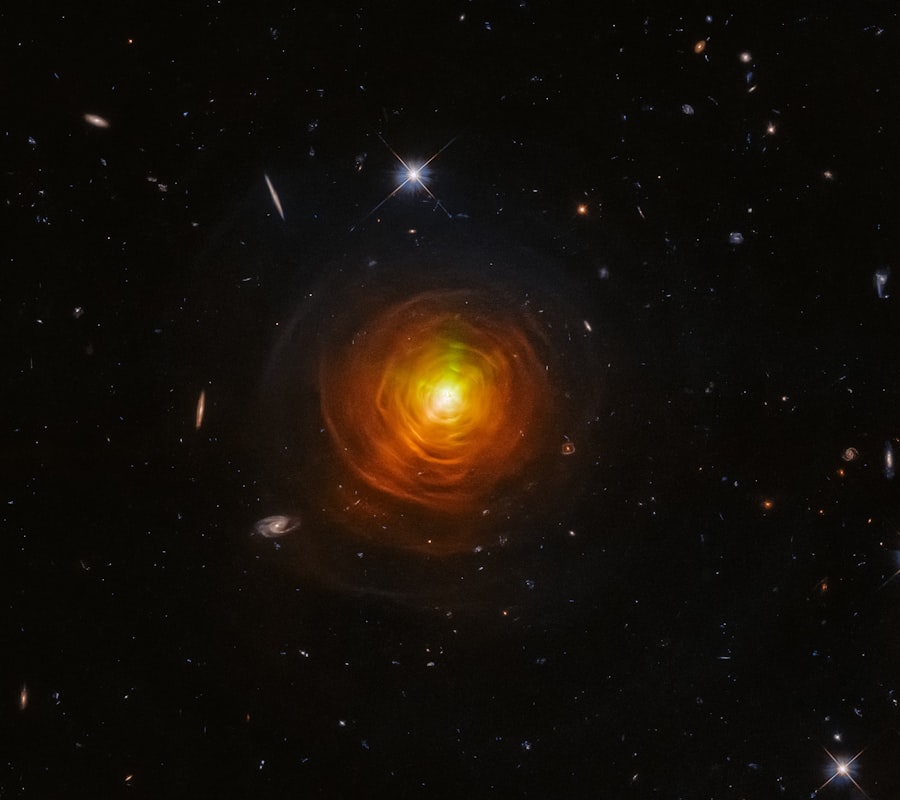
Despite the excitement generated by its discovery, the origin of this interstellar object remains shrouded in mystery. Scientists have proposed several theories regarding where it might have come from, ranging from nearby star systems to distant regions of the galaxy. Each hypothesis presents its own set of challenges and implications, complicating efforts to pinpoint the object’s birthplace.
The lack of definitive data has led to a proliferation of speculation, with some researchers suggesting that it could be a remnant from a protoplanetary disk or even a fragment from a collision between celestial bodies in another solar system. The object’s unusual trajectory further complicates its origin story. Unlike typical asteroids or comets that orbit the sun in predictable paths, this interstellar visitor follows a hyperbolic trajectory that suggests it is merely passing through our solar system on a one-time journey.
This raises questions about how many such objects exist in our galaxy and how often they might visit our solar neighborhood.
NASA’s Efforts to Study the Object
| Effort | Details |
|---|---|
| Mission Name | Lucy Mission |
| Launch Date | October 16, 2021 |
| Objective | Study Trojan asteroids |
| Spacecraft | Lucy spacecraft |
| Duration | 12 years |
In response to the discovery of this interstellar object, NASA has mobilized a range of resources and expertise to study it comprehensively. The agency has coordinated efforts among various research teams and institutions, pooling knowledge and technology to maximize their understanding of this celestial enigma. Observatories around the world have been enlisted to track its trajectory and gather data, while spacecraft equipped with advanced instruments are being prepared for potential close encounters.
NASA’s commitment to studying this object reflects its broader mission to explore and understand the universe. By analyzing the object’s composition and behavior, scientists hope to glean insights into not only its origins but also the processes that govern celestial bodies throughout the cosmos. The agency’s efforts underscore the importance of collaboration in scientific research, as teams from diverse backgrounds come together to tackle one of astronomy’s most intriguing challenges.
The Debate Among Scientists
As researchers delve into the complexities surrounding this interstellar object, a lively debate has emerged within the scientific community. Some scientists advocate for a cautious approach, emphasizing the need for rigorous data collection and analysis before drawing conclusions about its origins or implications.
This debate reflects broader tensions within science itself—between empirical rigor and imaginative exploration. While some researchers prioritize concrete evidence and established theories, others are drawn to the allure of possibilities that challenge conventional wisdom. This dynamic discourse not only enriches scientific inquiry but also highlights the importance of diverse perspectives in unraveling complex mysteries.
The Potential Implications for Interstellar Travel
The discovery of an interstellar object carries profound implications for humanity’s aspirations regarding interstellar travel. If such objects can traverse vast distances between star systems, it raises questions about the feasibility of sending spacecraft beyond our solar system. The study of this interstellar visitor could provide critical insights into propulsion technologies and navigation strategies necessary for future missions aimed at exploring distant worlds.
Moreover, understanding how this object interacts with solar radiation and gravitational forces could inform designs for spacecraft capable of enduring similar conditions during interstellar journeys. As scientists analyze its trajectory and behavior, they may uncover principles that could be applied to future exploration endeavors, potentially paving the way for humanity’s first steps into interstellar space.
The Object’s Unique Characteristics
One of the most intriguing aspects of this interstellar object is its unique characteristics that set it apart from typical asteroids or comets found within our solar system. Preliminary observations suggest that it possesses an elongated shape, unlike most celestial bodies that tend to be more spherical due to gravitational forces. This unusual morphology raises questions about its formation and history—how did it acquire such a shape, and what does it reveal about its journey through space?
Additionally, scientists have noted peculiarities in its surface composition that differ from those typically found in solar system objects. The presence of certain minerals or compounds could provide clues about its origin and the conditions present in its home star system. By studying these characteristics in detail, researchers hope to piece together a more comprehensive picture of this interstellar visitor and what it can teach us about planetary formation processes across different environments.
The Challenges of Studying Interstellar Objects
Studying interstellar objects presents a unique set of challenges that complicate efforts to gather data and draw conclusions. One significant hurdle is their fleeting nature; these objects often move at high velocities and spend only a short time within our solar system before continuing on their journey through space. This limited window for observation necessitates rapid response times from researchers and advanced tracking technologies to ensure that valuable data is collected before the object departs.
Moreover, the vast distances involved pose additional difficulties in terms of resolution and clarity when observing these objects from Earth-based telescopes or even spacecraft. The faintness of these visitors can make them difficult to detect against the backdrop of stars, requiring sophisticated imaging techniques and powerful instruments to capture meaningful data. As scientists navigate these challenges, they must also contend with uncertainties related to their findings—each observation may raise new questions even as it answers others.
The Possibility of Extraterrestrial Origins
Among the most tantalizing possibilities surrounding this interstellar object is its potential connection to extraterrestrial origins. While many scientists approach this idea with caution, considering it speculative without concrete evidence, others are drawn to the implications it holds for understanding life beyond Earth. If this object were indeed a product of an alien civilization or contained materials indicative of life-sustaining environments, it could revolutionize humanity’s perspective on existence in the universe.
The search for extraterrestrial life has long been a driving force behind space exploration, and discoveries like this interstellar visitor fuel interest in pursuing such inquiries further. Researchers are keenly aware that even small pieces of evidence could lead to significant breakthroughs in our understanding of life’s potential elsewhere in the cosmos. As they study this object, they remain vigilant for any signs that might hint at connections beyond our own planet.
The Impact on Our Understanding of the Universe
The implications of studying this interstellar object extend far beyond its immediate characteristics; they touch upon fundamental questions about our understanding of the universe itself. By examining how such objects form, evolve, and interact with their environments, scientists can gain insights into broader cosmic processes that govern celestial bodies across galaxies. This knowledge could reshape theories about planetary formation and migration patterns within star systems.
Furthermore, discoveries related to this interstellar visitor may challenge existing paradigms within astrophysics and cosmology. As researchers uncover new data about its origins or behavior, they may find themselves reevaluating long-held beliefs about how celestial bodies interact over vast distances or how life might arise under different conditions. Each revelation contributes to an ever-evolving narrative about humanity’s place in an expansive universe filled with mysteries yet to be unraveled.
Future Missions and Research Plans
Looking ahead, NASA and other space agencies are poised to embark on ambitious missions aimed at further exploring interstellar objects like this one. Plans are already underway for dedicated observational campaigns utilizing advanced telescopes capable of capturing high-resolution images and spectra from these fleeting visitors. Additionally, proposals for future spacecraft missions are being developed with an eye toward potential rendezvous with known interstellar objects.
These future endeavors reflect a growing recognition within the scientific community of the importance of studying interstellar phenomena as part of humanity’s broader quest for knowledge about our universe. As technology continues to advance, researchers are optimistic that they will unlock new secrets hidden within these cosmic travelers—secrets that could illuminate not only our understanding of celestial mechanics but also our place within an ever-expanding cosmos. In conclusion, NASA’s secret interstellar object dilemma encapsulates both excitement and uncertainty as scientists grapple with profound questions surrounding an enigmatic visitor from beyond our solar system.
Through collaborative efforts and innovative research strategies, they aim to unravel its mysteries while contemplating what it means for humanity’s future in exploring the cosmos. As we stand on the brink of new discoveries, one thing remains clear: each step taken toward understanding these interstellar travelers brings us closer to unlocking the secrets of our universe.
NASA’s ongoing investigation into the mysterious interstellar object, often referred to as ‘Oumuamua’, has sparked significant interest in the scientific community. For a deeper understanding of the challenges and implications surrounding this enigmatic visitor, you can read more in the article available at this link. The article delves into the various theories proposed to explain its unusual characteristics and the potential for future interstellar exploration.
WATCH THIS! Why NASA Hid the 3I/ATLAS Anomaly
FAQs
What is the NASA secret interstellar object problem?
The NASA secret interstellar object problem refers to the discovery of an unidentified object of interstellar origin within our solar system. This object, named ‘Oumuamua, was first observed in 2017 and has since sparked significant interest and debate within the scientific community.
What is ‘Oumuamua?
‘Oumuamua is the first known interstellar object to pass through our solar system. It is an elongated, cigar-shaped object that was first detected by astronomers in October 2017. Its unusual shape and trajectory have led to speculation about its origins and nature.
Why is ‘Oumuamua considered a problem for NASA?
‘Oumuamua presents a problem for NASA and the scientific community because its interstellar origin challenges our current understanding of the formation and dynamics of objects within our solar system. Its unexpected appearance and behavior have raised questions about how common such interstellar visitors might be and what implications they may have for our understanding of the universe.
What are the implications of ‘Oumuamua’s discovery?
The discovery of ‘Oumuamua has significant implications for our understanding of the prevalence of interstellar objects in our cosmic neighborhood. It also raises questions about the potential for future encounters with similar objects and the need for enhanced observational and detection capabilities to study them.
What is NASA doing to study ‘Oumuamua?
NASA has been actively studying ‘Oumuamua using a variety of telescopes and instruments to gather as much data as possible about its composition, trajectory, and behavior. The agency is also considering future missions and initiatives to better understand interstellar objects and their potential impact on our understanding of the universe.