
Quantum physics, often regarded as one of the most revolutionary fields of science, delves into the behavior of matter and energy at the smallest scales. It emerged in the early 20th century, challenging classical physics and introducing concepts that defy everyday intuition. The development of quantum theory was propelled by the need to explain phenomena that could not be accounted for by classical mechanics, such as blackbody radiation and the photoelectric effect.
As scientists began to explore the atomic and subatomic realms, they uncovered a world governed by probabilities rather than certainties, leading to a profound shift in understanding the nature of reality. The implications of quantum physics extend far beyond theoretical musings; they have practical applications that permeate modern technology. From semiconductors to lasers, the principles of quantum mechanics underpin many devices that have transformed society.
As researchers continue to probe deeper into the quantum realm, they uncover new phenomena that challenge existing paradigms and inspire innovative technologies. This article will explore key concepts within quantum physics, shedding light on its complexities and the potential it holds for the future.
Key Takeaways
- Quantum physics is the study of the behavior of matter and energy at the atomic and subatomic levels.
- Particles exhibit both wave-like and particle-like behavior, known as the dual nature of particles.
- Quantum entanglement is a phenomenon where particles become interconnected and their states are linked, even when separated by large distances.
- The uncertainty principle states that it is impossible to simultaneously know the exact position and momentum of a particle.
- Quantum tunneling is the phenomenon where particles can pass through energy barriers that would be impossible according to classical physics.
The Dual Nature of Particles
One of the most intriguing aspects of quantum physics is the dual nature of particles, which posits that particles can exhibit both wave-like and particle-like properties. This concept is famously illustrated by the double-slit experiment, where light and matter demonstrate interference patterns characteristic of waves when not observed. However, when a measurement is made, these same entities behave as discrete particles.
This duality raises profound questions about the nature of reality and observation itself, suggesting that the act of measurement plays a crucial role in determining the state of a system. The implications of this duality extend beyond mere academic curiosity; they challenge the very foundations of how reality is perceived. The wave-particle duality suggests that particles do not possess definite properties until they are observed, leading to philosophical debates about determinism and free will.
This phenomenon has led to various interpretations within quantum mechanics, each attempting to reconcile the strange behavior of particles with our understanding of the universe. As scientists continue to explore this duality, they uncover deeper layers of complexity that further blur the lines between classical and quantum realms.
Quantum Entanglement

Quantum entanglement is another cornerstone of quantum physics that captivates both scientists and philosophers alike. When two or more particles become entangled, their states become interdependent, such that the state of one particle instantaneously influences the state of another, regardless of the distance separating them. This phenomenon was famously described by Albert Einstein as “spooky action at a distance,” highlighting its counterintuitive nature.
Entangled particles can remain connected even when separated by vast distances, challenging classical notions of locality and causality. The implications of entanglement are profound, particularly in the realm of information transfer and communication. Quantum entanglement forms the basis for emerging technologies such as quantum cryptography and quantum teleportation.
In quantum cryptography, entangled particles can be used to create secure communication channels that are theoretically immune to eavesdropping. As researchers delve deeper into the intricacies of entanglement, they uncover new possibilities for harnessing this phenomenon in practical applications, paving the way for advancements in secure communication and information processing.
The Uncertainty Principle
| Concept | Definition |
|---|---|
| Uncertainty Principle | A principle in quantum mechanics that states that the more precisely the position of a particle is known, the less precisely its momentum can be known, and vice versa. |
| Formulated by | Werner Heisenberg in 1927 |
| Mathematical expression | Δx * Δp ≥ ħ/2, where Δx is the uncertainty in position, Δp is the uncertainty in momentum, and ħ is the reduced Planck constant |
| Implications | Challenges the classical notion of determinism and has profound implications for the understanding of quantum mechanics and the behavior of subatomic particles. |
The uncertainty principle, formulated by Werner Heisenberg in 1927, is a fundamental tenet of quantum mechanics that asserts a limit to how precisely certain pairs of physical properties can be known simultaneously. For instance, one cannot simultaneously know both the position and momentum of a particle with absolute certainty. The more accurately one property is measured, the less accurately the other can be determined.
This principle challenges classical notions of determinism and introduces an inherent fuzziness to the behavior of particles at the quantum level. The uncertainty principle has far-reaching implications for our understanding of reality. It suggests that at a fundamental level, nature is not deterministic but probabilistic, where outcomes can only be predicted in terms of likelihoods rather than certainties.
This realization has led to a reevaluation of concepts such as causality and predictability in physics. As scientists grapple with these ideas, they continue to explore how uncertainty shapes not only quantum systems but also our broader understanding of the universe.
Quantum Tunneling
Quantum tunneling is a phenomenon that allows particles to pass through energy barriers that would be insurmountable according to classical physics. In essence, particles can “tunnel” through barriers due to their wave-like nature and the probabilistic framework of quantum mechanics. This effect has significant implications in various fields, including nuclear fusion and semiconductor technology.
For instance, it plays a crucial role in enabling nuclear reactions within stars, where protons can overcome repulsive forces due to tunneling. The concept of tunneling also challenges conventional wisdom about barriers and boundaries in physics. It suggests that particles do not adhere strictly to classical trajectories but can instead explore multiple pathways simultaneously.
This behavior has led to innovative applications in technology, such as tunnel diodes and scanning tunneling microscopes, which exploit tunneling effects for practical purposes. As researchers continue to investigate quantum tunneling, they uncover new avenues for harnessing this phenomenon in both scientific research and technological advancements.
Quantum Superposition
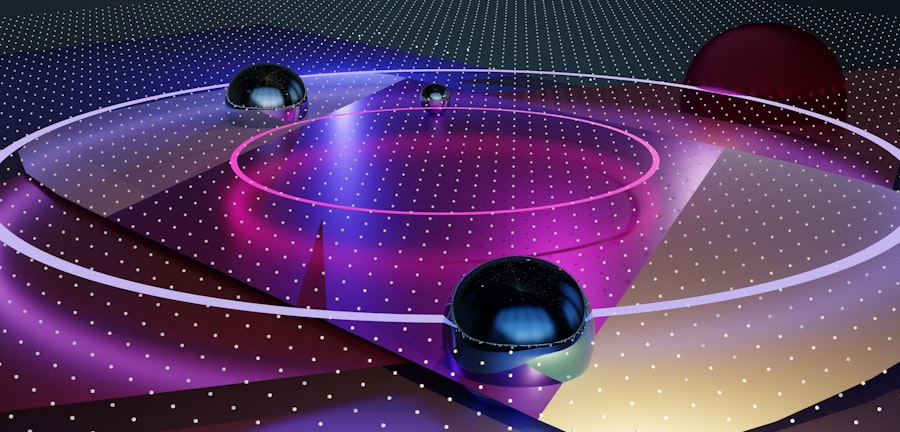
Quantum superposition is a fundamental principle that allows particles to exist in multiple states simultaneously until measured or observed. This concept is famously illustrated by Schrödinger’s cat thought experiment, where a cat in a sealed box is simultaneously alive and dead until someone opens the box to observe its state. Superposition challenges classical intuitions about reality by suggesting that systems can exist in multiple configurations at once, leading to a rich tapestry of possibilities.
The implications of superposition extend beyond philosophical musings; they are integral to emerging technologies such as quantum computing. In a quantum computer, qubits can exist in superposition states, allowing for parallel processing and vastly increased computational power compared to classical bits. This capability has the potential to revolutionize fields ranging from cryptography to drug discovery.
Quantum Teleportation
Quantum teleportation is a fascinating process that allows for the transfer of quantum information from one location to another without physically moving the particle itself. This phenomenon relies on entanglement and superposition, enabling the instantaneous transfer of information between entangled particles over arbitrary distances. While it may sound like science fiction, quantum teleportation has been experimentally demonstrated with photons and atoms in laboratory settings.
The potential applications of quantum teleportation are vast and varied. In secure communication systems, it could enable instantaneous data transfer without risk of interception due to its reliance on entangled states. Additionally, it holds promise for advancements in quantum computing networks, where information could be transmitted seamlessly between qubits across different locations.
Quantum Computing
Quantum computing represents a paradigm shift in computational capabilities, leveraging the principles of quantum mechanics to perform calculations at unprecedented speeds. Unlike classical computers that rely on bits as binary units of information (0s and 1s), quantum computers utilize qubits that can exist in superposition states. This allows them to process vast amounts of data simultaneously, making them particularly suited for complex problems such as optimization tasks and simulations of quantum systems.
The potential impact of quantum computing on various industries is immense. Fields such as cryptography stand to be transformed as quantum computers could break traditional encryption methods with ease. Additionally, drug discovery could be accelerated through simulations that model molecular interactions at a quantum level.
As researchers continue to develop more stable qubits and scalable architectures for quantum computers, they pave the way for a future where computational limitations are redefined.
The Many-Worlds Interpretation
The Many-Worlds Interpretation (MWI) offers a radical perspective on quantum mechanics by positing that all possible outcomes of a quantum event actually occur in separate, branching universes. According to this interpretation, every time a measurement is made, reality splits into multiple branches where each possible outcome is realized. This view challenges traditional notions of probability and determinism by suggesting that every decision or event creates a multitude of parallel realities.
While MWI remains a topic of debate among physicists and philosophers alike, it provides intriguing insights into the nature of reality and consciousness. It raises questions about free will and the nature of existence itself—if every possible outcome exists in some universe, what does it mean for individual choices? As researchers explore the implications of MWI further, they delve into philosophical inquiries about identity and existence while grappling with its scientific ramifications.
Applications of Quantum Physics
The applications of quantum physics are vast and varied, permeating numerous fields beyond theoretical research. In telecommunications, quantum cryptography offers secure communication channels based on principles such as entanglement and superposition. These systems promise unparalleled security against eavesdropping due to their reliance on fundamental laws of physics rather than mathematical algorithms alone.
In medicine, quantum imaging techniques are being developed to enhance diagnostic capabilities through improved imaging resolution at molecular levels. Additionally, advancements in materials science driven by quantum principles have led to innovations such as superconductors and advanced nanomaterials with unique properties. As researchers continue to explore new applications for quantum physics across diverse domains, they unlock transformative technologies that have the potential to reshape industries.
The Future of Quantum Physics
The future of quantum physics holds immense promise as researchers continue to unravel its complexities and explore new frontiers. With advancements in experimental techniques and theoretical frameworks, scientists are poised to make groundbreaking discoveries that could redefine our understanding of reality itself. The ongoing development of quantum technologies—ranging from computing to communication—suggests that society stands on the brink of a technological revolution driven by quantum principles.
As interdisciplinary collaboration flourishes between physicists, engineers, computer scientists, and philosophers, new insights emerge that challenge existing paradigms while inspiring innovative solutions to pressing global challenges. The journey into the quantum realm is far from over; it is an evolving narrative filled with possibilities waiting to be explored. As humanity ventures deeper into this enigmatic domain, it may ultimately lead to profound revelations about existence itself—transforming not only technology but also our understanding of life and reality as we know it.
Quantum physics is filled with mind-blowing facts that challenge our understanding of reality, and one fascinating article that delves into these concepts can be found on My Cosmic Ventures. This article explores the peculiarities of quantum entanglement and the implications it has for our perception of time and space. To read more about these astonishing phenomena, check out the article [here](https://www.mycosmicventures.com/).
WATCH THIS! The Universe Doesn’t Exist (And Science Proves It)
FAQs
What is quantum physics?
Quantum physics is the branch of physics that deals with the behavior of particles at the atomic and subatomic levels. It seeks to understand the fundamental nature of energy and matter.
What are some mind-blowing facts about quantum physics?
– Quantum particles can exist in multiple states at the same time, a phenomenon known as superposition.
– Quantum entanglement allows particles to become interconnected in such a way that the state of one particle can instantly affect the state of another, regardless of the distance between them.
– Quantum tunneling allows particles to pass through barriers that would be impossible according to classical physics.
– Quantum mechanics predicts that particles can behave as both particles and waves, a concept known as wave-particle duality.
How does quantum physics challenge our understanding of reality?
Quantum physics challenges our classical understanding of reality by introducing concepts such as superposition, entanglement, and wave-particle duality, which defy our everyday experiences and intuition. These concepts have profound implications for our understanding of the nature of the universe.
What are some practical applications of quantum physics?
Quantum physics has led to the development of technologies such as quantum computing, quantum cryptography, and quantum sensors. These technologies have the potential to revolutionize fields such as computing, communication, and sensing by harnessing the unique properties of quantum particles.