So, you’ve heard the whispers, the tantalizing hints of a theory that might just be the ultimate key to understanding everything. You’ve encountered the enigmatic phrase “string theory” and felt a prickle of curiosity, perhaps mixed with a healthy dose of intimidation. Fear not! You’re about to embark on a journey into the mind-bending world of fundamental physics, and we’re going to break it down, making it as accessible as possible. Forget the intimidating equations and the abstract jargon for a moment. Imagine you’re holding a single thread, a vibrant, impossibly thin thread that, when you pull it just right, reveals the very fabric of reality. That, in essence, is where we’re starting.
The Quest for a Unified Theory
For centuries, physicists have been driven by an insatiable desire to understand the fundamental building blocks of the universe and the rules that govern their interactions. This quest has led to two towering pillars of modern physics: General Relativity and Quantum Mechanics.
General Relativity: The Grand Architect of Spacetime
Albert Einstein’s General Relativity is a masterpiece. It describes gravity not as a force, but as a curvature or warping of spacetime caused by mass and energy. Think of spacetime as a vast, invisible trampoline. When you place a bowling ball (a star) on it, it creates a dip. If you then roll a marble (a planet) nearby, it will follow the curve, appearing to be pulled towards the bowling ball. This elegant geometric description of gravity has been incredibly successful, explaining everything from the orbit of planets to the bending of light around massive objects. It’s your go-to theory for the large-scale universe – the cosmos, galaxies, and black holes.
Quantum Mechanics: The Tiny World’s Unpredictable Dancer
On the other end of the spectrum, you have Quantum Mechanics. This is the realm of the incredibly small – atoms, subatomic particles like electrons and quarks. Here, the rules change dramatically. Particles don’t behave like predictable billiard balls; they exist in probabilities, can be in multiple places at once, and interact in ways that defy classical intuition. Quantum mechanics is the driving force behind lasers, transistors, and much of the technology that shapes your daily life. It’s incredibly accurate for describing the subatomic world, from the behavior of individual atoms to the interactions of elementary particles.
The Great Divide: A Cosmic Disconnect
The problem arises when you try to reconcile these two incredibly powerful theories. They work beautifully in their own domains, but when you attempt to apply them to extreme situations where both gravity and quantum effects are significant – like the heart of a black hole or the very first moments of the Big Bang – they break down. The equations become nonsensical, spitting out infinities and contradictions. It’s like trying to use a microscope to study constellations, or a telescope to examine a single cell. You have two incredibly precise tools, but they are designed for fundamentally different scales and phenomena. This disconnect is one of the biggest unsolved mysteries in physics, a gaping chasm that physicists have been trying to bridge for decades.
If you’re looking for a straightforward explanation of string theory, you might find the article on My Cosmic Ventures particularly helpful. It breaks down complex concepts into easily digestible pieces, making it accessible for readers without a deep background in physics. To explore this engaging resource, check out the article here: String Theory Explained Simply.
Enter String Theory: The Vibrating Threads of Reality
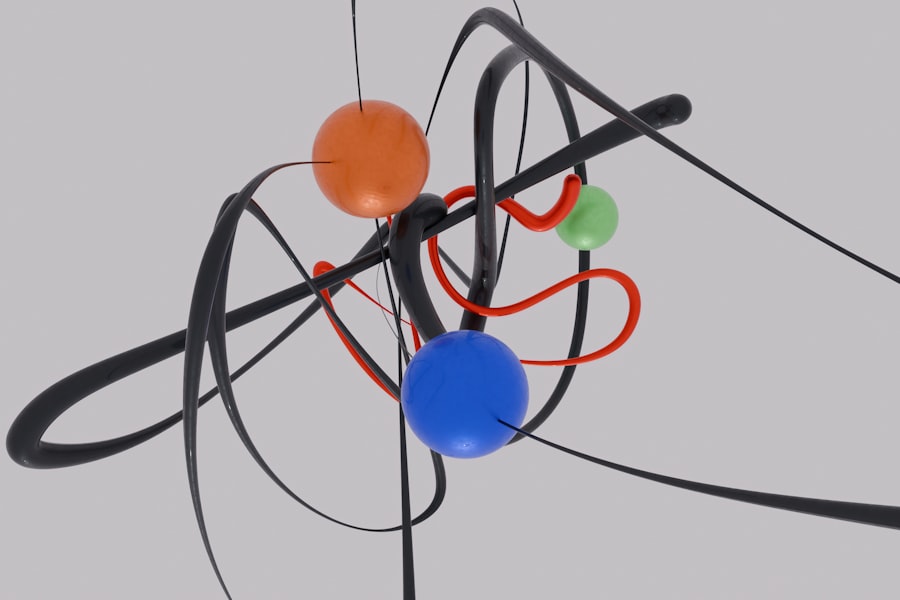
This is where string theory swoops in, not with a new set of rules, but with a radical new perspective on what those fundamental building blocks are. Instead of thinking of elementary particles as point-like dots with no size, string theory proposes that they are actually tiny, one-dimensional strings.
The Fundamental Fuzzball: Beyond Point Particles
Imagine the electron, a fundamental particle we know well. In the standard model of particle physics, we treat it as a dimensionless point. String theory suggests that this “point” is actually a vibrating loop or segment of a string. The way this string vibrates determines its properties, such as its mass and charge.
Different Vibrations, Different Particles
Think of a guitar string. When you pluck it, it can vibrate in different ways, producing different musical notes. Similarly, in string theory, different vibrational patterns of these fundamental strings correspond to different elementary particles. One vibration might manifest as an electron, another as a photon (a light particle), and yet another as a quark. It’s a beautiful and elegant idea: all the diverse particles that make up our universe are simply different “notes” played by these fundamental strings. This offers the tantalizing prospect of unifying all the known particles and forces under a single, coherent framework.
All Forces, One Harmony
The real magic of string theory is its potential to unify all fundamental forces. We know of four fundamental forces in nature:
- Gravity: The force that holds planets in orbit and makes apples fall.
- Electromagnetism: The force behind light, electricity, and magnetism.
- The Strong Nuclear Force: The force that binds protons and neutrons together in atomic nuclei.
- The Weak Nuclear Force: The force responsible for radioactive decay.
The Standard Model of particle physics successfully describes electromagnetism, the strong nuclear force, and the weak nuclear force. However, gravity, as described by General Relativity, has always been a stubborn outlier. Attempts to incorporate gravity into the quantum framework have proven incredibly difficult. String theory offers a way to naturally include gravity. In fact, one of the vibrational modes of a string in certain versions of string theory is the graviton, the hypothetical quantum particle that mediates the force of gravity. This is a monumental achievement, suggesting that gravity might not be separate from the other forces at all, but rather an emergent property of these vibrating strings.
The Need for Extra Dimensions: A Spooky Twist
Here’s where things get a bit weirder, and where your intuition might start to stretch. For string theory to work mathematically and consistently, it requires more dimensions than the three spatial dimensions (up/down, left/right, forward/backward) and one time dimension that we experience.
More Than Meets the Eye
Think about the dimensions we perceive. You can move forward and backward, left and right, up and down. Time is the fourth dimension we experience. String theory, however, requires a universe with 10 or even 11 dimensions.
Where Are They Hiding?
“But wait,” you might ask, “if there are all these extra dimensions, why don’t we see them?” This is a crucial question, and string theorists have come up with some ingenious explanations. The most popular idea is that these extra dimensions are compactified, meaning they are curled up into incredibly small, microscopic shapes.
The Microscopic Origami of Spacetime
Imagine a garden hose. From far away, it looks like a one-dimensional line. But if you get very close and look at its cross-section, you see it’s actually a two-dimensional surface, a circle. The extra dimensions in string theory are thought to be curled up in a similar way, but on a scale so infinitesimally small – far, far smaller than an atom – that we cannot perceive them directly with our current observational tools.
The Shape Matters
The way these extra dimensions are compactified is not arbitrary. The specific geometry and shape of these curled-up dimensions are believed to determine the physical laws and the types of particles that exist in our observable universe. Different compactifications could lead to vastly different universes with different fundamental constants and particle spectra. This is a fascinating implication: the universe we observe might be just one of many possibilities, determined by the “folding” of these extra dimensions.
Different Flavors of String Theory: A Family Affair
As string theory evolved, physicists discovered that it wasn’t just one monolithic theory, but rather a family of related theories, all pointing towards a unified understanding.
Early Models: Building Blocks of the Idea
In the early days, there were several distinct string theories. These theories often had specific requirements, such as working with particular numbers of dimensions or only describing certain types of particles. These were important steps, but they didn’t quite capture the full picture.
The Breakthrough: M-Theory and the Underlying Unity
The major breakthrough came with the realization that these seemingly different string theories were actually different aspects or limits of a deeper, more fundamental theory, often referred to as M-theory. This unification happened in the mid-1990s, often called the “second superstring revolution.” M-theory is believed to operate in 11 dimensions and incorporates objects called branes (short for membranes) in addition to strings.
Strings and Branes: Interconnected Entities
Strings can be open (with two ends) or closed (forming a loop). Branes are higher-dimensional objects. For example, a 0-brane is a point, a 1-brane is a string, a 2-brane is a surface, and so on. In M-theory, strings can be thought of as a special type of 1-brane. The interactions between strings and branes, and the ways they can move and vibrate, are all described by M-theory. This has dramatically simplified the landscape and pointed towards a grander, overarching framework.
String theory is a fascinating concept in theoretical physics that attempts to reconcile quantum mechanics and general relativity by proposing that the fundamental building blocks of the universe are not point particles but rather tiny, vibrating strings. For those looking to understand this complex topic in a more accessible way, you might find the article on string theory explained simply particularly helpful. It breaks down the essential ideas and implications of the theory in an engaging manner. You can read more about it here.
The Promise of String Theory: Why It Matters
Despite its abstract nature and the lack of direct experimental evidence so far, string theory continues to captivate physicists for several compelling reasons.
The Holy Grail: A Theory of Everything
The ultimate goal of physics is to find a “Theory of Everything” – a single, consistent framework that can describe all fundamental forces and particles in the universe, from the smallest subatomic particle to the vastest cosmological structures. String theory is the leading candidate for such a theory. It offers the elegant possibility of unifying gravity with quantum mechanics, the two pillars of modern physics that have stubbornly refused to be reconciled.
Insights into Black Holes and Cosmology
String theory has also provided profound insights into some of the most mysterious objects in the universe. It has offered new ways to understand the thermodynamics of black holes, a long-standing puzzle. By studying black holes within the framework of string theory, physicists have found remarkable connections between gravity and quantum field theory, suggesting a deep underlying unity. Furthermore, it offers potential explanations for the very beginning of the universe, the Big Bang, and the nature of dark matter and dark energy – the enigmatic components that make up the vast majority of the cosmos.
A Playground for Mathematical Innovation
Beyond its direct physical implications, string theory has also been a incredibly fertile ground for mathematical innovation. The pursuit of understanding string theory has led to the development of entirely new areas of mathematics and has deepened our understanding of existing ones. This cross-pollination between physics and mathematics is a testament to the profound and far-reaching implications of this ambitious theory.
The Challenges and the Future: Looking Ahead
Despite its breathtaking potential, string theory faces significant challenges that prevent it from being a fully established and experimentally verified theory.
The Elusive Experimental Evidence
The biggest hurdle is the lack of direct experimental evidence. The energy scales at which stringy effects are predicted to become significant are incredibly high, far beyond the reach of current particle accelerators like the Large Hadron Collider. This means that directly testing the predictions of string theory is exceedingly difficult. Physicists are actively searching for indirect experimental signatures or observable consequences that could provide support for the theory.
The Landscape Problem
Another significant challenge is what physicists call the “landscape problem.” Because the way extra dimensions are compactified can take on a vast number of different forms, string theory appears to predict an enormous number of possible universes, each with different physical laws and constants. This raises the question: why do we live in this particular universe, with its specific laws and constants? Finding a way to explain this fine-tuning or to select the correct vacuum from this vast landscape remains a major area of research.
The Path Forward: Continued Exploration
The journey into string theory is far from over. It remains an active and vibrant area of research, with scientists around the globe tirelessly working to refine its mathematical framework, explore its implications, and search for observable consequences. While a complete and experimentally verified understanding may still be a long way off, the questions that string theory provokes and the insights it offers are transforming our understanding of the universe and pushing the boundaries of human knowledge. You’re witnessing the cutting edge of human curiosity, the relentless pursuit of the grandest answers. And at its heart, it all begins with a single, vibrating thread.

Physicists Think Reality Might Be 2D
FAQs
What is string theory?
String theory is a theoretical framework in which the point-like particles of particle physics are replaced by one-dimensional objects called strings. These strings can vibrate at different frequencies, giving rise to different particles.
What is the goal of string theory?
The goal of string theory is to provide a unified description of the fundamental forces of nature, including gravity, electromagnetism, and the strong and weak nuclear forces. It aims to reconcile general relativity and quantum mechanics.
How does string theory differ from traditional particle physics?
In traditional particle physics, particles are considered to be point-like objects with no internal structure. In string theory, particles are replaced by strings, which can vibrate in different ways to produce the various particles observed in nature.
What are the implications of string theory?
If string theory is correct, it would provide a unified framework for understanding the fundamental forces of nature and could potentially lead to a theory of everything. It could also have implications for our understanding of the early universe and the nature of space and time.
Is string theory widely accepted in the scientific community?
String theory has generated a great deal of interest and research within the theoretical physics community, but it remains a highly speculative and controversial theory. It has not yet been confirmed by experimental evidence, and some physicists are skeptical of its ability to provide a complete description of the universe.