You stand at the precipice of understanding the universe at its most fundamental level, where the seemingly disparate realms of quantum mechanics and general relativity collide. For decades, these two pillars of modern physics, so profoundly successful in their respective domains, have resisted unification. Quantum mechanics, dealing with the infinitesimally small, describes the probabilistic dance of particles and forces. General relativity, on the other hand, paints a picture of a smooth, continuous spacetime, warped by mass and energy. Yet, when you probe the extreme conditions of black holes or the nascent moments of the universe, these two descriptions become irreconcilable. This is where quantum information theory, a burgeoning field focused on the nature of information at the quantum level, steps onto the stage, offering a tantalizing path to bridging this seemingly insurmountable gap.
You’ve likely encountered the concept of quantum entanglement, the mind-bending phenomenon where particles become linked in such a way that their fates are intertwined, regardless of the distance separating them. Quantum information theory doesn’t just acknowledge this strangeness; it actively leverages it. Imagine information not as static bits of 0s and 1s, but as quantum bits, or qubits, which can exist in a superposition of both states simultaneously, and more importantly, can be entangled. This entanglement is the bedrock upon which much of our exploration into quantum gravity rests.
Superposition and the Illusion of Classical Bits
Think about a classical computer bit. It’s either a 0 or a 1. There’s no in-between. Now, consider a qubit. It can be 0, 1, or a combination of both. This “superposition” means a single qubit can hold far more potential information than a classical bit. In the context of quantum gravity, this ability to represent multiple states simultaneously is crucial for describing the fuzzy, indeterminate nature of spacetime at its most fundamental scales. You can’t pinpoint a precise location or momentum for a quantum gravitational field in the same way you can for a classical object.
Entanglement: The Non-Local Connection
Entanglement is arguably the most counter-intuitive aspect of quantum mechanics. When two qubits are entangled, measuring the state of one instantaneously influences the state of the other, no matter how far apart they are. This “spooky action at a distance,” as Einstein famously called it, suggests a deeper, non-local connection in reality. In the quest for quantum gravity, this non-locality is a prime candidate for explaining how disparate parts of spacetime might be fundamentally interwoven.
Quantum Gates and Information Processing
Just as classical computers use logic gates to manipulate bits, quantum computers use quantum gates to manipulate qubits. These gates perform operations that exploit superposition and entanglement. Understanding how these quantum operations affect information is vital when considering how gravitational interactions might be processed at the quantum level. Are there “gravitational gates” that link quantum degrees of freedom in spacetime?
Recent advancements in the field of quantum information and gravity have sparked significant interest among physicists, particularly regarding the implications for our understanding of black holes and the nature of spacetime. A related article that delves deeper into these concepts can be found at My Cosmic Ventures, where researchers explore how quantum entanglement may provide insights into the fundamental structure of the universe and the interplay between quantum mechanics and general relativity.
The Spacetime Fabric: A Quantum Perspective
General relativity describes spacetime as a smooth, continuous manifold. But at the Planck scale (approximately 10^-35 meters), the realm where quantum effects are expected to dominate gravity, this smooth picture likely breaks down. Here, quantum information theory suggests that spacetime itself might be emergent, built from fundamental quantum constituents.
The Discreteness of Spacetime
Imagine zooming in on a digital image. At a certain magnification, you see individual pixels. Could spacetime be similar, composed of discrete “quantum units” rather than a smooth continuum? Quantum information might provide the framework to describe these fundamental building blocks and how they interact to create the illusion of continuous spacetime. This discreteness is often theorized to be a consequence of quantum gravitational effects.
Holographic Principle: Information Encoded on a Boundary
One of the most profound insights connecting quantum information and gravity comes from the holographic principle. This idea, born from studies of black holes, suggests that the information content of a volume of spacetime can be fully described by information encoded on its boundary. This is akin to a 3D object being represented by a 2D hologram. This principle is deeply rooted in quantum entanglement and has significant implications for how we think about gravity.
Black Holes: Laboratories of Quantum Gravity
Black holes are the ultimate testbeds for quantum gravity. Their singularities, points of infinite density, represent a breakdown of classical physics. The information paradox, concerning whether information falling into a black hole is truly lost (violating a tenet of quantum mechanics), is a central puzzle. Quantum information theory offers tools to analyze how information might be preserved, perhaps encoded in Hawking radiation, the faint thermal radiation emitted by black holes.
Entanglement Entropy as a Measure of Spacetime Geometry
Entanglement entropy, a measure of how much entanglement exists between different parts of a quantum system, has emerged as a critical tool. Studies have shown a remarkable connection between entanglement entropy and the area of surfaces in spacetime, echoing the Bekenstein-Hawking formula that relates black hole entropy to their surface area. This suggests that geometric properties of spacetime might be directly related to the quantum entanglement of its underlying constituents.
Quantum Gravity Theories: Where Information Plays a Role
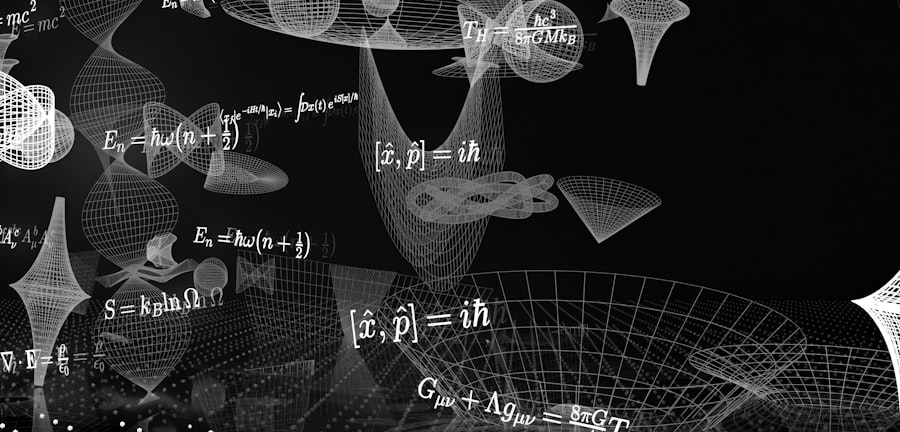
Several theoretical frameworks are vying to describe quantum gravity. Quantum information provides a powerful lens through which to scrutinize and develop these theories.
Loop Quantum Gravity: Quantizing Spacetime Itself
Loop Quantum Gravity (LQG) is a major candidate theory that attempts to quantize spacetime directly. It envisions spacetime as a network of interwoven loops, with the fundamental excitations being “quanta” of area and volume. Quantum information concepts are employed to understand how these loops entangle and form the macroscopic spacetime we observe.
String Theory: Vibrating Strings and Extra Dimensions
String theory proposes that fundamental particles are not point-like but rather one-dimensional vibrating strings. These strings exist in higher dimensions. While diverse, string theory also grapples with the emergence of spacetime and the role of quantum entanglement in its structure. The AdS/CFT correspondence, a duality within string theory, explicitly links a gravitational theory in Anti-de Sitter space to a quantum field theory on its boundary, heavily relying on quantum information concepts.
Causal Set Theory: A Discrete, Relational Spacetime
Causal Set Theory postulates that spacetime is fundamentally discrete and that the causal relationships between these discrete points are primary. Quantum information can be used to model the growth and evolution of these causal sets, potentially revealing emergent spacetime geometries.
Emergent Gravity: Gravity as a Collective Phenomenon
Some theories suggest that gravity isn’t a fundamental force but rather an emergent property arising from the collective behavior of more fundamental, quantum degrees of freedom. Quantum information, particularly entanglement, is a prime candidate for the “glue” that binds these degrees of freedom together to manifest as gravity.
The Information Paradox and Black Hole Evaporation
The information paradox associated with black holes poses a serious challenge to our understanding of physics. According to general relativity, anything falling into a black hole is lost forever behind its event horizon. However, quantum mechanics dictates that information cannot be destroyed.
Hawking Radiation: A Quantum Revelation
Stephen Hawking’s groundbreaking work showed that black holes aren’t entirely black; they emit thermal radiation, now known as Hawking radiation. This radiation, though seemingly random, carries information about the matter that fell into the black hole. The challenge lies in understanding how this information is encoded in the radiation.
Quantum Error Correction and Information Retrieval
Quantum information theory has developed sophisticated techniques for quantum error correction, which allow for the detection and correction of errors in quantum computations. These same principles might be at play in black hole evaporation, providing a mechanism for information to be preserved and eventually re-emitted.
The Fuzzball Proposal: A Smooth Boundary
Some theoretical models, like the “fuzzball” proposal within string theory, suggest that black holes are not singular points but rather complex, quantum objects with no true event horizon. Instead, they have a “fuzzy” boundary, which allows information to be accessed and preserved. Quantum information plays a crucial role in describing the intricate quantum states that constitute these fuzzballs.
Recent advancements in the intersection of quantum information and gravity have sparked significant interest among physicists. One particularly intriguing article discusses how quantum entanglement may provide insights into the nature of black holes and the fabric of spacetime. For those interested in exploring this topic further, you can read more about it in this insightful piece on quantum gravity. The implications of these findings could reshape our understanding of the universe, making it a fascinating area of study. You can find the article here: quantum gravity.
Quantum Information as the Language of Gravity
| Topic | Metrics |
|---|---|
| Quantum Entanglement | Entanglement entropy, Bell inequality violation |
| Quantum Gravity | Black hole entropy, Hawking radiation |
| Quantum Information Theory | Quantum error correction, Quantum cryptography |
| Quantum Computing | Qubits, Quantum gates, Quantum algorithms |
The growing realization is that quantum information isn’t just a tool for studying quantum gravity; it might be the very language in which gravity is written at its most fundamental level. The relationships and dynamics of quantum information might dictate the curvature of spacetime and the very fabric of reality.
Entanglement as the Glue of Spacetime
If spacetime is emergent, then what holds it together? Increasingly, physicists are looking to quantum entanglement. The interconnectedness of quantum degrees of freedom, mediated by entanglement, could be the fundamental mechanism responsible for knitting spacetime into the smooth continuum we perceive.
Correlations Beyond Classical Understanding
Quantum information allows for correlations that go far beyond anything seen in classical physics. These deeper, non-local correlations could be the key to understanding how gravitational forces arise from the quantum realm.
Towards a Unified Theory: The Role of Quantum Information
The ultimate goal is a theory of quantum gravity that seamlessly unifies general relativity and quantum mechanics. Quantum information theory offers promising avenues to achieve this by providing a consistent framework for understanding the quantum nature of spacetime and the fundamental interactions within it. Your journey into this field is a journey into the very heart of reality.

Physicists Think Reality Might Be 2D
FAQs
What is quantum information and gravity?
Quantum information and gravity is a field of study that explores the relationship between quantum mechanics and the theory of general relativity. It seeks to understand how information behaves in the presence of strong gravitational fields and how gravity may be described in terms of quantum information.
What are the main challenges in understanding the relationship between quantum information and gravity?
One of the main challenges is reconciling the principles of quantum mechanics with those of general relativity, as these two theories have different frameworks and mathematical descriptions. Another challenge is understanding the behavior of information in extreme gravitational environments, such as black holes.
How does quantum information relate to black holes?
Quantum information theory has been used to study the behavior of information in the context of black holes. This has led to the development of concepts such as black hole entropy, the holographic principle, and the idea that information may be encoded on the surface of a black hole.
What are some potential applications of understanding the relationship between quantum information and gravity?
Understanding this relationship could have implications for the development of quantum technologies, such as quantum computing and quantum communication. It may also provide insights into the fundamental nature of spacetime and the information content of the universe.
What are some current areas of research in quantum information and gravity?
Current research in this field includes studying the information paradox of black holes, exploring the connections between quantum entanglement and spacetime geometry, and investigating the role of quantum information in the emergence of spacetime from a more fundamental theory.