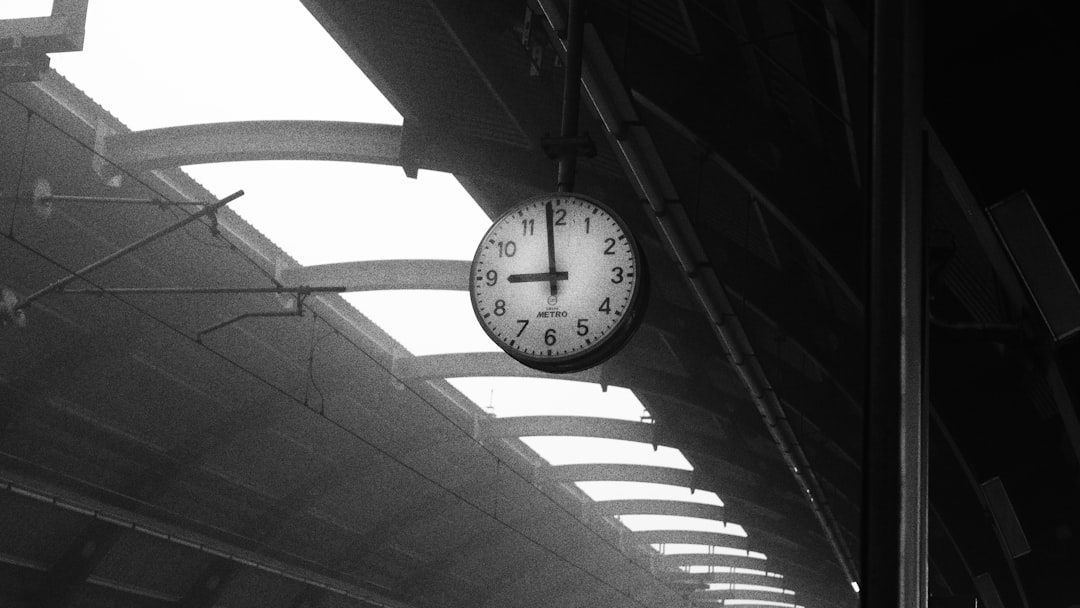
The Copenhagen Interpretation, one of the most widely accepted frameworks for understanding quantum mechanics, offers a unique perspective on the nature of time. Developed in the early 20th century by physicists such as Niels Bohr and Werner Heisenberg, this interpretation emphasizes the role of measurement and observation in determining the state of a quantum system. In this context, time is not merely a linear progression of events but is intricately linked to the act of observation itself.
The Copenhagen Interpretation posits that until a measurement is made, particles exist in a superposition of states, and it is only through observation that these states collapse into a definite outcome. This interpretation raises profound questions about the nature of reality and the role of time within it. Unlike classical physics, where time is an absolute and continuous entity, the Copenhagen Interpretation suggests that time may be more fluid and dependent on the observer’s interaction with the quantum world.
This perspective invites a deeper exploration into how time is perceived and understood within the framework of quantum mechanics, challenging traditional notions and opening up new avenues for inquiry.
Key Takeaways
- The Copenhagen Interpretation of Time proposes that time is a probabilistic concept in quantum physics.
- Quantum mechanics suggests that time is not absolute, but rather a constructed reality influenced by observers.
- The Uncertainty Principle in quantum mechanics has a significant impact on our understanding of time.
- Time and entanglement in quantum systems are closely linked, challenging traditional notions of time.
- The Measurement Problem in quantum theory raises important implications for our understanding of time and reality.
The Quantum Perspective on Time
In quantum mechanics, time is often treated differently than in classical physics. While classical physics views time as a constant backdrop against which events unfold, quantum mechanics introduces a more complex relationship between time and the behavior of particles. In this realm, time can be seen as a parameter that influences the evolution of quantum states, yet it does not possess the same absolute quality that it does in classical theories.
Instead, time becomes intertwined with the probabilistic nature of quantum events, leading to a more nuanced understanding of its role. The quantum perspective on time also raises intriguing questions about causality and the sequence of events. In classical physics, cause precedes effect in a linear fashion; however, in the quantum realm, this relationship can become blurred.
Events may not follow a straightforward timeline, as particles can exist in multiple states simultaneously until observed. This challenges the conventional understanding of temporal order and suggests that time may not be as rigidly structured as previously thought.
Understanding Time in Quantum Mechanics

To grasp the concept of time in quantum mechanics, one must consider how it interacts with fundamental principles such as superposition and entanglement. In quantum systems, particles can exist in a superposition of states, meaning they can simultaneously occupy multiple positions or possess various properties until measured. This phenomenon complicates the notion of time, as it implies that events do not unfold in a singular, predetermined manner.
Instead, time becomes a variable that is influenced by the act of measurement itself. Moreover, entanglement further complicates the understanding of time in quantum mechanics. When two particles become entangled, their states become interdependent regardless of the distance separating them.
This interconnectedness raises questions about how time operates in such scenarios. If one particle is measured and its state is determined, the other particle’s state is instantaneously affected, seemingly defying the conventional flow of time. This phenomenon challenges traditional notions of temporal separation and suggests that time may be more interconnected with quantum states than previously understood.
The Role of Observers in the Copenhagen Interpretation
| Aspect | Details |
|---|---|
| Key Concept | The role of observers in the Copenhagen Interpretation of quantum mechanics |
| Explanation | In the Copenhagen Interpretation, the act of measurement or observation is considered to collapse the wave function, determining the state of a quantum system. |
| Debate | There is ongoing debate about the role of consciousness in the act of observation and whether it is necessary for the collapse of the wave function. |
| Implications | The role of observers has significant implications for our understanding of the nature of reality at the quantum level. |
In the Copenhagen Interpretation, observers play a crucial role in shaping the reality of quantum systems. The act of observation is not merely passive; it actively influences the outcome of measurements and determines the state of particles. This perspective posits that reality does not exist independently of observation; rather, it is contingent upon the interaction between observers and quantum systems.
As such, time becomes intricately linked to these interactions. The implications of this observer-dependent reality extend to how time is perceived within quantum mechanics. Since measurements collapse superpositions into definite states, the timing of these observations becomes significant.
The observer’s choice to measure at a particular moment can alter the trajectory of events within a quantum system. This interplay between observation and time raises philosophical questions about free will and determinism, suggesting that the act of observing may influence not only what is observed but also when it occurs.
Time as a Probabilistic Concept in Quantum Physics
In quantum physics, time is often viewed through a probabilistic lens rather than as a deterministic continuum. The uncertainty inherent in quantum systems means that predicting specific outcomes becomes a matter of probabilities rather than certainties. This probabilistic nature extends to temporal measurements as well; rather than pinpointing exact moments in time, physicists often work with statistical distributions that describe likely outcomes over intervals.
This approach to time challenges traditional notions of predictability and control. In classical physics, one could calculate future events with precision based on initial conditions; however, in quantum mechanics, uncertainty reigns supreme. The probabilistic interpretation suggests that time itself may be subject to inherent unpredictability, leading to a more complex understanding of how events unfold within the quantum realm.
The Uncertainty Principle and its Impact on Time

The Uncertainty Principle, formulated by Werner Heisenberg, plays a pivotal role in shaping our understanding of time within quantum mechanics. This principle asserts that certain pairs of physical properties—such as position and momentum—cannot be simultaneously measured with arbitrary precision. The implications extend to time as well; for instance, measuring a particle’s energy with high precision results in an inherent uncertainty regarding its temporal position.
This relationship between uncertainty and time introduces a fundamental limit to what can be known about quantum systems. As physicists grapple with these limitations, they must reconsider how they approach temporal measurements and predictions. The Uncertainty Principle suggests that time cannot be treated as an absolute parameter but rather as an entity intertwined with the probabilistic nature of quantum phenomena.
Time and Entanglement in Quantum Systems
Entanglement presents another layer of complexity when examining time within quantum systems. When two particles become entangled, their states are linked regardless of the distance separating them. This phenomenon raises intriguing questions about how time operates in such scenarios.
If one particle is measured and its state determined, the other particle’s state is instantaneously affected—an occurrence that seems to defy conventional notions of temporal separation. The implications for time are profound; entangled particles challenge traditional ideas about causality and sequence. If information can be transmitted instantaneously between entangled particles, does this suggest that time may not function linearly?
The interconnectedness inherent in entangled systems invites further exploration into how time is perceived and understood within the framework of quantum mechanics.
Time as a Constructed Reality in Quantum Theory
Within the realm of quantum theory, some physicists propose that time itself may be a constructed reality rather than an objective feature of the universe. This perspective suggests that our understanding of time is shaped by human perception and interaction with quantum systems rather than existing independently as an absolute entity. In this view, time becomes a conceptual framework through which we interpret events rather than an intrinsic property of reality.
This constructed nature of time raises philosophical questions about its significance in our understanding of existence. If time is contingent upon observation and measurement, what does this imply for our perception of reality? The idea that time may be a product of human cognition challenges traditional notions and invites deeper inquiry into how individuals experience and understand temporal phenomena.
The Measurement Problem and its Implications for Time
The measurement problem lies at the heart of quantum mechanics and has significant implications for understanding time within this framework. It highlights the challenge of reconciling the behavior of quantum systems with classical observations. When a measurement occurs, superpositions collapse into definite states; however, this process raises questions about what constitutes a measurement and how it influences temporal dynamics.
As physicists grapple with these complexities, they must reconsider how measurements are defined and how they relate to temporal phenomena. This ongoing inquiry underscores the need for new perspectives on time that account for the intricacies inherent in quantum mechanics.
Time in the Many-Worlds Interpretation of Quantum Mechanics
The Many-Worlds Interpretation offers an alternative perspective on time within quantum mechanics by positing that all possible outcomes of a measurement actually occur in separate branches of reality. In this framework, every decision or measurement creates divergent timelines where each possibility unfolds simultaneously across parallel universes. This interpretation challenges conventional notions of linearity and causality by suggesting that all potential outcomes coexist.
In terms of time, this interpretation implies that every moment branches into multiple realities based on different choices or measurements made by observers. Rather than viewing time as a singular path leading to one outcome, the Many-Worlds Interpretation presents it as an expansive tapestry woven from countless possibilities. This perspective invites further exploration into how individuals perceive their own timelines within this multifaceted reality.
The Future of Time: Implications of the Copenhagen Interpretation
As physicists continue to explore the implications of the Copenhagen Interpretation on our understanding of time, new avenues for inquiry emerge. The interplay between observation, measurement, and temporal dynamics invites deeper philosophical reflections on existence itself. As researchers delve into these complexities, they may uncover novel insights into how individuals experience reality and perceive temporal phenomena.
By challenging traditional notions and embracing new perspectives rooted in quantum theory, scientists may pave the way for groundbreaking discoveries that redefine humanity’s relationship with time and reality itself. As this journey unfolds, it will undoubtedly inspire further inquiry into one of humanity’s most profound questions: What is the true nature of time?
The Copenhagen interpretation of quantum mechanics, which addresses the nature of time and observation, has been a topic of much debate and discussion among physicists and philosophers alike. For those interested in exploring this subject further, an insightful article can be found on My Cosmic Ventures. This article delves into the nuances of quantum theory and its implications on our understanding of time. You can read more about it by visiting this page.
WATCH THIS! Time Is An Illusion: Quantum Physics Proves It
FAQs
What is the Copenhagen interpretation of time?
The Copenhagen interpretation of time is a concept in quantum mechanics that was developed by Niels Bohr and Werner Heisenberg in the 1920s. It suggests that time is not an absolute concept, but rather a subjective experience that is influenced by the observer and the measurement process.
How does the Copenhagen interpretation of time differ from classical physics?
In classical physics, time is considered to be a universal and absolute concept that flows independently of any observer or measurement process. In contrast, the Copenhagen interpretation of time suggests that time is a subjective experience that is influenced by the observer and the act of measurement.
What are the implications of the Copenhagen interpretation of time?
The Copenhagen interpretation of time has profound implications for our understanding of reality and the nature of time. It suggests that the act of observation and measurement can fundamentally alter the experience of time, and that time may not be as fixed and objective as it appears in classical physics.
How does the Copenhagen interpretation of time relate to quantum mechanics?
The Copenhagen interpretation of time is closely related to the broader framework of quantum mechanics, which describes the behavior of particles at the atomic and subatomic level. In quantum mechanics, the act of measurement is believed to collapse the wave function of a particle, leading to the emergence of a specific outcome. This collapse of the wave function is also thought to influence the experience of time.
Are there alternative interpretations of time in quantum mechanics?
Yes, there are alternative interpretations of time in quantum mechanics, such as the many-worlds interpretation and the pilot-wave theory. These interpretations offer different perspectives on the nature of time and its relationship to the quantum world, and they continue to be the subject of ongoing debate and research within the field of physics.