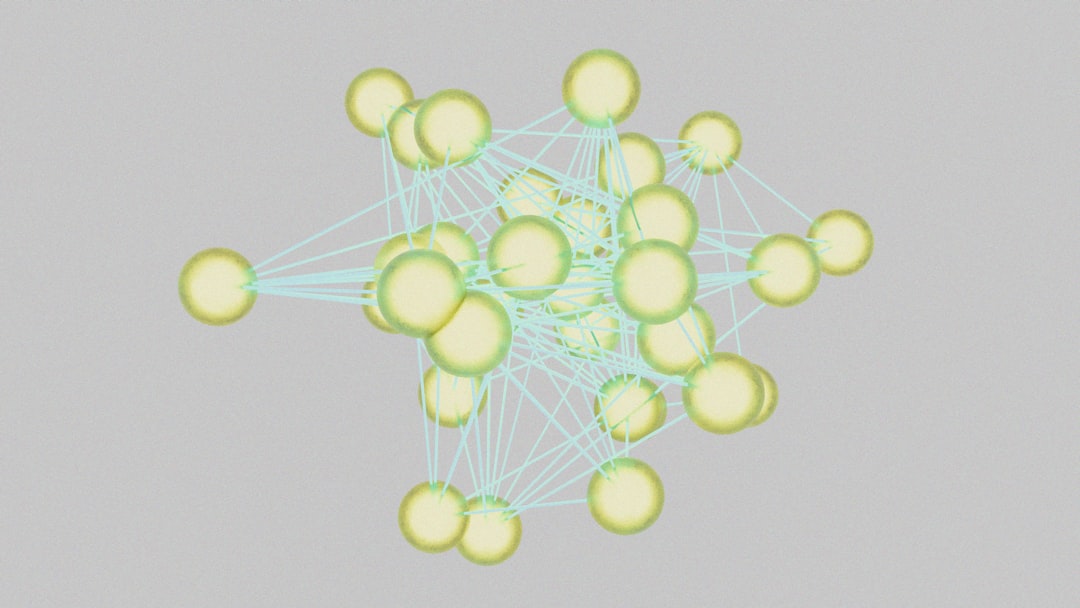
Tensor networks represent a powerful framework in the realm of quantum physics and computational science. At their core, tensor networks are mathematical structures that facilitate the representation of complex quantum states. They consist of interconnected tensors, which are multi-dimensional arrays of numbers that can encapsulate vast amounts of information about quantum systems.
The beauty of tensor networks lies in their ability to simplify the representation of quantum states, making it easier to perform calculations and analyze the properties of many-body systems. By breaking down complex quantum states into simpler components, researchers can gain insights into phenomena that would otherwise be computationally prohibitive. The concept of tensor networks has gained traction in recent years, particularly in the context of quantum many-body physics.
They provide a systematic way to encode the entanglement structure of quantum states, which is crucial for understanding the behavior of particles in a quantum system. Various types of tensor networks, such as Matrix Product States (MPS) and Projected Entangled Pair States (PEPS), have been developed to address different challenges in quantum computation and simulation. These networks not only serve as tools for theoretical exploration but also have practical implications in developing efficient algorithms for simulating quantum systems on classical computers.
Key Takeaways
- Tensor networks are a mathematical tool used to represent and manipulate high-dimensional data in a more efficient way.
- Quantum entanglement plays a crucial role in the structure and behavior of tensor networks, allowing for the representation of complex quantum states.
- Tensor networks have been used to study the connection between quantum information and the emergence of spacetime in the context of quantum gravity.
- Entropy and complexity measures in tensor networks provide insights into the organization and behavior of quantum systems.
- The holographic principle suggests that the information in a higher-dimensional space can be encoded on the boundary of that space, a concept that tensor networks help to explore in the context of quantum field theory and black hole physics.
The Role of Quantum Entanglement
Quantum entanglement is a fundamental phenomenon that underpins the behavior of particles at the quantum level. It describes a situation where two or more particles become interconnected in such a way that the state of one particle cannot be described independently of the state of the other(s), regardless of the distance separating them. This non-local correlation is a cornerstone of quantum mechanics and plays a pivotal role in the functioning of tensor networks.
In fact, tensor networks can be viewed as a graphical representation of entangled states, where the connections between tensors illustrate the intricate relationships between different parts of a quantum system. The significance of entanglement extends beyond mere theoretical interest; it has practical applications in quantum computing and information theory. For instance, entangled states are essential for quantum teleportation and superdense coding, both of which leverage the unique properties of entanglement to transmit information more efficiently than classical methods allow.
Tensor networks provide a framework for visualizing and manipulating these entangled states, enabling researchers to explore their implications in various contexts, from condensed matter physics to quantum gravity.
From Quantum Information to Spacetime
The relationship between quantum information and spacetime is an area of intense research and speculation. As physicists delve deeper into the nature of reality, they are increasingly considering the possibility that spacetime itself may emerge from underlying quantum processes. Tensor networks play a crucial role in this exploration by offering a mathematical language that bridges the gap between quantum information theory and geometric concepts.
By representing quantum states as networks of tensors, researchers can investigate how these structures might give rise to the fabric of spacetime. One intriguing aspect of this inquiry is the idea that entanglement could be a key ingredient in the emergence of spacetime. Some theorists propose that the geometric properties of spacetime may be encoded in the entanglement structure of quantum states represented by tensor networks.
This perspective suggests that spacetime is not merely a backdrop for physical events but is instead woven from the intricate patterns of entanglement among quantum particles.
Entropy and Complexity in Tensor Networks
| Metrics | Description |
|---|---|
| Von Neumann Entropy | Quantifies the amount of entanglement in a quantum state |
| Entanglement Entropy | Measures the amount of entanglement between different parts of a quantum system |
| Renormalization Group Entropy | Describes the entropy of a system under renormalization group transformations |
| Complexity | Quantifies the difficulty of simulating or describing a quantum state |
| Tensor Network Entropy | Entropy measures specifically tailored for tensor network states |
Entropy is a central concept in both thermodynamics and information theory, serving as a measure of disorder or uncertainty within a system. In the context of tensor networks, entropy plays a critical role in characterizing the complexity of quantum states. The entanglement entropy, in particular, quantifies how much information is shared between subsystems and provides insights into the structure and behavior of many-body systems.
By analyzing the entanglement entropy associated with different configurations of tensor networks, researchers can glean valuable information about phase transitions and critical phenomena. The complexity inherent in tensor networks also reflects the computational challenges associated with simulating quantum systems. As the number of particles increases, so does the complexity of their interactions, leading to an exponential growth in the amount of information required to describe the system accurately.
Tensor networks offer a way to manage this complexity by providing efficient algorithms for approximating quantum states while preserving essential features such as entanglement. This efficiency is particularly important for exploring large-scale quantum systems, where traditional methods may falter due to computational limitations.
The Holographic Principle
The holographic principle is a fascinating conjecture that suggests that all the information contained within a volume of space can be represented as a theory defined on its boundary. This idea has profound implications for our understanding of gravity and quantum mechanics, suggesting that spacetime itself may be an emergent phenomenon arising from more fundamental degrees of freedom. Tensor networks have emerged as a powerful tool for exploring this principle, providing a framework for visualizing how information might be encoded at the boundary while still capturing the dynamics within the bulk.
In this context, tensor networks can be seen as a bridge between holography and quantum information theory. They allow researchers to construct models that illustrate how bulk gravitational dynamics can be described in terms of boundary theories, thereby shedding light on the nature of black holes and other gravitational phenomena. By leveraging tensor networks, physicists can explore how entanglement and information flow across boundaries might give rise to the rich tapestry of spacetime we observe.
Tensor Networks and Quantum Field Theory
Quantum field theory (QFT) serves as one of the cornerstones of modern physics, providing a framework for understanding particle interactions and fundamental forces. Tensor networks have found significant applications within this domain, offering new perspectives on how to represent and compute quantum states in QFT. By employing tensor network techniques, researchers can tackle complex problems related to particle interactions, scattering processes, and vacuum states with greater efficiency than traditional methods allow.
One notable application is in the study of conformal field theories (CFTs), which are pivotal in understanding critical phenomena and phase transitions. Tensor networks enable physicists to construct efficient representations of CFTs, allowing them to explore their properties and symmetries more effectively. This approach not only enhances our understanding of QFT but also provides insights into broader questions regarding the nature of spacetime and its relationship with quantum mechanics.
Simulating Quantum Gravity with Tensor Networks
The quest to understand quantum gravity remains one of the most profound challenges in theoretical physics. Tensor networks offer a promising avenue for simulating gravitational phenomena at the quantum level, providing tools to model complex interactions between spacetime geometry and quantum fields. By representing gravitational degrees of freedom as tensors within a network, researchers can explore how these structures evolve over time and interact with matter.
One approach involves using tensor networks to study lattice models that approximate general relativity or other theories of gravity. These models allow physicists to investigate how spacetime might behave under various conditions, such as near black holes or during cosmic inflation. By leveraging tensor network techniques, researchers can gain insights into how classical gravitational behavior emerges from underlying quantum processes, potentially leading to breakthroughs in our understanding of fundamental physics.
Tensor Networks in Black Hole Physics
Black holes represent one of the most enigmatic aspects of modern physics, challenging our understanding of gravity, thermodynamics, and information theory. Tensor networks have emerged as valuable tools for exploring various aspects of black hole physics, particularly in relation to entanglement and information loss. The study of black holes through the lens of tensor networks allows researchers to investigate how entangled states behave near event horizons and what implications this has for our understanding of information preservation.
One significant area of research involves examining the so-called “black hole information paradox,” which questions whether information that falls into a black hole is lost forever or can be recovered in some form. Tensor networks provide a framework for modeling these scenarios by representing black hole states as interconnected tensors that capture their entanglement structure. Through this lens, physicists can explore potential resolutions to the paradox and gain insights into how black holes might encode information about their surroundings.
Tensor Networks and AdS/CFT Correspondence
The Anti-de Sitter/Conformal Field Theory (AdS/CFT) correspondence is a groundbreaking theoretical framework that posits a duality between gravitational theories in Anti-de Sitter space and conformal field theories defined on its boundary. Tensor networks have become instrumental in exploring this correspondence by providing visual representations that elucidate how bulk gravitational dynamics relate to boundary field theories. This duality has profound implications for our understanding of both gravity and quantum field theory.
By employing tensor network techniques within the context of AdS/CFT correspondence, researchers can investigate various aspects such as holographic entanglement entropy and correlation functions. These studies not only deepen our understanding of dualities but also shed light on broader questions regarding emergent phenomena in theoretical physics. The interplay between tensor networks and AdS/CFT continues to inspire new avenues for research, pushing the boundaries of knowledge in both gravitational physics and quantum field theory.
Tensor Networks and the Emergence of Geometry
The emergence of geometry from more fundamental principles is an area that has captivated physicists for decades. Tensor networks provide a unique perspective on this issue by illustrating how geometric structures might arise from entangled quantum states. As researchers explore how tensors can represent spatial relationships within quantum systems, they uncover potential pathways through which geometry could emerge from underlying quantum processes.
This exploration raises intriguing questions about the nature of spacetime itself. If geometry can indeed be derived from entanglement patterns encoded within tensor networks, it suggests that our conventional understanding of space may need reevaluation. Such insights could lead to new theories that unify gravity with quantum mechanics, offering fresh perspectives on longstanding puzzles within theoretical physics.
Applications of Tensor Networks in Cosmology
The applications of tensor networks extend beyond fundamental physics into cosmology, where they offer tools for modeling complex systems such as early universe dynamics and cosmic inflation. By representing cosmological models as tensor networks, researchers can simulate various scenarios related to structure formation, dark energy dynamics, and cosmic microwave background radiation with greater efficiency than traditional methods allow. One promising avenue involves using tensor networks to study non-equilibrium dynamics during cosmic inflation—a period when rapid expansion occurred shortly after the Big Bang.
By leveraging these techniques, cosmologists can gain insights into how fluctuations during inflation might have seeded the large-scale structure we observe today.
In conclusion, tensor networks represent a rich and versatile framework that bridges various domains within theoretical physics—from quantum mechanics to cosmology.
Their ability to encapsulate complex relationships among quantum states while providing insights into fundamental questions about spacetime makes them an invaluable tool for researchers seeking to understand the intricacies of our universe.
In recent years, the study of tensor networks has gained significant attention in the field of theoretical physics, particularly in understanding the concept of emergent spacetime. These networks provide a powerful framework for modeling complex quantum systems and have been instrumental in exploring the holographic principle, which suggests that our universe might be a projection from a lower-dimensional space. For those interested in delving deeper into this fascinating topic, a related article can be found on My Cosmic Ventures. This article explores the intricate connections between tensor networks and the fabric of spacetime, offering insights into how these mathematical structures could potentially reveal the underlying geometry of our universe. To read more, visit this article on My Cosmic Ventures.
WATCH THIS! Time Is An Illusion: Quantum Physics Proves It
FAQs
What are tensor networks?
Tensor networks are a mathematical tool used to represent and manipulate high-dimensional data, such as quantum states in physics or large datasets in machine learning. They are composed of interconnected tensors, which are multi-dimensional arrays of numbers.
How are tensor networks used in physics?
In physics, tensor networks are used to study quantum many-body systems, such as the behavior of particles in a material or the entanglement of quantum states. They provide a way to efficiently represent and analyze complex quantum systems.
What is emergent spacetime?
Emergent spacetime is a concept in theoretical physics where the geometry of spacetime and the laws of gravity are thought to emerge from the interactions of more fundamental building blocks, such as quantum particles or fields. This idea is often explored in the context of quantum gravity and the unification of quantum mechanics and general relativity.
How are tensor networks related to emergent spacetime?
Tensor networks have been used in theoretical physics to study the emergence of spacetime from more fundamental quantum degrees of freedom. By representing the quantum states and interactions in a system using tensor networks, researchers can explore how spacetime and gravity may emerge from underlying quantum entanglement and correlations.
What are some potential applications of tensor networks and emergent spacetime?
The study of tensor networks and emergent spacetime has potential applications in understanding the behavior of quantum systems, developing new approaches to quantum gravity, and exploring the connections between quantum mechanics and general relativity. These ideas may also have implications for quantum information processing and the development of new computational methods.