
The concept of time has long fascinated philosophers, scientists, and thinkers alike, serving as a fundamental aspect of human experience. However, the advent of quantum physics has introduced a radically different perspective on time, challenging traditional notions and inviting deeper inquiry into its nature. In the quantum realm, time is not merely a linear progression from past to future; rather, it emerges as a complex and multifaceted phenomenon that intertwines with the very fabric of reality.
This article aims to explore the quantum view of time, delving into its implications for our understanding of the universe and the philosophical questions it raises. As researchers continue to probe the mysteries of quantum mechanics, they uncover layers of complexity that suggest time may not be as straightforward as it appears. The quantum view of time invites a reevaluation of established paradigms, urging scholars to consider how time interacts with fundamental forces and particles.
By examining the nuances of time within quantum physics, one can begin to appreciate its role in shaping the universe and influencing the behavior of matter at the smallest scales.
Key Takeaways
- Time in quantum physics is not absolute and can be understood as a variable rather than a constant.
- Quantum mechanics considers time as a fundamental aspect, with time evolution being a key concept in the theory.
- Quantum field theory introduces the concept of time as an operator, allowing for a more dynamic understanding of time in the quantum realm.
- Quantum gravity further complicates the concept of time, suggesting that time may not be fundamental at the quantum level.
- Entanglement in quantum systems challenges our traditional understanding of time and its role in causality.
Understanding Time in Quantum Physics
In classical physics, time is often treated as an absolute entity, a constant backdrop against which events unfold. However, quantum physics presents a more intricate picture. In this framework, time is not an immutable stage but rather a dynamic variable that can be influenced by various factors.
Quantum mechanics introduces the idea that particles exist in superpositions of states, and their behavior can be probabilistic rather than deterministic. This inherent uncertainty raises questions about how time is perceived and measured within the quantum domain. One of the key aspects of understanding time in quantum physics is the role of observers.
The act of measurement plays a crucial part in determining the state of a quantum system, leading to what is known as the “observer effect.” This phenomenon suggests that time may not be an independent entity but rather intertwined with the act of observation itself. As such, the relationship between time and measurement becomes a focal point for exploring how events are sequenced and understood in the quantum world.
Time as a Fundamental Aspect of Quantum Mechanics
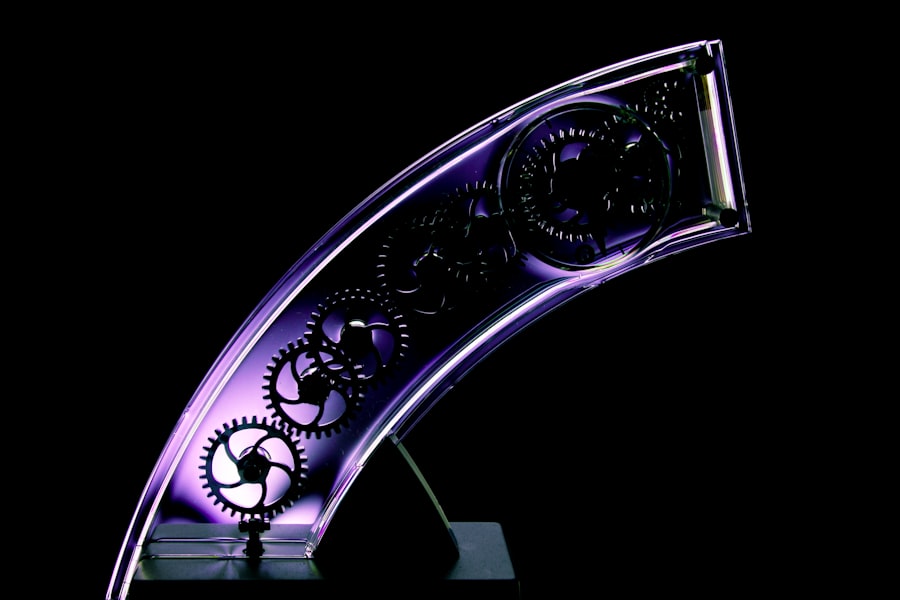
Time occupies a unique position within the framework of quantum mechanics. Unlike other physical quantities such as position or momentum, which can be directly measured and manipulated, time remains elusive and abstract. In many formulations of quantum mechanics, time is treated as a parameter rather than an observable quantity.
This distinction raises profound questions about the nature of time itself and its role in shaping physical laws. The treatment of time in quantum mechanics also leads to intriguing implications for causality. In classical physics, causality is often viewed as a linear progression where causes precede effects in a clear temporal order.
However, in the quantum realm, this linearity can become blurred. The phenomenon of entanglement, where particles become correlated regardless of distance, challenges conventional notions of causality and suggests that time may not function in a straightforward manner within quantum systems.
The Concept of Time in Quantum Field Theory
| Concept | Definition |
|---|---|
| Quantum Field Theory | A theoretical framework that combines classical field theory, special relativity, and quantum mechanics to describe the behavior of subatomic particles and their interactions. |
| Time | In quantum field theory, time is treated as a parameter rather than an observable, and the theory is formulated in terms of fields evolving in space and time. |
| Quantization of Time | Quantum field theory does not inherently quantize time, as time is treated classically in the theory. However, some approaches to quantum gravity and other theories attempt to incorporate quantization of time. |
| Time Evolution Operator | In quantum field theory, the time evolution of a system is described by the time evolution operator, which determines how the system evolves from one time to another. |
Quantum field theory (QFT) represents a significant advancement in understanding the interplay between particles and fields at the quantum level. In this framework, time is treated as an integral component that interacts with spatial dimensions to form a four-dimensional spacetime continuum. This perspective allows for a more comprehensive understanding of how particles propagate and interact over time.
In QFT, time is not merely a passive backdrop; it actively influences the behavior of fields and particles. The dynamics of these interactions are governed by mathematical equations that incorporate both spatial and temporal variables. As such, time becomes an essential factor in determining how particles evolve and interact within the quantum field.
This approach highlights the interconnectedness of time and space, suggesting that any exploration of one must consider the implications for the other.
Time as a Variable in Quantum Gravity
The quest to unify quantum mechanics with general relativity has led to significant advancements in understanding time within the context of quantum gravity.
This perspective challenges traditional notions of absolute time and suggests that time may be relative to the observer’s position within a gravitational field.
Incorporating time as a variable in quantum gravity opens up new avenues for exploring phenomena such as black holes and the early universe. The interplay between gravity and quantum mechanics raises profound questions about the nature of spacetime itself. As researchers delve deeper into these complexities, they confront fundamental issues regarding the continuity of time and its relationship with the fabric of reality.
Time and Entanglement in Quantum Systems

Entanglement is one of the most intriguing phenomena in quantum mechanics, where particles become interconnected in such a way that the state of one particle instantaneously influences the state of another, regardless of distance. This phenomenon raises compelling questions about the nature of time and causality within quantum systems. If entangled particles can affect each other instantaneously, does this imply that traditional notions of temporal order are insufficient to describe their interactions?
The relationship between entanglement and time challenges conventional understandings of cause and effect. In classical physics, events are typically ordered in a linear fashion; however, entangled particles seem to defy this structure. This leads to speculation about whether time itself is an emergent property arising from deeper underlying processes or if it is fundamentally intertwined with entangled states.
Time and the Arrow of Quantum Causality
The concept of causality is central to both classical and quantum physics, yet its interpretation varies significantly between these realms. In classical physics, causality follows a clear arrow: causes precede effects in a linear timeline. However, in quantum mechanics, this arrow becomes less defined due to phenomena such as superposition and entanglement.
The arrow of quantum causality suggests that events may not always unfold in a straightforward manner. Instead, they may be influenced by probabilistic outcomes and interconnected states that challenge traditional temporal sequences. This raises profound philosophical questions about free will, determinism, and the nature of reality itself.
As researchers continue to explore these ideas, they confront fundamental issues regarding how we understand causation within the quantum framework.
Quantum Time and the Measurement Problem
The measurement problem is one of the most significant challenges in quantum mechanics, highlighting the complexities surrounding observation and its impact on quantum systems. When a measurement is made, a superposition collapses into a definite state; however, this process raises questions about the role of time in determining outcomes. In this context, time becomes intricately linked to measurement processes.
The act of measuring not only influences the state of a system but also introduces temporal considerations regarding when measurements occur and how they affect subsequent events. This interplay between measurement and time invites further exploration into how observers interact with quantum systems and how these interactions shape our understanding of reality.
Quantum Time and the Nature of Reality
The exploration of time within quantum physics has profound implications for our understanding of reality itself. As researchers grapple with concepts such as superposition, entanglement, and non-locality, they are compelled to reconsider what constitutes existence at its most fundamental level. The notion that reality may not be fixed but rather fluid and interconnected challenges long-held beliefs about the nature of existence.
This fluidity raises questions about how individuals perceive reality through their experiences over time. If time is not an absolute entity but rather an emergent property influenced by various factors, then our understanding of past, present, and future becomes more complex. This perspective invites philosophical inquiry into consciousness, perception, and the very essence of being.
Implications of the Quantum View of Time for Philosophy and Cosmology
The implications of adopting a quantum view of time extend beyond physics into philosophy and cosmology. Philosophers have long debated the nature of time—whether it is real or merely an illusion—and quantum mechanics adds layers to this discourse. The idea that time may be relative or emergent challenges traditional metaphysical frameworks and invites new interpretations.
In cosmology, understanding time through a quantum lens has significant ramifications for theories regarding the origins and evolution of the universe. Concepts such as cosmic inflation or black hole thermodynamics may require reevaluation when considering how time operates at both macroscopic and microscopic scales. As researchers continue to explore these intersections between quantum physics and cosmology, they pave the way for new insights into fundamental questions about existence.
Future Directions in Quantum Time Research
As scientific inquiry into quantum mechanics continues to evolve, future directions in research on quantum time hold great promise for expanding our understanding of reality. Emerging technologies such as quantum computing may provide new tools for exploring complex interactions between time and quantum systems. These advancements could lead to breakthroughs in our comprehension of entanglement, causality, and measurement processes.
Moreover, interdisciplinary collaboration between physicists, philosophers, and cosmologists will be essential for addressing the profound questions raised by the quantum view of time. By fostering dialogue across disciplines, researchers can develop more comprehensive frameworks for understanding how time operates within both classical and quantum realms. As they navigate these uncharted territories, they stand on the brink of potentially transformative discoveries that could reshape humanity’s understanding of existence itself.
In conclusion, the exploration of time through a quantum lens reveals a rich tapestry woven with complexity and intrigue. As researchers continue to unravel its mysteries, they challenge conventional wisdom while opening new avenues for inquiry across multiple disciplines. The journey into understanding quantum time promises not only to deepen scientific knowledge but also to provoke philosophical reflection on what it means to exist within an ever-evolving universe.
In exploring the quantum mechanical view of time, one might find it intriguing to delve into discussions that bridge the gap between theoretical physics and our understanding of the universe.
This article delves into the complexities of time from a quantum perspective, offering a fresh look at how time might be perceived beyond classical interpretations. For those interested in expanding their knowledge on this fascinating topic, you can read more by visiting this article.
WATCH THIS! Time Is An Illusion: Quantum Physics Proves It
FAQs
What is the quantum mechanical view of time?
The quantum mechanical view of time is a concept that arises from the principles of quantum mechanics, which is the branch of physics that describes the behavior of particles at the smallest scales. In this view, time is not considered to be a constant and absolute quantity, but rather a dynamic and probabilistic aspect of the universe.
How does quantum mechanics describe time?
In quantum mechanics, time is treated as a parameter that is subject to uncertainty and fluctuations. According to the theory, the precise measurement of time is limited by the Heisenberg uncertainty principle, which states that the more precisely the position of a particle is known, the less precisely its momentum can be known, and vice versa.
What are some implications of the quantum mechanical view of time?
The quantum mechanical view of time has led to the development of theories such as quantum gravity, which seeks to reconcile the principles of quantum mechanics with those of general relativity. It also raises questions about the nature of time at the smallest scales and its relationship to other fundamental forces and particles in the universe.
How does the quantum mechanical view of time differ from classical physics?
In classical physics, time is considered to be an absolute and linear quantity that progresses uniformly. In contrast, quantum mechanics introduces the concept of time as a dynamic and uncertain parameter that is intertwined with the behavior of particles at the quantum level. This leads to a fundamentally different understanding of the nature of time and its role in the universe.