
Albert Einstein, a name synonymous with groundbreaking scientific thought, revolutionized our understanding of time and space in the early 20th century. His theories not only challenged the conventional notions of physics but also reshaped the very fabric of how you perceive time itself. As you delve into the intricacies of his work, you will discover that Einstein’s contributions extend far beyond mere equations; they invite you to reconsider the nature of reality and your place within it.
His insights into time have sparked curiosity and debate, leading to profound implications in both theoretical physics and philosophical discourse. Einstein’s journey began with a simple question: what is the nature of time? This inquiry led him to develop theories that would forever alter the landscape of physics.
His work, particularly in special and general relativity, introduced concepts that were not only revolutionary but also counterintuitive. As you explore these theories, you will find that they challenge your everyday experiences and perceptions, urging you to think beyond the limits of classical mechanics. The exploration of time in Einstein’s work is not just an academic pursuit; it is an invitation to engage with the mysteries of the universe.
Key Takeaways
- Einstein’s theory of special relativity revolutionized our understanding of time and space, introducing the concept of time dilation and the relativity of simultaneity.
- The concept of space-time, as introduced by Einstein, unified space and time into a single, interconnected continuum, challenging traditional notions of time as a separate entity.
- Einstein’s theory of general relativity further expanded our understanding of time by introducing the idea of space-time curvature, demonstrating how gravity can affect the passage of time.
- The curvature of space-time has profound implications, including the prediction of phenomena such as gravitational time dilation and the bending of light.
- Einstein’s work laid the foundation for the understanding of time dilation, which has been confirmed through experiments and has practical applications in technologies such as GPS.
Einstein’s Theory of Special Relativity and its Impact on Time
In 1905, Einstein published his theory of special relativity, a groundbreaking framework that fundamentally altered your understanding of time. One of the most significant implications of this theory is the idea that time is not an absolute entity but rather relative to the observer’s state of motion. This means that as you move through space at high speeds, your experience of time can differ dramatically from someone who remains stationary.
This concept, often illustrated by the famous thought experiment involving twins—where one twin travels at near-light speed while the other stays on Earth—demonstrates how time can stretch and contract based on velocity. The impact of special relativity on your perception of time is profound. It suggests that time is intertwined with space, forming a four-dimensional continuum known as space-time.
This revelation challenges the traditional view that time flows uniformly for everyone, regardless of their circumstances. Instead, you are invited to consider that your experience of time is uniquely shaped by your motion through the universe. This realization not only alters your understanding of time but also raises questions about simultaneity and causality, compelling you to rethink how events are ordered in your own life.
The Concept of Space-Time in Einstein’s Work

Einstein’s introduction of space-time as a unified concept marks a pivotal moment in physics. By merging the three dimensions of space with the dimension of time, he created a framework that allows you to visualize the universe in a more holistic manner. In this model, events are not merely points in space or time; they exist within a four-dimensional continuum where the coordinates of an event include both its spatial location and its temporal position.
This perspective encourages you to see time as an integral part of the fabric of reality rather than a separate entity. The implications of space-time extend beyond theoretical physics; they influence how you understand gravity and motion. In this framework, massive objects like planets and stars warp the fabric of space-time around them, creating what you perceive as gravitational attraction.
This means that when you think about gravity, you are not just considering forces acting at a distance; you are contemplating how objects interact within a curved space-time continuum. This shift in perspective invites you to appreciate the interconnectedness of all things in the universe and how your own experiences are shaped by these fundamental principles.
Einstein’s Theory of General Relativity and its Influence on Time
| Aspect | Details |
|---|---|
| Theory | General Relativity |
| Proposed by | Albert Einstein |
| Year | 1915 |
| Key concept | Space-time curvature |
| Influence on time | Time dilation and gravitational time dilation |
| Experimental confirmation | Gravitational redshift, gravitational waves |
In 1915, Einstein expanded upon his earlier work with the theory of general relativity, which further revolutionized your understanding of time by incorporating gravity into the equation. Unlike special relativity, which dealt with inertial frames of reference, general relativity addresses how gravity affects the curvature of space-time itself. This theory posits that massive objects cause a distortion in space-time, leading to what you perceive as gravitational attraction.
As a result, time is affected by gravity; it flows more slowly in stronger gravitational fields compared to weaker ones. This phenomenon has been experimentally confirmed through various observations, such as the behavior of clocks on satellites compared to those on Earth. As you consider these findings, it becomes clear that your experience of time is not only influenced by your speed but also by the gravitational forces acting upon you.
This realization deepens your understanding of how interconnected time is with other fundamental forces in the universe, prompting you to reflect on how these principles govern your daily life and experiences.
The Curvature of Space-Time and its Implications
The curvature of space-time is one of the most profound implications of Einstein’s theories. When you think about this curvature, imagine placing a heavy ball on a stretched rubber sheet; the ball creates a dip in the sheet, illustrating how mass influences the geometry of space-time.
The implications are vast: this curvature explains phenomena such as planetary orbits and gravitational lensing, where light bends around massive objects. As you explore these concepts further, consider how this curvature affects your perception of time itself. In regions where space-time is significantly curved—such as near a black hole—time behaves differently than it does in less curved regions.
This leads to fascinating scenarios where time can appear to stand still for an observer near a massive object while moving quickly for someone far away. Such insights challenge your intuitive understanding of time as a constant flow and invite you to embrace a more nuanced view that recognizes the complexities inherent in the universe.
Einstein’s Contribution to the Understanding of Time Dilation
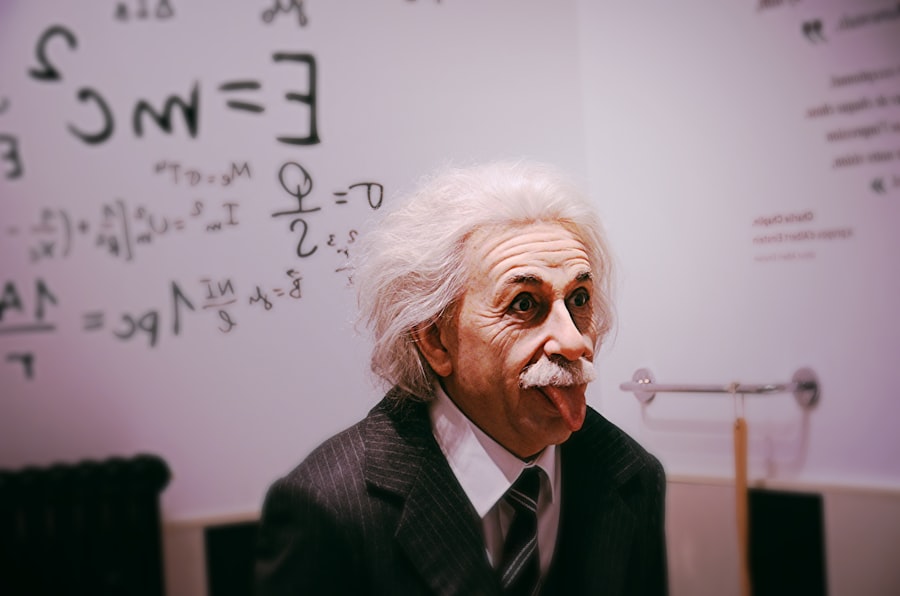
Time dilation is one of the most intriguing consequences of Einstein’s theories, particularly special relativity. As you delve into this concept, you’ll find that it describes how time can pass at different rates for observers in varying states of motion or gravitational fields. For instance, if you were to travel at speeds approaching that of light, you would experience time more slowly than someone who remained stationary on Earth.
This phenomenon has been confirmed through numerous experiments involving high-speed particles and precise atomic clocks. The implications of time dilation extend beyond theoretical discussions; they have practical applications in modern technology. For example, GPS satellites orbiting Earth experience both velocity-based and gravitational time dilation due to their speed and distance from Earth’s gravitational field.
As a result, their onboard clocks tick slightly faster than those on Earth, necessitating adjustments to ensure accurate positioning data for users like yourself. This intersection between Einstein’s theories and everyday technology highlights how deeply his work influences your life, even in ways you may not immediately recognize.
The Concept of Time Travel in Einstein’s Work
The notion of time travel has captivated human imagination for centuries, and Einstein’s theories provide a scientific foundation for exploring this concept. While traditional science fiction often portrays time travel as a fantastical journey through different eras, Einstein’s work suggests that certain conditions could theoretically allow for such phenomena within the framework of relativity. For instance, wormholes—hypothetical passages through space-time—could potentially connect distant points in both space and time.
However, as you contemplate these possibilities, it’s essential to recognize that practical time travel remains firmly within the realm of speculation and theoretical physics. The challenges associated with creating or navigating wormholes are immense and currently beyond our technological capabilities. Nevertheless, engaging with these ideas encourages you to think critically about the nature of time itself and how it might be manipulated under specific conditions.
This exploration invites you to ponder not only the scientific implications but also the philosophical questions surrounding causality and free will.
Einstein’s Views on the Arrow of Time and Entropy
Einstein’s work also touches upon philosophical questions regarding the arrow of time—the directionality in which time seems to flow from past to present to future. One significant aspect he considered is related to entropy, a concept from thermodynamics that describes how systems tend toward disorder over time. In this context, you can think about how events unfold in a way that aligns with increasing entropy; for example, a broken glass does not spontaneously reassemble itself.
This relationship between entropy and the arrow of time raises intriguing questions about why we perceive time as moving forward rather than backward. While Einstein’s theories primarily focus on the physical aspects of time, they also invite you to reflect on deeper philosophical implications regarding memory, experience, and change. As you contemplate these ideas, consider how they shape your understanding of existence and influence your perception of life’s fleeting moments.
The Relationship Between Time and Quantum Mechanics in Einstein’s Work
While Einstein made monumental contributions to classical physics and relativity, he also grappled with the implications of quantum mechanics—a field that challenges many traditional notions he held dear. One area where his views diverged from mainstream quantum theory was regarding the nature of time itself. In quantum mechanics, events can appear probabilistic rather than deterministic, leading to questions about how time operates at subatomic levels.
Einstein famously remarked that “God does not play dice,” expressing his discomfort with the inherent randomness present in quantum mechanics. This tension between his theories and quantum principles invites you to explore how different frameworks approach the concept of time. As scientists continue to investigate these relationships, they seek to reconcile classical physics with quantum mechanics—a pursuit that may ultimately reshape your understanding of reality itself.
Einstein’s Legacy and Influence on the Study of Time
The legacy left by Albert Einstein extends far beyond his lifetime; it continues to influence contemporary physics and our understanding of time today. His theories have laid the groundwork for numerous advancements in technology and scientific inquiry, shaping fields such as cosmology, astrophysics, and even philosophy.
Moreover, Einstein’s ability to challenge established norms encourages critical thinking and creativity within scientific communities. His willingness to question assumptions invites you to adopt a similar mindset when approaching complex problems or exploring new ideas. By embracing this spirit of inquiry inspired by Einstein’s legacy, you contribute to an ongoing dialogue about the nature of time and reality—one that continues to evolve as new discoveries emerge.
Reflecting on Albert Einstein’s Work Time
As you reflect on Albert Einstein’s contributions to our understanding of time, it becomes evident that his work transcends mere scientific inquiry; it invites profound philosophical contemplation about existence itself. From special relativity’s revelations about relative motion to general relativity’s insights into gravity’s influence on time flow, each aspect challenges your perceptions and encourages deeper exploration into the nature of reality. Einstein’s legacy serves as a reminder that science is not just about equations or theories; it is about curiosity—the desire to understand our universe better and our place within it.
As you continue your journey through life armed with these insights into time, consider how they shape your experiences and interactions with others. Ultimately, engaging with Einstein’s work allows you to appreciate not only the complexities inherent in time but also its beauty—a reminder that every moment is part of an intricate tapestry woven into the fabric of existence itself.
Albert Einstein’s groundbreaking work on the theory of relativity revolutionized our understanding of time and space. His insights into the nature of time, particularly through his famous equation E=mc², have had profound implications across various scientific fields. For those interested in exploring more about Einstein’s contributions and their impact on modern science, a related article can be found on My Cosmic Ventures. This article delves into the nuances of Einstein’s theories and their relevance today. You can read more about it by visiting this link.
Why Time Freezes at Light Speed
FAQs
What was Albert Einstein’s work time like?
Albert Einstein was known for his intense work ethic and spent long hours in the office and laboratory. He often worked late into the night and on weekends, sometimes to the detriment of his personal life.
How many hours did Albert Einstein work per day?
Einstein was known to work 10-12 hours a day, often without taking breaks. He was deeply committed to his research and often became so engrossed in his work that he lost track of time.
Did Albert Einstein have a regular work schedule?
Einstein did not adhere to a regular work schedule and often worked irregular hours. He preferred to work when he felt most inspired and productive, regardless of the time of day.
Did Albert Einstein take vacations or time off from work?
Einstein was known to take occasional vacations and breaks from work, but even during these times, he often continued to think about and work on his scientific theories.
Did Albert Einstein’s work time impact his personal life?
Einstein’s intense work schedule often took a toll on his personal life, leading to strained relationships with family members and colleagues. He struggled to balance his dedication to his work with his personal responsibilities.