
Carbon dioxide, a colorless gas that plays a crucial role in Earth’s atmosphere, is also a significant component in the study of celestial bodies, particularly comets. These icy wanderers, originating from the outer reaches of the solar system, are composed of various volatile compounds, including carbon dioxide.
The interaction between carbon dioxide and other materials within a comet can lead to fascinating phenomena, including outgassing and tail formation, which are critical for observing these objects from Earth. The study of carbon dioxide in relation to comet activity not only enhances knowledge about these celestial bodies but also provides insights into the early solar system’s conditions. Comets are often considered time capsules, preserving the primordial materials from which the solar system formed.
By examining the role of carbon dioxide in comet activity, researchers can glean information about the chemical processes that occurred during the solar system’s formation and evolution. This exploration opens up avenues for understanding not just comets but also the broader dynamics of planetary formation and the potential for life beyond Earth.
Key Takeaways
- Carbon dioxide plays a significant role in comet activity, impacting various aspects such as nucleus, tail formation, brightness, visibility, composition, outgassing, and activity cycles.
- The presence of carbon dioxide affects comet nuclei by sublimating and releasing gas, leading to the formation of a coma and tail.
- Carbon dioxide contributes to the formation of comet tails through the process of outgassing, where the gas and dust released create the characteristic tail structure.
- The impact of carbon dioxide on comet brightness and visibility is crucial for observing and studying comets, as it influences their appearance and behavior in the night sky.
- Understanding the influence of carbon dioxide on comet activity is essential for future research directions and has potential implications for advancing comet research and our understanding of the solar system.
The Role of Carbon Dioxide in Comet Activity
Carbon dioxide serves as a vital component in the volatile makeup of comets, influencing their activity as they approach the Sun. When a comet nears the Sun, the increase in temperature causes the solid carbon dioxide within its nucleus to sublimate, transitioning directly from a solid to a gas. This process is crucial because it initiates a series of events that lead to the comet’s characteristic outgassing and tail formation.
The release of carbon dioxide gas contributes to the overall pressure within the comet’s nucleus, which can lead to further sublimation of other volatile materials, such as water ice and ammonia. Moreover, carbon dioxide plays a significant role in determining the physical and chemical properties of a comet’s nucleus. The presence of this gas can affect the structural integrity of the nucleus itself, influencing how it breaks apart or evolves as it travels through space.
As comets are subjected to solar radiation and gravitational forces, carbon dioxide’s behavior can dictate how much material is released into space and how quickly these changes occur. Understanding these dynamics is essential for predicting comet activity and behavior during their perihelion passages.
How Carbon Dioxide Affects Comet Nuclei
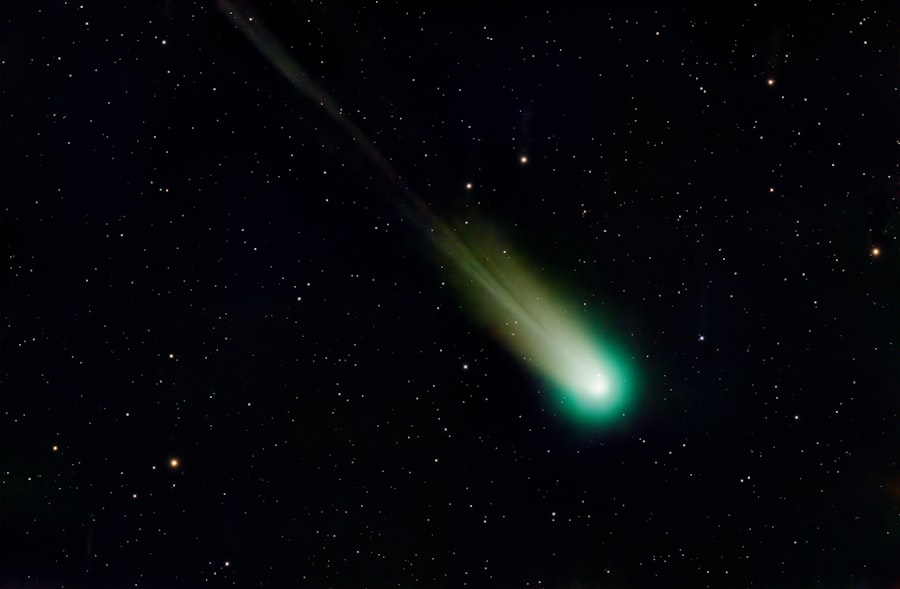
The nuclei of comets are often described as “dirty snowballs,” composed of ice, dust, and various organic compounds. Carbon dioxide is one of the key volatiles found within these nuclei, and its presence significantly impacts their physical characteristics. When carbon dioxide sublimates, it can create pressure within the nucleus that may lead to fracturing or even explosive outgassing events.
These phenomena can dramatically alter the surface features of a comet, creating jets and pits that are observable from Earth-based telescopes or spacecraft. Additionally, carbon dioxide can influence the thermal properties of a comet’s nucleus. The gas has a relatively low sublimation temperature compared to other volatiles like water ice.
As a result, when a comet approaches the Sun, carbon dioxide can begin to sublimate at greater distances than other materials. This early activity can provide valuable information about the composition and structure of the nucleus, allowing scientists to infer details about its history and formation processes. By studying how carbon dioxide interacts with other components within the nucleus, researchers can gain insights into the complex interplay of forces that shape these fascinating celestial objects.
The Relationship Between Carbon Dioxide and Comet Tail Formation
| Carbon Dioxide Concentration (ppm) | Comet Tail Formation |
|---|---|
| 0-100 | None |
| 100-500 | Minimal |
| 500-1000 | Visible |
| Above 1000 | Significant |
The formation of a comet’s tail is one of its most striking features, captivating astronomers and skywatchers alike. Carbon dioxide plays a pivotal role in this process by contributing to the outgassing that generates the tail’s material. As carbon dioxide sublimates from the nucleus, it carries with it other volatile compounds and dust particles.
This mixture forms a cloud around the comet known as a coma, which is illuminated by sunlight as it expands outward from the nucleus. The interaction between solar radiation and the gases released from a comet’s nucleus leads to the development of two distinct tails: the ion tail and the dust tail. The ion tail is formed by charged particles that are influenced by solar wind and magnetic fields, while the dust tail consists of larger particles that are pushed away from the nucleus by radiation pressure.
Carbon dioxide contributes to both tails by providing essential gases that interact with solar radiation. The dynamics of these interactions can vary depending on factors such as solar activity and the comet’s trajectory, making each comet’s tail unique.
Carbon Dioxide’s Impact on Comet Brightness and Visibility
The brightness of a comet is often determined by its distance from both the Sun and Earth, as well as its composition. Carbon dioxide significantly influences this brightness through its role in outgassing and coma formation. As carbon dioxide sublimates and contributes to the coma’s density, it enhances the scattering of sunlight, making the comet appear brighter to observers on Earth.
This effect can be particularly pronounced during perihelion when a comet is closest to the Sun and experiencing maximum outgassing. Furthermore, variations in carbon dioxide levels can lead to fluctuations in a comet’s brightness over time. For instance, if a comet experiences an increase in outgassing due to heightened solar heating or changes in its orbit, it may become temporarily brighter as more gas is released into space.
Conversely, if carbon dioxide levels decrease or if other volatile materials dominate the outgassing process, a comet may dim significantly. Understanding these dynamics is crucial for astronomers who seek to predict when comets will be most visible and how their brightness will change throughout their orbits.
The Influence of Carbon Dioxide on Comet Composition

The composition of comets is a subject of great interest among scientists seeking to understand their origins and evolution. Carbon dioxide is one of several key volatiles found in comets, alongside water ice, methane, and ammonia. The relative abundance of these materials can vary significantly between different comets, providing clues about their formation conditions in the early solar system.
By analyzing carbon dioxide levels in various comets, researchers can infer information about their parent bodies and the environments in which they formed. Moreover, carbon dioxide can also act as a marker for chemical processes occurring within a comet’s nucleus. For example, when carbon dioxide interacts with other compounds during sublimation or outgassing events, it may lead to the formation of new molecules or compounds that were not previously present.
These reactions can alter a comet’s overall composition over time, making it essential for scientists to monitor changes in carbon dioxide levels as comets evolve during their journeys through space.
The Effect of Carbon Dioxide on Comet Outgassing
Outgassing is one of the most critical processes associated with comet activity, and carbon dioxide plays an integral role in this phenomenon. As comets approach the Sun, increasing temperatures cause solid carbon dioxide within their nuclei to sublimate rapidly. This process generates gas pressure that can lead to explosive outgassing events, releasing not only carbon dioxide but also other volatiles trapped within the nucleus.
The rate at which carbon dioxide sublimates can vary based on several factors, including the comet’s distance from the Sun and its surface temperature. Understanding these variables is essential for predicting how much gas will be released during different phases of a comet’s orbit. Additionally, variations in outgassing rates can provide insights into a comet’s internal structure and composition.
For instance, if certain areas of a comet’s surface exhibit higher outgassing rates than others, it may indicate differences in material composition or structural integrity.
The Connection Between Carbon Dioxide and Comet Activity Cycles
Comet activity is not uniform; rather, it often follows cyclical patterns influenced by various factors, including orbital dynamics and thermal conditions. Carbon dioxide plays a significant role in these cycles by affecting how comets respond to changes in their environment as they travel through space. For example, as a comet approaches perihelion, increased solar radiation leads to heightened sublimation rates for carbon dioxide and other volatiles.
These cycles can result in periods of intense activity followed by dormancy when a comet is farther from the Sun. During active phases, researchers may observe increased outgassing rates and pronounced tail formation due to elevated levels of carbon dioxide being released into space. Conversely, during quiescent periods when a comet is distant from solar influence, activity diminishes significantly as sublimation rates decline.
Understanding these cycles is crucial for predicting future behavior and activity levels for known comets.
The Potential Implications of Carbon Dioxide on Comet Research
The study of carbon dioxide’s role in comet activity has far-reaching implications for various fields within astronomy and planetary science. By understanding how this gas influences outgassing rates, tail formation, and overall comet behavior, researchers can refine models that predict future comet activity more accurately. This knowledge is essential not only for observational astronomy but also for missions aimed at exploring comets up close.
Furthermore, insights gained from studying carbon dioxide in comets may extend beyond our solar system. As scientists search for exoplanets and investigate their atmospheres for signs of habitability or life-supporting conditions, understanding how volatiles like carbon dioxide behave in different environments becomes increasingly important. The lessons learned from comets may provide valuable analogs for understanding similar processes occurring on distant celestial bodies.
Future Research Directions in Understanding Carbon Dioxide’s Impact on Comet Activity
As research into comets continues to evolve, several promising directions emerge for further exploration regarding carbon dioxide’s impact on comet activity. One area of focus could involve enhanced observational campaigns using advanced telescopes equipped with spectroscopic capabilities to analyze gas emissions from comets more precisely. By measuring specific wavelengths associated with carbon dioxide emissions during different phases of a comet’s orbit, scientists could gain deeper insights into its behavior.
Spacecraft equipped with instruments designed to analyze surface materials could help determine how carbon dioxide interacts with other volatiles within a comet’s nucleus during close encounters with the Sun.
The Importance of Studying Carbon Dioxide’s Role in Comet Activity
In conclusion, understanding carbon dioxide’s role in comet activity is vital for unraveling the mysteries surrounding these enigmatic celestial bodies. From influencing outgassing rates to shaping tail formation and affecting brightness levels observed from Earth, carbon dioxide serves as a key player in many aspects of comet behavior. As researchers continue to explore this relationship through advanced observational techniques and targeted missions, they will undoubtedly uncover new insights that enhance our understanding not only of comets but also of planetary formation processes throughout our solar system and beyond.
The implications extend far beyond mere curiosity; they touch upon fundamental questions regarding our origins and potential life elsewhere in the universe. By studying how volatiles like carbon dioxide behave under varying conditions across different celestial environments—whether within our solar system or beyond—scientists pave pathways toward answering some of humanity’s most profound questions about existence itself.
Recent studies have unveiled fascinating insights into the role of carbon dioxide in driving comet activity, shedding light on the dynamic processes that govern these celestial bodies. A related article on this topic can be found on My Cosmic Ventures, which delves into the mechanisms by which carbon dioxide sublimation influences cometary behavior. This article provides a comprehensive overview of the latest research findings and their implications for our understanding of cometary science. For more detailed information, you can read the full article by visiting My Cosmic Ventures.
WATCH THIS! Scientists Found an Alien “Fingerprint” on 3I/ATLAS (The Nickel Anomaly)
FAQs
What is carbon dioxide driven comet activity?
Carbon dioxide driven comet activity refers to the process by which carbon dioxide (CO2) sublimates from the surface of a comet, leading to the release of gas and dust into space. This sublimation process can cause the comet to develop a coma (a cloud of gas and dust) and a tail as it approaches the Sun.
How does carbon dioxide driven comet activity occur?
When a comet approaches the Sun, the increasing solar radiation causes the surface ices, including carbon dioxide, to sublimate directly from solid to gas. This release of gas and dust creates a coma around the comet’s nucleus and can also form a tail as the solar wind pushes the material away from the Sun.
What role does carbon dioxide play in comet activity?
Carbon dioxide is one of the key volatile substances found in comets. When it sublimates, it contributes to the overall activity of the comet, including the development of a coma and tail. The presence of carbon dioxide in comets has been observed through spectroscopic analysis of their emissions.
Why is carbon dioxide driven comet activity important to study?
Studying carbon dioxide driven comet activity can provide valuable insights into the composition and behavior of comets, as well as the processes that occur in the outer regions of the solar system. It can also help scientists better understand the role of carbon dioxide in the formation and evolution of comets.
What are some notable comets that exhibit carbon dioxide driven activity?
Comets such as 103P/Hartley 2 and 67P/Churyumov-Gerasimenko have been observed to exhibit significant carbon dioxide driven activity. These comets have been studied by space missions such as NASA’s Deep Impact and ESA’s Rosetta, providing detailed data on their carbon dioxide emissions and activity.