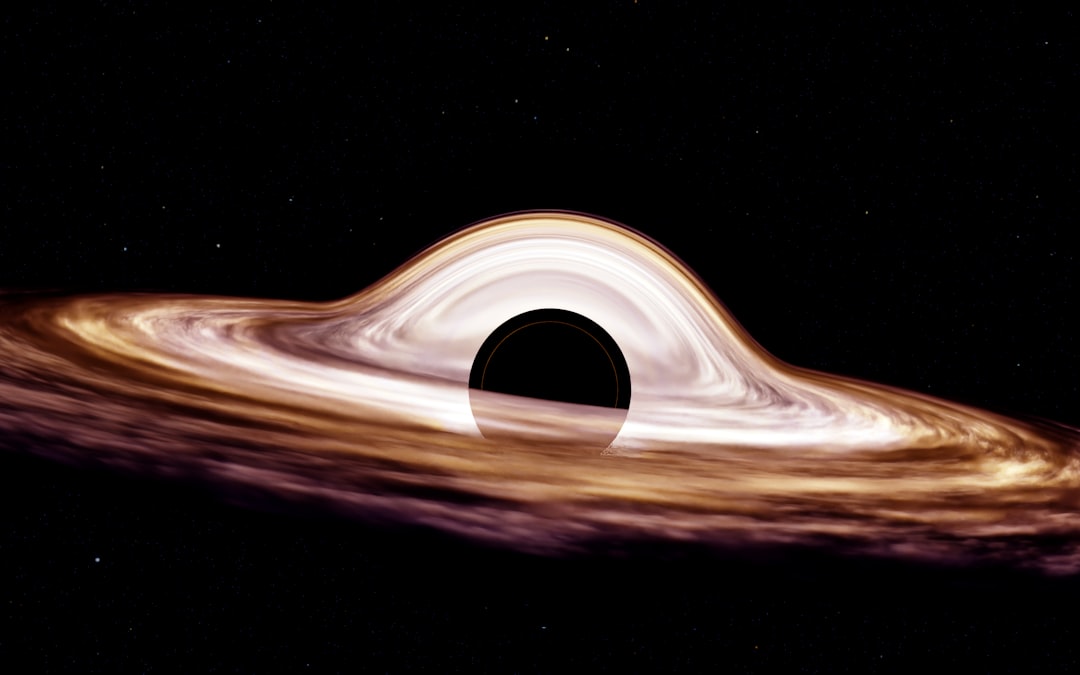
Gravitational lensing is a captivating phenomenon that occurs when a massive object, such as a galaxy or a black hole, bends the light from a more distant object. This bending of light is a direct consequence of Einstein’s theory of general relativity, which posits that massive bodies warp the fabric of spacetime around them. As light travels through this warped spacetime, it follows a curved path, leading to the distortion, magnification, or even multiple images of the background object.
This intriguing effect not only provides a unique method for observing distant celestial bodies but also serves as a powerful tool for understanding the universe’s structure and composition. The study of gravitational lensing has gained significant traction in recent years, particularly with advancements in observational technology and techniques. Astronomers have utilized gravitational lensing to probe the distribution of dark matter, study the expansion of the universe, and even detect exoplanets.
As researchers delve deeper into this phenomenon, they uncover new insights into the nature of gravity and the cosmos. The intersection of gravitational lensing and black holes presents an especially rich area for exploration, as these enigmatic objects possess immense gravitational pull capable of producing some of the most dramatic lensing effects observed in the universe.
Key Takeaways
- Gravitational lensing is a phenomenon where the gravitational pull of massive objects like black holes can bend and distort light from distant objects.
- Black holes are incredibly dense objects with a strong gravitational pull that can bend light and act as gravitational lenses.
- Understanding gravitational lensing with black holes can provide valuable insights into the nature of these enigmatic cosmic entities.
- Black holes can be used as gravitational lenses to magnify and study distant objects, including galaxies and quasars, that would otherwise be too faint to observe.
- Gravitational lensing with black holes has wide-ranging applications in astrophysics, from studying the properties of distant galaxies to testing the theory of general relativity.
Understanding Black Holes and Their Gravitational Pull
Black holes are among the most mysterious and intriguing entities in astrophysics. Formed from the remnants of massive stars that have undergone gravitational collapse, black holes possess gravitational fields so strong that nothing, not even light, can escape their grasp. This characteristic gives them their name and defines their nature as regions in spacetime where gravity is overwhelmingly dominant.
The boundary surrounding a black hole is known as the event horizon, beyond which any matter or radiation is irrevocably drawn into the singularity at its core.
When a star exhausts its nuclear fuel, it can no longer support itself against gravitational collapse.
Depending on its mass, it may form a neutron star or collapse entirely into a black hole. The immense density of these objects leads to extreme gravitational effects, influencing nearby stars and gas clouds. This gravitational influence extends far beyond the event horizon, allowing black holes to interact with their surroundings in complex ways.
Understanding these interactions is crucial for comprehending how black holes can act as gravitational lenses.
The Phenomenon of Gravitational Lensing
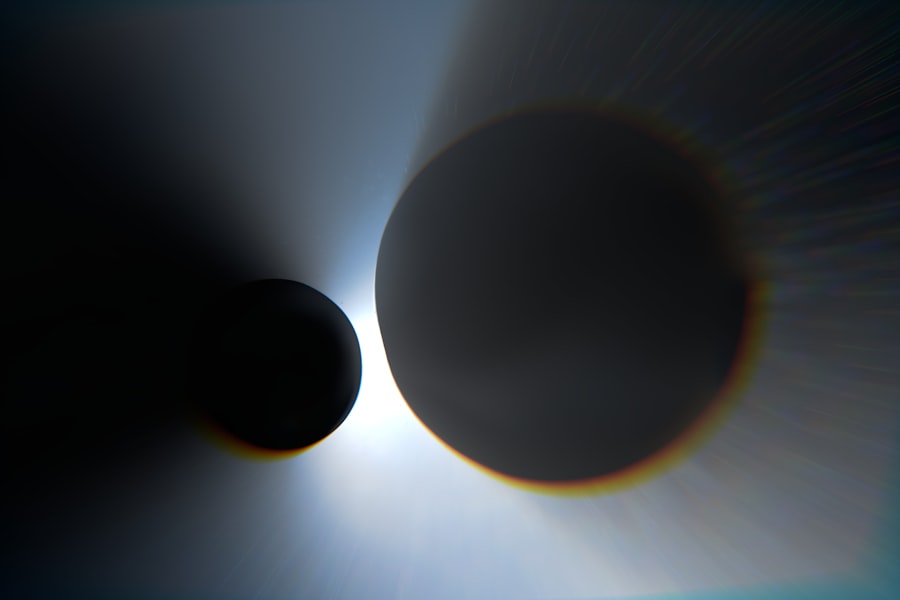
Gravitational lensing manifests in various forms, primarily categorized into three types: strong lensing, weak lensing, and microlensing. Strong lensing occurs when a massive object lies directly between an observer and a distant source, creating multiple images or arcs of the background object. This effect is particularly striking and can reveal intricate details about both the lensing object and the background source.
Weak lensing, on the other hand, involves subtle distortions that are not easily discernible but can be statistically analyzed over large fields of galaxies to map dark matter distribution. Microlensing is characterized by temporary brightness increases in distant stars caused by the gravitational field of a foreground object passing in front. The phenomenon of gravitational lensing not only enhances our understanding of cosmic structures but also serves as a natural laboratory for testing theories of gravity.
By studying how light behaves around massive objects, astronomers can glean insights into the mass distribution of galaxies and clusters, as well as the nature of dark matter. The ability to observe these effects has revolutionized astrophysics, providing a means to investigate regions of space that would otherwise remain hidden from view.
How Black Holes can be Used as Gravitational Lenses
| Aspect | Details |
|---|---|
| Formation | Black holes are formed when massive stars collapse under their own gravity. |
| Gravitational Lensing | Black holes can bend and distort light, acting as gravitational lenses. |
| Observations | Astronomers have observed gravitational lensing effects around black holes in distant galaxies. |
| Research | Studying gravitational lensing by black holes can provide insights into the nature of dark matter and dark energy. |
Black holes serve as powerful gravitational lenses due to their extreme mass and compactness. When light from a distant star or galaxy passes near a black hole, the intense gravitational field bends the light’s path, creating observable effects such as distorted images or increased brightness. This capability allows astronomers to study not only the black hole itself but also the properties of the background objects being lensed.
The unique characteristics of black holes make them particularly effective lenses compared to other astronomical objects. One fascinating aspect of using black holes as gravitational lenses is their potential to reveal information about their own properties. For instance, by analyzing the light curves and images produced by lensing events, researchers can infer details about the mass and spin of the black hole.
Additionally, these observations can provide insights into the environment surrounding black holes, including accretion disks and relativistic jets. As such, black holes become not just passive lenses but active participants in the cosmic drama unfolding around them.
Observing and Studying Gravitational Lensing with Black Holes
The observation of gravitational lensing effects caused by black holes requires sophisticated instruments and techniques. Telescopes equipped with advanced imaging capabilities are essential for capturing the subtle distortions in light caused by these massive objects. Ground-based observatories and space telescopes work in tandem to provide comprehensive data on lensing events.
The Hubble Space Telescope, for example, has been instrumental in identifying strong lensing cases involving black holes and has contributed significantly to our understanding of their properties. In addition to traditional observational methods, researchers employ computer simulations to model gravitational lensing scenarios involving black holes. These simulations help predict how light will behave around different configurations of mass and allow scientists to compare theoretical predictions with actual observations.
By combining observational data with theoretical models, astronomers can refine their understanding of both black holes and gravitational lensing phenomena.
Applications of Gravitational Lensing in Astrophysics
Gravitational lensing has far-reaching applications in astrophysics beyond merely observing distant objects. One significant application lies in mapping dark matter distribution within galaxies and galaxy clusters. Since dark matter does not emit light and is challenging to detect directly, gravitational lensing provides a means to infer its presence through its gravitational effects on visible matter.
By analyzing how light from background galaxies is distorted by foreground mass concentrations, researchers can create detailed maps that reveal the structure and distribution of dark matter. Moreover, gravitational lensing plays a crucial role in studying the expansion rate of the universe. By observing lensed supernovae or other standard candles, astronomers can measure distances more accurately than traditional methods allow.
This information contributes to our understanding of cosmic expansion and helps refine models related to dark energy. As such, gravitational lensing serves as a vital tool for addressing some of the most profound questions in cosmology.
Challenges and Limitations in Exploring Gravitational Lensing with Black Holes
Despite its many advantages, studying gravitational lensing with black holes presents several challenges and limitations. One primary obstacle is the rarity of suitable lensing events involving black holes. While strong lensing cases are spectacular when they occur, they are relatively infrequent compared to other types of lensing phenomena.
This scarcity makes it difficult for researchers to gather sufficient data for statistical analysis or to draw broad conclusions about black hole populations. Additionally, distinguishing between genuine lensing effects caused by black holes and other astrophysical phenomena can be complex. For instance, some observed distortions may arise from intervening galaxies or other massive structures rather than from a black hole itself.
This ambiguity necessitates careful analysis and often requires complementary observations across different wavelengths to confirm findings.
Future Prospects and Advancements in Gravitational Lensing Research
The future of gravitational lensing research involving black holes looks promising due to ongoing advancements in technology and observational techniques. Next-generation telescopes, such as the James Webb Space Telescope (JWST), are expected to revolutionize our understanding of gravitational lensing by providing unprecedented sensitivity and resolution in infrared wavelengths. These capabilities will enable astronomers to detect fainter background sources and study more distant lensed objects than ever before.
Furthermore, advancements in computational methods will enhance researchers’ ability to simulate complex gravitational lensing scenarios involving black holes. Improved algorithms will allow for more accurate modeling of light paths around massive objects, leading to better predictions and interpretations of observational data. As these technologies continue to evolve, they will undoubtedly expand our knowledge of both black holes and the broader universe.
Theoretical and Practical Implications of Gravitational Lensing with Black Holes
The implications of studying gravitational lensing with black holes extend beyond mere observation; they touch upon fundamental questions about gravity itself and the nature of spacetime. By examining how light behaves around these extreme objects, researchers can test predictions made by general relativity and explore potential modifications to existing theories. Such investigations may lead to new insights into gravity’s role at cosmic scales and contribute to ongoing efforts to unify general relativity with quantum mechanics.
Practically speaking, understanding gravitational lensing has significant implications for cosmology and astrophysics as a whole. The ability to map dark matter distribution accurately informs models related to galaxy formation and evolution while also shedding light on the universe’s large-scale structure. As researchers continue to unravel these complexities through gravitational lensing studies involving black holes, they contribute valuable knowledge that shapes our understanding of the cosmos.
Collaborative Efforts and International Projects in Gravitational Lensing Studies
Gravitational lensing research is inherently collaborative due to its interdisciplinary nature and reliance on diverse expertise from various fields within astrophysics. International projects often bring together astronomers, physicists, and computer scientists from around the world to tackle complex questions related to gravitational lensing phenomena involving black holes. These collaborations facilitate data sharing, resource pooling, and cross-disciplinary insights that enhance research outcomes.
One notable example is the Event Horizon Telescope (EHT) collaboration, which aims to capture images of black holes using an array of radio telescopes distributed globally. By synchronizing observations across multiple sites, researchers can achieve unprecedented resolution capable of imaging the event horizon of supermassive black holes at the centers of galaxies. Such collaborative efforts exemplify how pooling resources and expertise can lead to groundbreaking discoveries in gravitational lensing studies.
The Fascinating Intersection of Black Holes and Gravitational Lensing
The intersection of black holes and gravitational lensing represents one of the most exciting frontiers in modern astrophysics. As researchers continue to explore this captivating phenomenon, they unlock new insights into both the nature of gravity and the structure of the universe itself. Gravitational lensing not only enhances our understanding of distant celestial objects but also serves as a powerful tool for probing fundamental questions about dark matter, cosmic expansion, and the behavior of light in extreme environments.
As technology advances and collaborative efforts expand across borders, the future holds great promise for further discoveries at this intersection. The ongoing exploration of gravitational lensing with black holes will undoubtedly yield profound implications for our understanding of the cosmos while inspiring future generations to delve deeper into the mysteries that lie beyond our reach.
Gravitational lensing is a fascinating phenomenon that occurs when a massive object, like a black hole, bends the light from objects behind it, creating a magnified or distorted image. This effect not only provides a unique way to study distant galaxies but also offers insights into the nature of black holes themselves. For those interested in delving deeper into the mysteries of gravitational lensing and its implications in astrophysics, a related article can be found on My Cosmic Ventures. This article explores the intricate details of how gravitational lensing is used to map the universe and understand the enigmatic properties of black holes. You can read more about it by visiting com/’>this link.
WATCH THIS! 🌌The Biggest Black Hole Is A LIE
FAQs
What is gravitational lensing?
Gravitational lensing is a phenomenon in which the gravitational field of a massive object, such as a black hole, bends and distorts light from objects behind it. This can create multiple images of the background object or even a complete ring of light, known as an Einstein ring.
How does gravitational lensing occur around a black hole?
When light from a distant object passes close to a black hole, the intense gravitational field of the black hole bends the path of the light, causing it to be deflected. This can result in the appearance of the background object being distorted or magnified when observed from a different vantage point.
What are the applications of gravitational lensing around black holes?
Gravitational lensing around black holes can be used to study the properties of the black hole, such as its mass and spin. It can also be used to study the distribution of dark matter in the universe and to detect and study distant objects that would otherwise be too faint to observe.
Can gravitational lensing be used to detect black holes?
Yes, gravitational lensing can be used to indirectly detect the presence of black holes by observing the distortion of light from background objects. This can provide valuable information about the presence and properties of black holes in the universe.
What are some famous examples of gravitational lensing around black holes?
One famous example of gravitational lensing around a black hole is the observation of the Einstein ring created by the galaxy SDP.81, which is being lensed by a massive foreground galaxy. Another example is the observation of multiple images of a quasar, created by the gravitational lensing effect of a massive galaxy cluster.