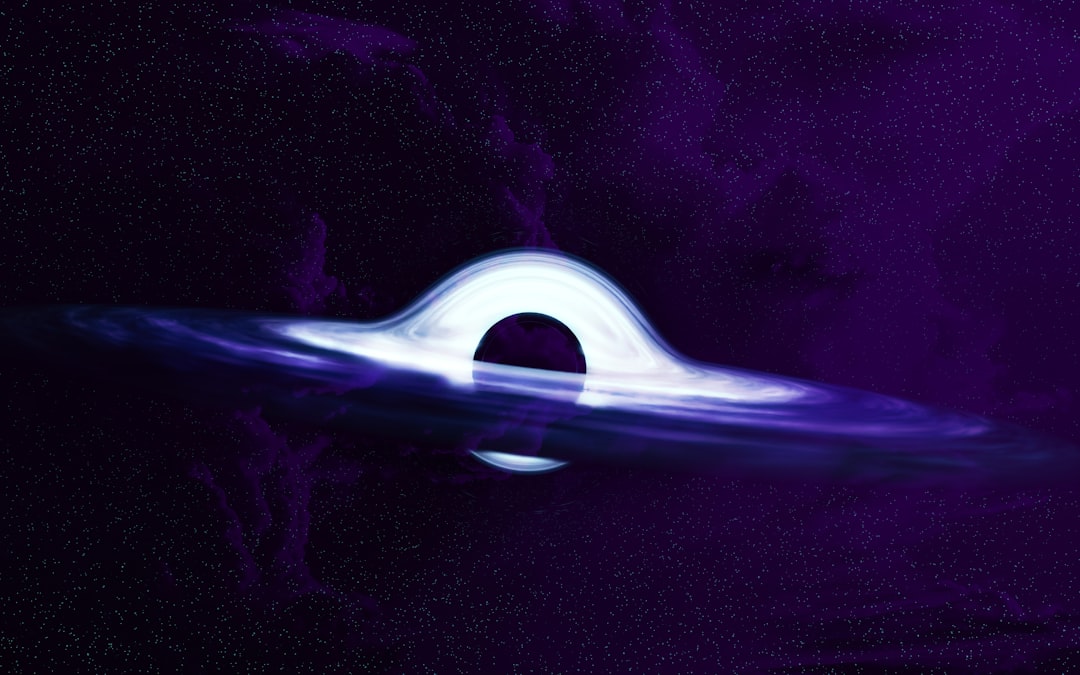
General relativity, a groundbreaking theory proposed by Albert Einstein in 1915, revolutionized the understanding of gravity and its effects on the fabric of the universe. This theory extended the principles of special relativity, which dealt primarily with objects moving at constant speeds, to include acceleration and gravitational fields. At its core, general relativity posits that gravity is not merely a force acting at a distance, as previously thought, but rather a curvature of spacetime caused by mass.
This radical shift in perspective has had profound implications for physics, astronomy, and cosmology. The introduction of general relativity marked a significant departure from Newtonian physics, which had dominated scientific thought for centuries. While Newton described gravity as an attractive force between masses, Einstein’s theory illustrated that massive objects like stars and planets warp the very fabric of spacetime around them.
This curvature dictates the motion of other objects, leading to the orbits of planets and the paths of light. The implications of this theory extend far beyond mere academic interest; they have been confirmed through numerous experiments and observations, fundamentally altering humanity’s understanding of the universe.
Key Takeaways
- General relativity is a theory of gravitation that describes the force of gravity as a curvature of spacetime caused by mass and energy.
- Spacetime is a four-dimensional continuum that combines three dimensions of space with one dimension of time, and it is the framework in which all physical events occur.
- Black holes are regions of spacetime where gravity is so strong that nothing, not even light, can escape from within a certain distance called the event horizon.
- The event horizon is the boundary surrounding a black hole beyond which nothing can escape, and the singularity is the point at the center of a black hole where density and gravity become infinite.
- Gravitational time dilation is the phenomenon where time passes more slowly in a strong gravitational field, such as near a black hole, compared to a weaker gravitational field.
Understanding the Concept of Spacetime
Spacetime is a central concept in general relativity, merging the three dimensions of space with the dimension of time into a single four-dimensional continuum. This innovative framework allows for a more comprehensive understanding of how objects interact within the universe. In this model, time is not an independent entity but is intrinsically linked to the spatial dimensions.
Events are described not just by their location in space but also by their position in time, creating a more holistic view of reality. The idea of spacetime also introduces the notion that time can be affected by gravity and velocity. For instance, an observer near a massive object will experience time differently than someone far away from it.
This interdependence of space and time leads to fascinating consequences, such as the phenomenon of gravitational time dilation, where time appears to pass more slowly in stronger gravitational fields. This concept challenges traditional notions of absolute time and highlights the intricate relationship between mass, energy, and the structure of the universe.
The Theory of Black Holes
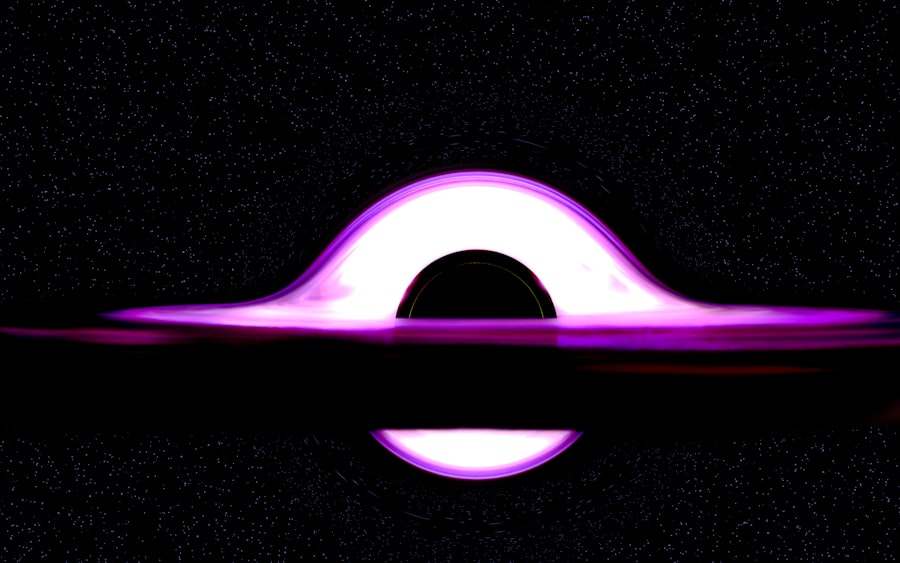
Black holes are one of the most intriguing predictions of general relativity, representing regions in spacetime where gravity is so intense that nothing, not even light, can escape their grasp. They form when massive stars exhaust their nuclear fuel and collapse under their own gravity, leading to a singularity—a point where density becomes infinite and the laws of physics as currently understood cease to function. The study of black holes has captivated scientists and the public alike, sparking imaginations and inspiring countless theories about their nature and implications.
There are several types of black holes, categorized primarily by their mass. Stellar black holes form from the remnants of massive stars, while supermassive black holes, which can contain millions or even billions of solar masses, reside at the centers of galaxies. Intermediate black holes are less understood but are believed to exist in certain environments.
Each type presents unique challenges and opportunities for research, as scientists strive to unravel the mysteries surrounding these enigmatic entities.
The Event Horizon and Singularity
| Concept | Definition |
|---|---|
| Event Horizon | The boundary surrounding a black hole beyond which no light or radiation can escape. |
| Singularity | The point within a black hole where the gravitational pull becomes infinite and spacetime curves infinitely. |
| Black Hole Mass | The mass of a black hole, which determines the size of its event horizon and gravitational pull. |
| Hawking Radiation | The theoretical radiation emitted by black holes due to quantum effects near the event horizon. |
At the heart of every black hole lies a singularity, surrounded by an event horizon—the boundary beyond which nothing can escape. The event horizon acts as a one-way barrier; once an object crosses this threshold, it is inexorably drawn toward the singularity. The nature of the event horizon raises profound questions about the fate of matter and information that falls into a black hole.
The singularity itself is a point of infinite density and gravitational pull, where current theories cannot adequately describe what occurs. This presents a significant challenge for physicists: reconciling general relativity with quantum mechanics to create a unified theory that can explain phenomena at both cosmic and subatomic scales.
The study of black holes thus serves as a crucial intersection between these two fundamental areas of physics, pushing researchers to explore new theoretical frameworks.
Gravitational Time Dilation
Gravitational time dilation is one of the most fascinating consequences of general relativity, illustrating how gravity can influence the passage of time. As an object approaches a massive body, such as a planet or black hole, time appears to slow down relative to an observer situated farther away from the gravitational influence. This effect has been confirmed through various experiments, including precise measurements using atomic clocks placed at different altitudes on Earth.
The implications of gravitational time dilation extend beyond theoretical musings; they have practical applications in technologies such as GPS satellites.
As a result, their onboard clocks tick slightly faster than those on Earth.
To ensure accurate positioning data, engineers must account for this discrepancy caused by gravitational time dilation. Such real-world applications underscore how deeply intertwined general relativity is with modern technology.
The Effects of Black Holes on Light
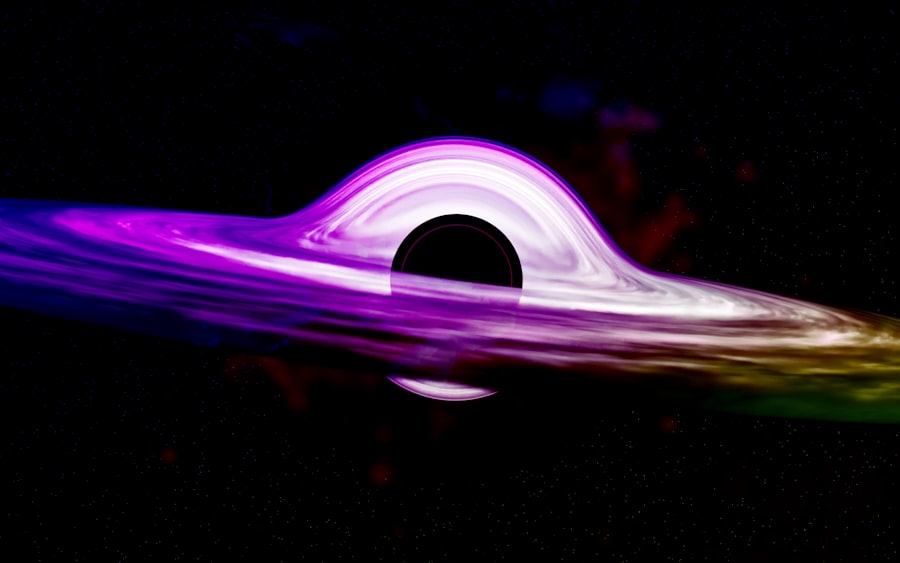
Black holes exert an extraordinary influence on light due to their immense gravitational pull. As light approaches a black hole, it experiences extreme bending—a phenomenon known as gravitational lensing. This effect can cause distant stars and galaxies to appear distorted or magnified when viewed from Earth.
Gravitational lensing not only provides insights into the presence of black holes but also offers valuable information about the distribution of dark matter in the universe. Moreover, light emitted from matter falling into a black hole can exhibit unique characteristics. As material spirals inward, it heats up and emits radiation across various wavelengths before crossing the event horizon.
This process creates what is known as an accretion disk—a swirling mass of gas and dust that emits X-rays detectable by telescopes. Observing these emissions allows astronomers to study black holes indirectly and gain insights into their properties and behavior.
Black Holes and the Theory of Wormholes
The concept of wormholes arises from solutions to Einstein’s equations in general relativity and presents intriguing possibilities for traversing vast distances in space-time. A wormhole can be envisioned as a tunnel connecting two separate points in spacetime, potentially allowing for shortcuts between distant regions of the universe. While purely theoretical at this stage, wormholes have captured the imagination of scientists and science fiction enthusiasts alike.
The relationship between black holes and wormholes is particularly fascinating. Some theories suggest that black holes could serve as one end of a wormhole, with the other end located elsewhere in space or even in another universe altogether. However, significant challenges remain regarding stability and traversability; most solutions indicate that any wormhole would require exotic matter with negative energy density to remain open.
Despite these hurdles, research into wormholes continues to inspire new ideas about the nature of spacetime and the potential for interstellar travel.
Observing Black Holes in the Universe
Observing black holes directly poses significant challenges due to their nature; they do not emit light that can be detected by conventional means. However, astronomers have developed innovative techniques to infer their presence through indirect observations. One prominent method involves studying the behavior of nearby stars or gas clouds that exhibit unusual motion indicative of a massive object lurking nearby.
In recent years, advancements in technology have led to groundbreaking discoveries related to black holes. The Event Horizon Telescope (EHT), a global network of radio telescopes, achieved a historic milestone in 2019 by capturing an image of the shadow cast by the supermassive black hole at the center of the galaxy M87. This achievement marked a significant leap forward in understanding these enigmatic entities and provided visual evidence supporting theoretical predictions made by general relativity.
The Role of Black Holes in the Evolution of Galaxies
Black holes play a crucial role in shaping galaxies and influencing their evolution over cosmic timescales. Supermassive black holes are often found at the centers of galaxies, exerting gravitational influence on surrounding stars and gas clouds. Their presence can regulate star formation rates within galaxies; when matter falls into a black hole, it releases energy that can heat surrounding gas and prevent it from collapsing into new stars.
Furthermore, interactions between galaxies can lead to mergers that trigger significant activity around supermassive black holes. These events can result in powerful jets and outflows that impact galactic evolution by redistributing gas and influencing star formation processes across vast regions. Understanding these dynamics is essential for comprehending how galaxies evolve over billions of years and how they are interconnected within the larger cosmic web.
Theoretical and Practical Applications of Black Holes
The study of black holes extends beyond theoretical physics; it has practical applications across various fields. For instance, insights gained from black hole research contribute to advancements in astrophysics, cosmology, and even quantum mechanics. The quest to understand black holes has led scientists to explore fundamental questions about space-time structure and the nature of reality itself.
Moreover, technologies developed for studying black holes have found applications in other areas as well. Techniques used in imaging black holes have parallels in medical imaging technologies such as MRI scans. Additionally, understanding extreme gravitational environments can inform research into high-energy physics and contribute to advancements in materials science through insights gained from studying matter under extreme conditions.
The Future of Black Hole Research
As technology continues to advance, the future of black hole research holds immense promise for uncovering new insights into these cosmic phenomena. Upcoming missions such as NASA’s James Webb Space Telescope aim to provide unprecedented views into distant galaxies harboring supermassive black holes while exploring their formation and growth over time. Additionally, ground-based observatories are enhancing their capabilities to detect gravitational waves—ripples in spacetime caused by merging black holes—offering new avenues for exploration.
Theoretical advancements also play a crucial role in shaping future research directions. Scientists are actively working on unifying general relativity with quantum mechanics to develop a comprehensive understanding of gravity at all scales. This endeavor could lead to groundbreaking discoveries about black holes’ true nature and their implications for our understanding of the universe.
In conclusion, black holes remain one of the most captivating subjects in modern astrophysics—a testament to humanity’s insatiable curiosity about the cosmos. Through continued exploration and research efforts, scientists hope to unlock further mysteries surrounding these enigmatic entities while deepening our understanding of fundamental principles governing space-time itself.
In recent years, the study of black holes has continued to captivate scientists and enthusiasts alike, particularly in the context of general relativity. A fascinating article that delves into this topic can be found on My Cosmic Ventures. This piece explores the intricate relationship between black holes and the fabric of spacetime, as predicted by Einstein’s theory of general relativity. For those interested in understanding how these cosmic phenomena challenge our understanding of physics, you can read more about it by visiting this article.
WATCH THIS! 🌌The Biggest Black Hole Is A LIE
FAQs
What is general relativity?
General relativity is a theory of gravitation that was developed by Albert Einstein in 1915. It describes the force of gravity as a curvature of spacetime caused by the presence of mass and energy.
What are black holes?
Black holes are regions of spacetime where gravity is so strong that nothing, not even light, can escape from them. They are formed when massive stars collapse under their own gravity at the end of their life cycle.
How are black holes related to general relativity?
General relativity predicts the existence of black holes and provides a mathematical framework for understanding their properties, such as their event horizon and singularity.
What is the event horizon of a black hole?
The event horizon of a black hole is the boundary beyond which nothing can escape its gravitational pull, not even light. It is the point of no return for anything that crosses it.
What is a singularity in the context of black holes?
A singularity is a point of infinite density and zero volume at the center of a black hole, where the laws of physics as we know them break down. It is where the curvature of spacetime becomes infinite.
Can black holes be observed directly?
Black holes cannot be observed directly because they do not emit any light. However, their presence can be inferred from the effects they have on nearby matter and light, such as gravitational lensing and the emission of X-rays from accretion disks.
What are some of the current theories and research about black holes and general relativity?
Current research in the field of general relativity and black holes includes studying the behavior of black holes in the context of quantum mechanics, the search for gravitational waves produced by black hole mergers, and the exploration of supermassive black holes at the centers of galaxies.