
You may find it fascinating to learn about the early life of Albert Einstein, a figure who would go on to revolutionize our understanding of the universe. Born on March 14, 1879, in Ulm, Germany, Einstein was not an ordinary child. His family moved to Munich shortly after his birth, where his father and uncle ran a successful electrical engineering business.
From a young age, you can see that Einstein exhibited a curious mind, often questioning the world around him. However, his early education was not without its challenges. He struggled with the rigid structure of the German educational system, which stifled his creativity and independent thinking.
As you delve deeper into his educational journey, you will discover that Einstein’s passion for learning was ignited by his exposure to mathematics and physics. At the age of 16, he took the entrance exam for the Swiss Federal Polytechnic in Zurich but failed to gain admission. Undeterred, he enrolled in a secondary school in Aarau, Switzerland, where he thrived in an environment that encouraged critical thinking.
Eventually, he was accepted into the Polytechnic, where he studied physics and mathematics. It was during these formative years that Einstein began to develop the ideas that would later challenge conventional wisdom and reshape scientific thought.
Key Takeaways
- Albert Einstein was born in Germany in 1879 and showed an early interest in mathematics and science.
- His Special Theory of Relativity, published in 1905, introduced the famous equation E=mc^2 and revolutionized the understanding of space and time.
- In 1915, Einstein completed his General Theory of Relativity, which provided a new understanding of gravity and the structure of the universe.
- Einstein was awarded the Nobel Prize in Physics in 1921 and spent his later years advocating for peace and civil rights.
- Einstein’s work on E=mc^2 had a profound impact on the development of the atomic bomb and nuclear energy.
Special Theory of Relativity
When you think about the Special Theory of Relativity, it’s essential to recognize how it fundamentally altered our understanding of space and time. Published in 1905, this groundbreaking theory introduced the idea that the laws of physics are the same for all observers, regardless of their relative motion. You might be surprised to learn that this concept emerged from Einstein’s thought experiments rather than traditional laboratory work.
He imagined what it would be like to travel alongside a beam of light, leading him to conclude that time and space are intertwined in ways that defy common sense. The implications of the Special Theory of Relativity are profound. For instance, you may have heard of the famous equation E=mc², which expresses the equivalence of mass and energy.
This equation suggests that a small amount of mass can be converted into a tremendous amount of energy, fundamentally changing how we understand both physics and energy production. As you explore this theory further, you will see how it laid the groundwork for modern physics and opened new avenues for research in both theoretical and experimental domains.
General Theory of Relativity
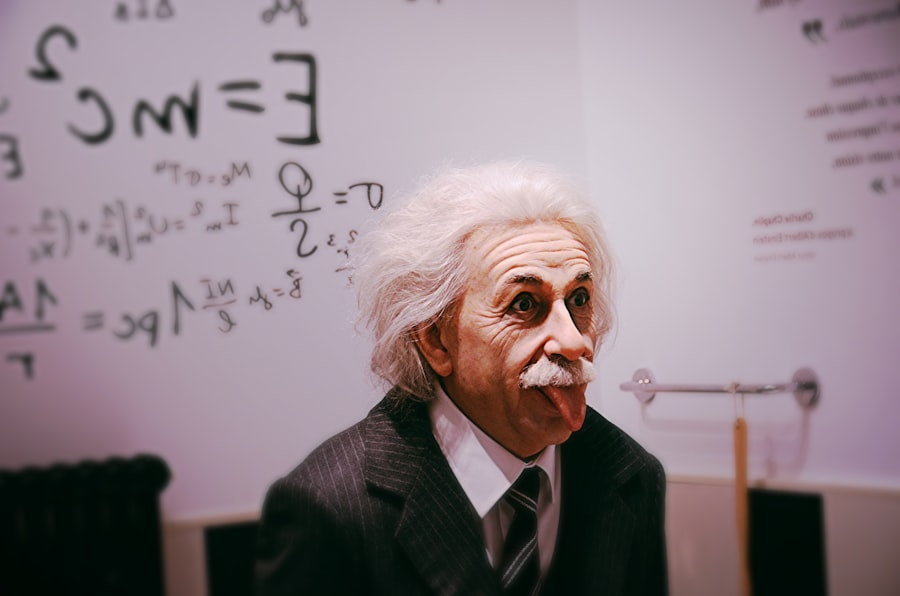
As you continue your journey through Einstein’s contributions to science, you will encounter the General Theory of Relativity, published in 1915. This theory expanded upon his earlier work by incorporating gravity into the framework of relativity. You might find it intriguing that Einstein proposed a revolutionary idea: gravity is not merely a force but rather a curvature of spacetime caused by massive objects.
This concept fundamentally changed how we perceive gravitational interactions and has had lasting implications for our understanding of the universe. The General Theory of Relativity has been confirmed through numerous experiments and observations over the years. For instance, when you consider how light bends around massive objects like stars or galaxies—a phenomenon known as gravitational lensing—you can appreciate how Einstein’s ideas have been validated in real-world scenarios.
This theory not only reshaped our understanding of gravity but also provided a new lens through which to view cosmology and astrophysics, influencing everything from black holes to the expansion of the universe.
Nobel Prize and Later Years
| Year | Nobel Prize Category | Recipient |
|---|---|---|
| 1962 | Peace | Linus Pauling |
| 1979 | Literature | Odysseas Elytis |
| 1993 | Peace | Nelson Mandela, F.W. de Klerk |
In 1921, your admiration for Einstein’s work would deepen when he was awarded the Nobel Prize in Physics. Interestingly, this prestigious accolade was not given for his theories of relativity but rather for his explanation of the photoelectric effect—a phenomenon that demonstrated how light can behave as both a wave and a particle. This recognition highlights the breadth of Einstein’s contributions to physics and underscores his role in laying the groundwork for quantum mechanics.
As you reflect on Einstein’s later years, you will find that he continued to be an influential figure in both science and society. After moving to the United States in 1933 due to the rise of the Nazi regime in Germany, he took a position at the Institute for Advanced Study in Princeton, New Jersey.
His later years were marked by a commitment to using his platform to address social issues, demonstrating that his influence extended far beyond the realm of physics.
E=mc² and the Atomic Bomb
The equation E=mc² is perhaps one of the most recognizable formulas in science, and its implications are both profound and troubling. As you explore this equation further, you will see how it laid the groundwork for nuclear energy and weapons development. While Einstein himself did not directly work on the atomic bomb, his letter to President Franklin D.
Roosevelt in 1939 warned about the potential for Nazi Germany to develop nuclear weapons. This letter ultimately led to the establishment of the Manhattan Project. You may grapple with the moral complexities surrounding Einstein’s contributions to nuclear technology.
On one hand, his work has enabled advancements in energy production; on the other hand, it has also facilitated devastating weapons capable of mass destruction. As you consider these dualities, you will come to appreciate how Einstein’s legacy is intertwined with both scientific progress and ethical dilemmas that continue to resonate today.
Unified Field Theory

As you delve into Einstein’s quest for a Unified Field Theory, you will uncover his desire to unify the fundamental forces of nature into a single theoretical framework. Throughout his later years, he sought to reconcile gravity with electromagnetism, believing that such a unification would provide a deeper understanding of the universe’s workings. This pursuit consumed much of his intellectual energy but ultimately eluded him.
You might find it intriguing that despite his failure to achieve a complete Unified Field Theory during his lifetime, Einstein’s efforts laid important groundwork for future physicists. His ideas inspired subsequent generations to explore unification theories, including string theory and quantum gravity. As you reflect on this aspect of his work, consider how Einstein’s relentless pursuit of knowledge exemplifies the spirit of scientific inquiry—an endeavor that often involves grappling with unanswered questions.
Influence on Quantum Mechanics
Einstein’s relationship with quantum mechanics is complex and multifaceted. While he made significant contributions to its development—most notably through his work on the photoelectric effect—he was also famously skeptical of some of its implications. You may recall his famous quote: “God does not play dice with the universe,” which reflects his discomfort with the inherent randomness present in quantum mechanics.
As you explore this tension between Einstein and quantum theory, you’ll discover that his critiques spurred further discussions and developments within the field. His debates with contemporaries like Niels Bohr highlighted fundamental philosophical questions about determinism and reality itself. Even though Einstein did not fully embrace quantum mechanics, his insights continue to influence ongoing research and discussions about the nature of reality.
Legacy in Astrophysics and Cosmology
Einstein’s impact on astrophysics and cosmology is nothing short of monumental. His theories have provided essential frameworks for understanding phenomena such as black holes, gravitational waves, and the expansion of the universe itself. As you study these concepts further, you’ll see how they have transformed our understanding of cosmic events and structures.
You may find it particularly fascinating that many modern discoveries in astrophysics are rooted in Einstein’s theories. For instance, observations confirming gravitational waves—ripples in spacetime caused by massive accelerating objects—validate predictions made by Einstein over a century ago. As you reflect on these advancements, consider how they underscore Einstein’s lasting influence on our quest to comprehend the cosmos.
Time Travel and Einstein’s Theories
The notion of time travel often captures your imagination, and it’s intriguing to consider how Einstein’s theories have contributed to this concept within scientific discourse. According to relativity, time is not a fixed entity; rather, it can be affected by speed and gravity. You might be surprised to learn that under certain conditions—such as traveling near the speed of light or existing near a massive object—time can dilate or contract.
As you ponder these ideas further, you’ll discover that while time travel remains largely theoretical at this point, Einstein’s work has inspired countless discussions about its possibilities within both science fiction and scientific inquiry. The interplay between relativity and time travel continues to captivate scientists and enthusiasts alike as they explore what might be possible within the fabric of spacetime.
Einstein’s Big Leap Through Time in Popular Culture
Einstein’s influence extends far beyond academic circles; he has become an iconic figure in popular culture as well. You may have encountered references to him in films, literature, and art—often symbolizing genius or groundbreaking thought. His image has become synonymous with intellectual prowess, making him a cultural touchstone for discussions about science and innovation.
As you explore these cultural representations further, you’ll find that they often reflect society’s fascination with science and its potential to reshape our understanding of reality. From movies depicting time travel inspired by relativity to books exploring philosophical questions raised by his theories, Einstein’s legacy continues to resonate across various forms of media.
Continuing Impact and Relevance of Einstein’s Work
As you reflect on Einstein’s enduring legacy, it’s clear that his work remains relevant today. His theories continue to inform contemporary research across multiple disciplines within physics and beyond.
Moreover, as society faces complex challenges—ranging from climate change to technological advancements—Einstein’s emphasis on curiosity and critical thinking serves as a guiding principle for future generations. His life exemplifies how one individual’s pursuit of knowledge can lead to transformative discoveries that shape our world for years to come. As you consider your own journey through learning and discovery, remember that curiosity is at the heart of scientific progress—a legacy that Albert Einstein has left behind for all who seek answers about our universe.
In the realm of personal development and time management, the concept of “Einstein Time” from Gay Hendricks’ book “The Big Leap” offers a transformative perspective on how we perceive and utilize time. This idea suggests that by taking full ownership of our time, we can expand it to accommodate our priorities and passions. For those interested in exploring similar concepts, an article on My Cosmic Ventures delves into innovative approaches to time management and personal growth, providing readers with practical insights and strategies to enhance their productivity and well-being.
Why Time Freezes at Light Speed
FAQs
What is the Big Leap Einstein Time?
The Big Leap Einstein Time is a concept introduced by Gay Hendricks in his book “The Big Leap.” It refers to a state of time where individuals are fully present and focused, allowing them to experience time as abundant and expansive.
Who is Einstein and what does he have to do with time?
Albert Einstein was a renowned physicist known for his theory of relativity, which revolutionized our understanding of time and space. His work showed that time is not a fixed and absolute concept, but rather a relative and flexible dimension that can be influenced by various factors.
How can one experience Big Leap Einstein Time?
According to Gay Hendricks, individuals can experience Big Leap Einstein Time by overcoming their “upper limit” beliefs and fears, and by fully embracing their zone of genius. This involves being fully present, focused, and engaged in activities that bring joy and fulfillment.
What are the benefits of experiencing Big Leap Einstein Time?
Experiencing Big Leap Einstein Time can lead to a sense of time abundance, increased productivity, creativity, and overall well-being. It allows individuals to tap into their full potential and live a more fulfilling and purposeful life.
Can anyone experience Big Leap Einstein Time?
According to Gay Hendricks, anyone has the potential to experience Big Leap Einstein Time by identifying and overcoming their limiting beliefs, and by fully embracing their zone of genius. It requires a willingness to let go of fears and self-imposed limitations.