
Black holes have long captivated the imagination of scientists and the general public alike. These enigmatic cosmic entities, regions in space where gravity is so intense that nothing, not even light, can escape their grasp, challenge the very fabric of our understanding of physics. The term “black hole” was first coined in the 1960s, but the concept has roots that trace back to the early 18th century when the idea of a “dark star” was proposed by the British natural philosopher John Michell.
Since then, black holes have evolved from theoretical curiosities into critical components of modern astrophysics. The study of black holes encompasses a wide range of phenomena, from their formation and growth to their interactions with surrounding matter and their influence on galaxy evolution. As researchers delve deeper into the mysteries of these cosmic giants, they uncover insights that not only enhance our understanding of the universe but also challenge existing theories of physics.
The quest to comprehend black holes is not merely an academic pursuit; it holds profound implications for our understanding of space, time, and the fundamental laws governing the cosmos.
Key Takeaways
- Black holes are regions of spacetime where gravity is so strong that nothing, not even light, can escape.
- Black holes can form from the collapse of massive stars, the collision of neutron stars, or the collapse of a large cloud of gas.
- Understanding black hole growth involves studying the process of accretion, where matter falls into the black hole and releases energy in the form of radiation.
- Supermassive black holes, with masses millions to billions of times that of the sun, are found at the centers of most galaxies.
- Observing black hole growth involves using telescopes and other instruments to detect the radiation emitted by the accretion process.
The Formation of Black Holes
The formation of black holes is a complex process that can occur through several distinct mechanisms. One of the most well-known pathways is the gravitational collapse of massive stars. When a star exhausts its nuclear fuel, it can no longer support itself against gravitational forces.
The core collapses under its own weight, leading to a supernova explosion that expels the outer layers of the star. If the remaining core’s mass exceeds a certain threshold, known as the Tolman-Oppenheimer-Volkoff limit, it will collapse into a black hole. Another intriguing formation mechanism involves the merging of smaller black holes or neutron stars.
In dense stellar environments, such as globular clusters, these compact objects can collide and merge, resulting in a more massive black hole. Additionally, primordial black holes may have formed in the early universe due to density fluctuations shortly after the Big Bang. These hypothetical black holes could provide insights into the conditions of the early universe and contribute to our understanding of dark matter.
Understanding Black Hole Growth
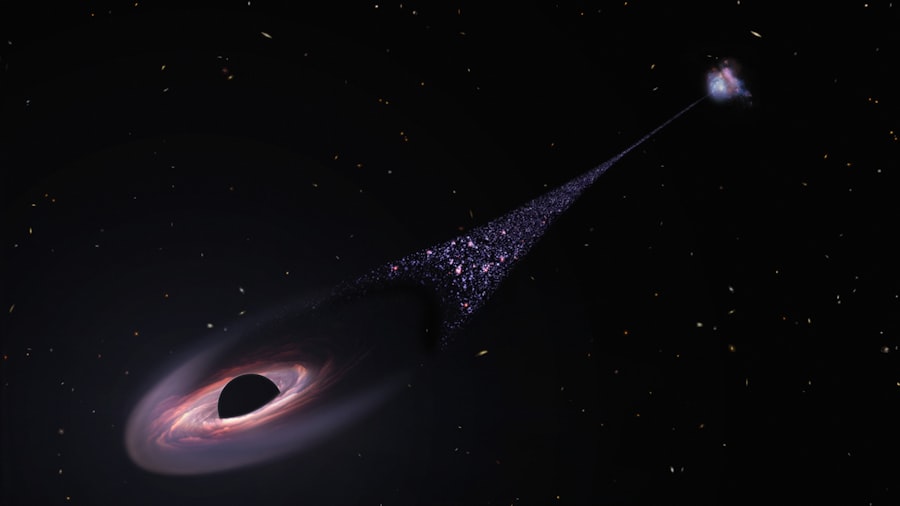
Once formed, black holes can grow significantly over time through various processes. Their growth is primarily driven by the accretion of surrounding matter, which can include gas, dust, and even stars. As matter spirals into a black hole, it forms an accretion disk—a swirling mass of material that heats up due to friction and gravitational forces, emitting radiation across the electromagnetic spectrum.
This process not only increases the mass of the black hole but also generates immense energy that can be observed from vast distances. The growth rate of a black hole can vary widely depending on its environment and the availability of material to consume. Some black holes grow rapidly, becoming supermassive within a relatively short time frame, while others may grow more slowly over billions of years.
Understanding these growth patterns is crucial for unraveling the mysteries surrounding black holes and their role in shaping galaxies and cosmic structures.
Accretion: The Fuel for Black Hole Growth
| Black Hole | Accretion Rate (Solar Masses per year) | Luminosity (Solar Luminosities) |
|---|---|---|
| Sagittarius A* | 1.5 x 10^-5 | 3.6 x 10^6 |
| NGC 4395 | 0.0002 | 0.0003 |
| Quasar 3C 273 | 10 | 2.2 x 10^12 |
Accretion serves as the primary fuel for black hole growth, and it occurs through various mechanisms depending on the surrounding environment. In many cases, gas from nearby stars or interstellar medium falls into the gravitational well of a black hole, forming an accretion disk. This disk is characterized by high temperatures and pressures, leading to the emission of X-rays and other forms of radiation as matter spirals inward.
The efficiency of accretion can vary significantly based on factors such as the density of surrounding material and the black hole’s spin. Rapidly spinning black holes can extract energy from their accretion disks more efficiently than non-rotating ones, leading to faster growth rates. Additionally, interactions with companion stars or other celestial bodies can enhance accretion rates by funneling material toward the black hole.
Understanding these processes is essential for comprehending how black holes evolve over time and their impact on their host galaxies.
The Role of Supermassive Black Holes
Supermassive black holes (SMBHs), which reside at the centers of most galaxies, play a pivotal role in cosmic evolution. These colossal entities can have masses ranging from millions to billions of times that of our Sun. Their formation is still a subject of intense research, but it is believed that they may have originated from smaller black holes merging or from direct collapse scenarios in dense environments.
SMBHs exert significant influence on their host galaxies through gravitational interactions and energetic feedback mechanisms. As they grow by accreting matter, they can release vast amounts of energy in the form of jets and radiation, impacting star formation rates and the overall dynamics of their galaxies. The relationship between SMBHs and their host galaxies is complex; they are thought to co-evolve, with each influencing the other’s growth and development over cosmic time.
Observing Black Hole Growth
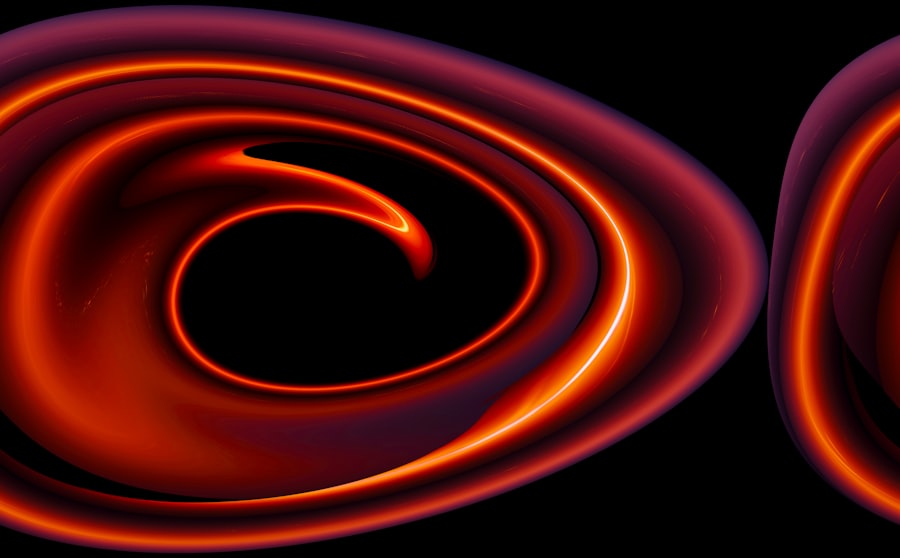
Observing black hole growth presents unique challenges due to their nature—specifically, their inability to emit light directly. However, astronomers have developed innovative techniques to study these elusive objects indirectly. One common method involves observing the effects of a black hole’s gravity on nearby stars or gas clouds.
Another powerful tool for studying black hole growth is through X-ray observations. When matter falls into a black hole and forms an accretion disk, it emits X-rays as it heats up.
Space-based observatories like NASA’s Chandra X-ray Observatory have provided invaluable data on these emissions, allowing researchers to estimate accretion rates and study the environments surrounding black holes. Additionally, gravitational wave detections from merging black holes have opened a new window into understanding their growth history and population.
The Influence of Galaxy Interactions on Black Hole Growth
Galaxy interactions play a crucial role in shaping both galaxies and their central black holes. When two galaxies collide or pass close to one another, their gravitational forces can trigger significant changes in their structures and dynamics.
Moreover, these interactions can result in mergers between supermassive black holes at the centers of colliding galaxies. As these black holes spiral toward each other due to gravitational radiation, they eventually merge into a single more massive entity. This process not only contributes to the growth of individual black holes but also has implications for galaxy evolution as a whole, influencing star formation rates and altering galactic morphology.
Feedback Mechanisms in Black Hole Growth
Feedback mechanisms are critical in regulating black hole growth and its impact on surrounding environments. As black holes accrete material and release energy in various forms—such as jets or radiation—they can influence star formation rates within their host galaxies. This feedback can either suppress or enhance star formation depending on the balance between energy output and gas availability.
For instance, powerful jets emitted by actively accreting supermassive black holes can heat surrounding gas and prevent it from cooling and collapsing into new stars. Conversely, in some scenarios, feedback may compress gas clouds, triggering bursts of star formation. Understanding these feedback mechanisms is essential for constructing accurate models of galaxy evolution and comprehending how black holes shape their cosmic neighborhoods.
Unraveling the Mysteries of Black Hole Jets
Black hole jets are among the most fascinating phenomena associated with these cosmic giants. These highly collimated streams of charged particles are ejected at nearly the speed of light from regions near supermassive black holes. The exact mechanisms behind jet formation remain an area of active research; however, it is believed that they are closely linked to the dynamics of accretion disks and magnetic fields.
The study of jets provides valuable insights into high-energy astrophysics and offers clues about the environments surrounding supermassive black holes. Observations across various wavelengths—from radio to gamma rays—have revealed intricate structures within jets and their interactions with surrounding matter. Understanding these jets not only enhances knowledge about black hole growth but also sheds light on fundamental processes occurring in extreme astrophysical environments.
The Connection Between Black Hole Growth and Galaxy Evolution
The interplay between black hole growth and galaxy evolution is a central theme in modern astrophysics. As supermassive black holes grow through accretion and mergers, they influence their host galaxies in profound ways. The energy released during these processes can regulate star formation rates and shape galactic structures over cosmic timescales.
Furthermore, there is evidence suggesting a correlation between the mass of supermassive black holes and various properties of their host galaxies—such as bulge mass or stellar velocity dispersion—known as the M-sigma relation. This relationship implies that as galaxies evolve, so too do their central black holes, highlighting a co-evolutionary process that shapes both entities over time.
Future Directions in Black Hole Research
As technology advances and observational techniques improve, future research on black holes promises to yield even deeper insights into these enigmatic objects. Upcoming missions such as NASA’s James Webb Space Telescope will enable astronomers to probe distant galaxies and study early supermassive black holes in unprecedented detail. Additionally, advancements in gravitational wave astronomy will continue to provide valuable data on merging black holes, enhancing understanding of their population dynamics.
Moreover, theoretical developments in physics may lead to new models that better explain phenomena associated with black holes, including jet formation and feedback mechanisms. As researchers continue to unravel the complexities surrounding these cosmic giants, they will not only deepen our understanding of black holes but also illuminate fundamental questions about the nature of space, time, and the universe itself. The journey into the heart of darkness promises to be one filled with discovery and wonder for generations to come.
In recent years, the study of black hole growth mechanisms has garnered significant attention in the astrophysics community. One intriguing aspect of this research is the role of accretion disks and their influence on the mass and spin of black holes. For a deeper understanding of these processes, you can explore a related article on the topic by visiting this page. This article delves into the complex interactions between black holes and their surrounding environments, shedding light on the dynamic processes that contribute to their growth and evolution.
WATCH THIS! 🌌The Biggest Black Hole Is A LIE
FAQs
What are black hole growth mechanisms?
Black hole growth mechanisms refer to the processes through which black holes increase in mass and size over time. This can occur through accretion of surrounding matter, mergers with other black holes, and other astrophysical phenomena.
How do black holes grow through accretion?
Black holes can grow through accretion, which is the process of pulling in surrounding matter such as gas, dust, and other celestial objects. As this matter falls into the black hole’s gravitational pull, it forms an accretion disk around the black hole and eventually gets consumed, adding to the black hole’s mass.
What role do mergers play in black hole growth?
Mergers between black holes can also contribute to their growth. When two black holes come into close proximity, they can merge together, combining their masses and forming a larger black hole.
Are there other mechanisms that contribute to black hole growth?
Other mechanisms that contribute to black hole growth include interactions with stars and other celestial bodies, as well as the potential influence of dark matter and other exotic forms of matter.
What are the implications of black hole growth mechanisms in astrophysics?
Understanding black hole growth mechanisms is crucial for astrophysicists to comprehend the evolution and behavior of black holes, as well as their impact on the surrounding galaxies and the universe as a whole. It also provides insights into the formation and growth of supermassive black holes at the centers of galaxies.