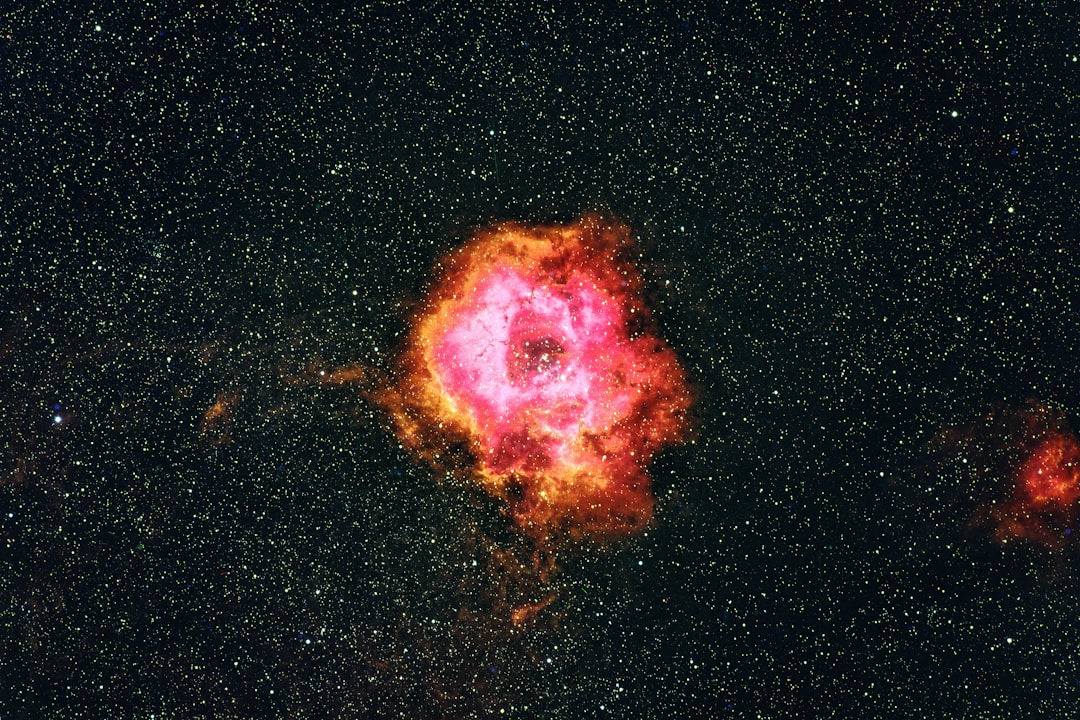
Black holes have long captivated the imagination of scientists and the general public alike. These enigmatic cosmic entities, formed from the remnants of massive stars, possess gravitational fields so intense that nothing, not even light, can escape their grasp. The concept of a black hole challenges the very foundations of physics, pushing the boundaries of human understanding about the universe.
As researchers delve deeper into the mysteries surrounding these celestial phenomena, they uncover a wealth of information that not only enhances our comprehension of black holes but also sheds light on the fundamental workings of the cosmos. The term “black hole” was first coined in the 1960s, but the idea has roots that trace back to the early 18th century when the British natural philosopher John Michell speculated about “dark stars” whose gravity was so strong that light could not escape. Since then, advancements in theoretical physics and observational technology have allowed scientists to study black holes more closely.
Today, they are recognized as critical components of the universe, influencing the formation and evolution of galaxies and stars. As researchers continue to explore their properties and behaviors, black holes remain a focal point in astrophysics, offering insights into the nature of space, time, and gravity.
Key Takeaways
- Black holes are regions in space where the gravitational pull is so strong that nothing, not even light, can escape.
- The mass of a black hole is a key factor in determining its properties, including its size and gravitational pull.
- The Schwarzschild radius is the distance from the center of a black hole to the event horizon, the point of no return for anything falling into the black hole.
- There is an upper limit to the mass of a black hole, beyond which it would collapse into a singularity or undergo other exotic processes.
- Stellar evolution plays a crucial role in determining the mass of black holes, as massive stars can collapse into black holes at the end of their life cycle.
The Concept of Black Hole Mass
The mass of a black hole is one of its defining characteristics and plays a crucial role in determining its behavior and influence on surrounding matter. Black holes can vary significantly in mass, ranging from stellar black holes, which typically have masses several times that of our Sun, to supermassive black holes that can contain millions or even billions of solar masses. Understanding the mass of a black hole is essential for comprehending its gravitational pull and its interactions with nearby celestial bodies.
Mass is not merely a measure of how much matter a black hole contains; it also dictates the black hole’s lifecycle and its potential to grow over time. For instance, stellar black holes are formed from the gravitational collapse of massive stars at the end of their life cycles. In contrast, supermassive black holes are believed to have formed through different processes, including the merging of smaller black holes and the accretion of gas and stars over billions of years.
The study of black hole mass is thus intertwined with various astrophysical phenomena, making it a vital area of research in understanding the universe’s evolution.
The Schwarzschild Radius and Event Horizon
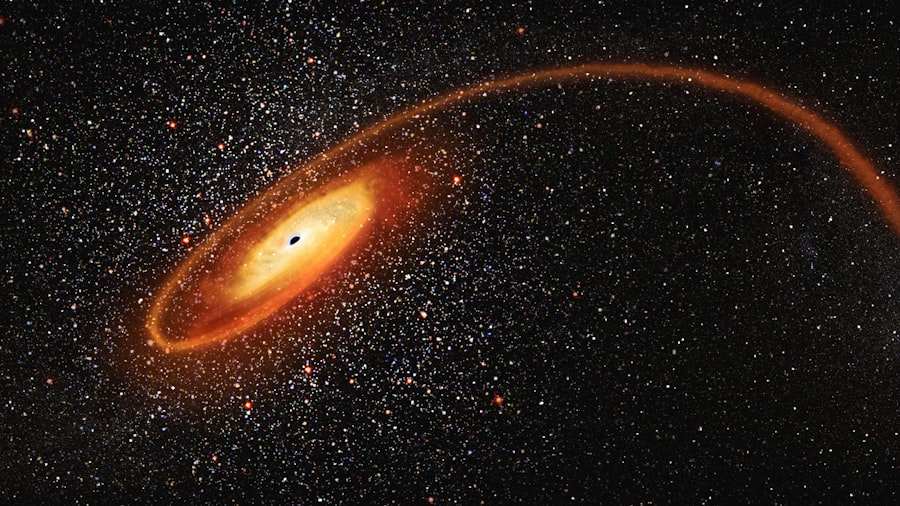
The Schwarzschild radius is a critical concept in understanding black holes, representing the boundary beyond which nothing can escape their gravitational pull. Named after the German physicist Karl Schwarzschild, who derived this solution to Einstein’s field equations in 1916, the Schwarzschild radius is directly proportional to the mass of the black hole. For any given mass, this radius defines the size of the event horizon—the point of no return for any object approaching a black hole.
The event horizon serves as a crucial demarcation line in the study of black holes. Once an object crosses this threshold, it is inexorably drawn into the black hole’s singularity, where density becomes infinite and the laws of physics as currently understood cease to apply. This boundary is not a physical surface but rather a mathematical construct that helps scientists understand how black holes interact with their surroundings.
The event horizon’s properties are essential for predicting how black holes will behave as they consume matter and interact with other celestial objects.
The Upper Limit of Black Hole Mass
| Black Hole | Upper Limit of Mass (solar masses) | Reference |
|---|---|---|
| Stellar-mass black hole | 100 | Observational evidence |
| Intermediate-mass black hole | 1000 | Observational evidence |
| Supermassive black hole | 10^10 – 10^11 | Observational evidence |
While black holes can grow to immense sizes, there appears to be an upper limit to their mass, particularly for stellar black holes. This limit is often referred to as the Tolman-Oppenheimer-Volkoff (TOV) limit, which suggests that there is a maximum mass beyond which a neutron star cannot support itself against gravitational collapse. For stellar remnants, this limit is typically around three solar masses; beyond this threshold, a neutron star would collapse into a black hole.
These colossal entities can reach masses far exceeding those of stellar black holes, with some estimates suggesting they can grow to billions of solar masses. The mechanisms behind their formation and growth remain an active area of research.
Theories propose that supermassive black holes may form from the merging of smaller black holes or through direct collapse from massive gas clouds in the early universe. Understanding these limits is crucial for astrophysicists as they seek to unravel the complexities surrounding black hole formation and evolution.
The Role of Stellar Evolution in Black Hole Mass
Stellar evolution plays a pivotal role in determining the mass of black holes formed from dying stars. When massive stars exhaust their nuclear fuel, they undergo dramatic changes that lead to their eventual collapse under gravity. This process results in either a neutron star or a black hole, depending on the initial mass of the star.
Stars with masses greater than approximately 20 solar masses are likely to end their lives as black holes after undergoing supernova explosions. The mass of the progenitor star directly influences the characteristics of the resulting black hole. For instance, more massive stars tend to produce larger black holes due to their greater gravitational pull during collapse.
Additionally, factors such as metallicity—the abundance of elements heavier than hydrogen and helium—can affect stellar evolution pathways and ultimately influence black hole mass. As researchers continue to study stellar evolution and its relationship with black hole formation, they gain valuable insights into how these cosmic giants come into existence.
The Influence of Accretion on Black Hole Mass
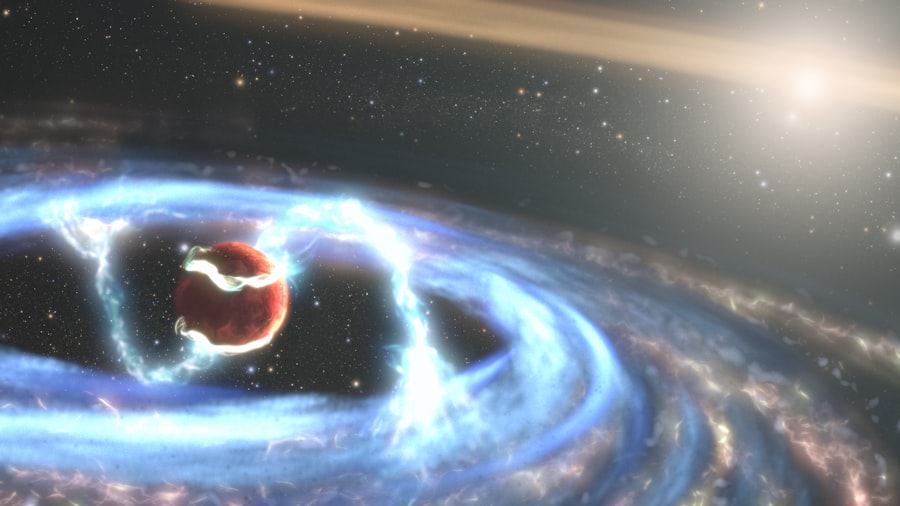
Accretion plays a significant role in determining how black holes grow over time. As matter falls into a black hole’s gravitational well, it forms an accretion disk—a swirling disk of gas and dust that spirals inward before crossing the event horizon. This process not only contributes to an increase in mass but also generates immense amounts of energy in the form of radiation due to friction and gravitational forces acting on the infalling material.
The rate at which a black hole accretes matter can vary widely depending on its environment. In regions rich in gas and dust, such as active galactic nuclei or star-forming regions, black holes can experience rapid growth. Conversely, in less dense environments, accretion may occur at a much slower pace.
Understanding these dynamics is crucial for astrophysicists seeking to explain how supermassive black holes can reach their enormous sizes within relatively short cosmic timescales.
The Impact of Supermassive Black Holes
Supermassive black holes are found at the centers of most galaxies, including our own Milky Way. Their presence has profound implications for galaxy formation and evolution. These colossal entities exert significant gravitational influence on their host galaxies, affecting star formation rates and galactic dynamics.
The relationship between supermassive black holes and their host galaxies is complex; as galaxies evolve, so too do their central black holes. Research has shown that there is a correlation between the mass of a supermassive black hole and various properties of its host galaxy, such as bulge mass and stellar velocity dispersion.
As scientists continue to investigate these connections, they uncover new insights into how supermassive black holes shape not only their immediate surroundings but also the broader structure of the universe.
Theoretical and Observational Constraints on Black Hole Mass
The study of black hole mass is constrained by both theoretical frameworks and observational techniques. Theoretical models provide predictions about how black holes should behave based on their mass and surrounding environment. These models are essential for interpreting observational data collected from telescopes and other instruments designed to detect electromagnetic radiation emitted by accreting matter or gravitational waves produced by merging black holes.
Observationally, measuring black hole mass can be challenging due to their inherently elusive nature. Techniques such as stellar dynamics—analyzing the motion of stars around a central object—have been employed to estimate masses indirectly. Additionally, advancements in gravitational wave astronomy have opened new avenues for detecting merging black holes and measuring their masses with unprecedented precision.
As technology continues to evolve, researchers are better equipped to refine their understanding of black hole mass and its implications for astrophysics.
The Connection Between Black Hole Mass and Galaxy Evolution
The interplay between black hole mass and galaxy evolution is an area of intense research interest within astrophysics. Observations suggest that supermassive black holes are intimately linked with their host galaxies’ growth and development over cosmic time scales. This connection raises important questions about causality: do galaxies form around supermassive black holes, or do these central giants emerge as a result of galactic evolution?
Recent studies indicate that feedback mechanisms from supermassive black holes may regulate star formation within galaxies by expelling gas or heating it up through energetic outflows. This process can inhibit further star formation and shape the overall structure of galaxies. Understanding this relationship is crucial for developing comprehensive models that explain how galaxies evolve alongside their central black holes throughout cosmic history.
The Role of Black Holes in the Universe
Black holes play an integral role in shaping the universe as we know it. Beyond their influence on individual galaxies, they contribute to large-scale cosmic structures and dynamics. For instance, supermassive black holes are thought to be key players in galaxy mergers, where two galaxies collide and interact gravitationally.
These events can lead to significant changes in both galaxies’ structures and star formation activities. Moreover, black holes are essential for understanding fundamental physics concepts such as gravity and spacetime curvature. They serve as natural laboratories for testing theories like general relativity under extreme conditions.
As researchers continue to explore these enigmatic objects, they uncover new insights into not only their nature but also the broader workings of the universe itself.
Future Research and Implications for Astrophysics
The study of black holes remains one of the most dynamic fields within astrophysics, with ongoing research poised to yield groundbreaking discoveries in the coming years. Future advancements in observational technology—such as next-generation telescopes and gravitational wave detectors—will enhance scientists’ ability to probe deeper into the mysteries surrounding these cosmic giants. As researchers continue to unravel the complexities associated with black hole mass and its implications for galaxy evolution and cosmic structure formation, they will undoubtedly refine existing theories while potentially uncovering new phenomena that challenge current understanding.
The quest to comprehend black holes not only enriches knowledge about these fascinating entities but also contributes significantly to humanity’s broader understanding of the universe’s origins and evolution.
In the fascinating realm of astrophysics, the study of black holes continues to captivate scientists and enthusiasts alike. One intriguing aspect of this research is the exploration of the limits of black hole mass. For those interested in delving deeper into this topic, a related article can be found on My Cosmic Ventures. This article provides insights into the theoretical and observational constraints that define the maximum mass a black hole can attain. To explore this further, you can visit the article by following this link.
WATCH THIS! 🌌The Biggest Black Hole Is A LIE
FAQs
What are the limits of black hole mass?
The limits of black hole mass are determined by the processes of black hole formation and evolution, as well as the physical laws governing the behavior of matter and energy in the universe.
What is the minimum mass for a black hole to form?
The minimum mass for a black hole to form is generally believed to be around 3 times the mass of the Sun. This is known as the Tolman-Oppenheimer-Volkoff limit, which is the maximum mass of a stable, non-rotating neutron star.
What is the maximum mass for a black hole to exist?
The maximum mass for a black hole to exist is not precisely known, but it is believed to be around 100 times the mass of the Sun. This is based on theoretical models and observations of the largest known black holes in the universe.
What happens if a black hole exceeds its maximum mass limit?
If a black hole exceeds its maximum mass limit, it may undergo a process called “runaway fusion” where the excess mass is converted into energy through nuclear fusion, potentially leading to a catastrophic explosion known as a “pair-instability supernova.”
Can black holes merge to form larger black holes?
Yes, black holes can merge to form larger black holes through a process called black hole coalescence. This occurs when two or more black holes orbit each other and eventually merge due to the emission of gravitational waves.
Are there any observed black holes that exceed the maximum mass limit?
As of now, there are no observed black holes that exceed the maximum mass limit of around 100 times the mass of the Sun. However, ongoing research and observations continue to expand our understanding of black hole mass limits.