
Black holes have long captivated the imagination of scientists and the general public alike. These enigmatic cosmic entities, formed from the remnants of massive stars that have undergone gravitational collapse, possess gravitational fields so intense that nothing, not even light, can escape their grasp. The concept of a black hole challenges the very foundations of physics, raising profound questions about the nature of space, time, and the universe itself.
As researchers delve deeper into the mysteries surrounding these celestial phenomena, they uncover layers of complexity that continue to intrigue and perplex. The study of black holes is not merely an academic pursuit; it has significant implications for our understanding of the universe. From their formation to their potential role in the evolution of galaxies, black holes are integral to the cosmic tapestry.
They serve as laboratories for testing the laws of physics under extreme conditions, providing insights into the fundamental forces that govern the cosmos. As technology advances and observational techniques improve, the exploration of black holes promises to yield even more groundbreaking discoveries in the years to come.
Key Takeaways
- Black holes are regions in space where the gravitational pull is so strong that nothing, not even light, can escape.
- The event horizon is the boundary around a black hole beyond which nothing can escape, and the singularity is the point of infinite density at the center of a black hole.
- The curvature of spacetime around a black hole is so extreme that it causes time to slow down and space to be distorted.
- Black holes have entropy and are subject to the information paradox, which raises questions about the conservation of information in the universe.
- Black hole thermodynamics describes the relationship between the mass, area, and entropy of a black hole, and how it behaves like a thermodynamic system.
The Event Horizon and Singularity
At the heart of every black hole lies a boundary known as the event horizon, a point of no return beyond which nothing can escape the black hole’s gravitational pull. This boundary is not a physical surface but rather a mathematical construct that delineates the region where escape velocity exceeds the speed of light. Once an object crosses this threshold, it is inexorably drawn toward the singularity, a point of infinite density where the laws of physics as we know them break down.
The event horizon thus serves as a critical demarcation in understanding the behavior of matter and energy in extreme gravitational fields. The singularity itself poses profound challenges to physicists. It represents a breakdown of our current understanding of space and time, as general relativity predicts that all mass collapses into an infinitely small point.
This raises fundamental questions about the nature of reality and the limits of human knowledge. The singularity is shrouded in mystery, and while it is a theoretical construct, its implications ripple through various fields of study, from quantum mechanics to cosmology. As researchers grapple with these concepts, they seek to reconcile the apparent contradictions between general relativity and quantum theory, hoping to unlock the secrets held within these cosmic enigmas.
The Curvature of Spacetime
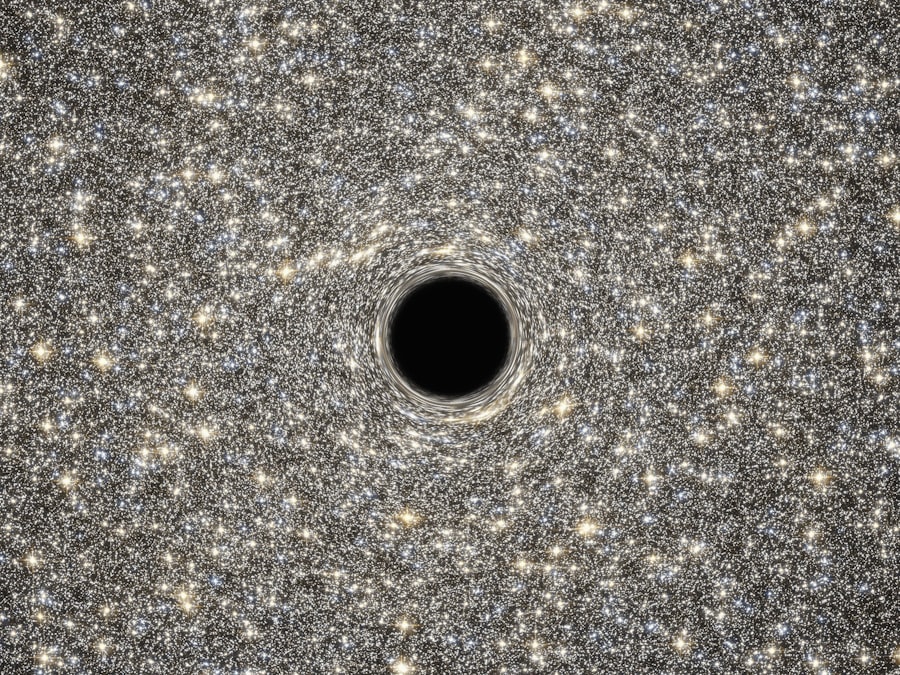
The concept of spacetime curvature is central to understanding black holes and their effects on surrounding matter and light. According to Einstein’s theory of general relativity, massive objects warp the fabric of spacetime, creating a gravitational field that influences the motion of other objects. In the vicinity of a black hole, this curvature becomes extreme, leading to phenomena such as gravitational lensing, where light from distant stars is bent around the black hole, creating distorted images.
This effect not only provides evidence for the existence of black holes but also offers insights into their mass and spin. As spacetime curves around a black hole, it creates a dynamic environment where time behaves differently than in less extreme gravitational fields. For an observer far from a black hole, time appears to pass normally; however, for an object approaching the event horizon, time slows down significantly due to the intense gravitational effects.
This phenomenon has profound implications for our understanding of time itself and raises questions about how different observers perceive reality in varying gravitational contexts. The interplay between mass, energy, and spacetime curvature continues to be a rich area of research, with implications for both theoretical physics and observational astronomy.
Black Hole Entropy and Information Paradox
| Concept | Definition |
|---|---|
| Black Hole Entropy | The measure of the number of ways in which the microscopic constituents of a black hole can be arranged to correspond to the macroscopic black hole state. |
| Information Paradox | The conflict between the principles of quantum mechanics and general relativity regarding the fate of information that falls into a black hole. |
| Hawking Radiation | The theoretical radiation that is predicted to be emitted by black holes due to quantum effects near the event horizon. |
| Event Horizon | The boundary surrounding a black hole beyond which events cannot affect an outside observer. |
The concept of entropy in relation to black holes introduces intriguing questions about thermodynamics and information theory. In 1970, physicist Jacob Bekenstein proposed that black holes possess entropy proportional to their surface area rather than their volume, leading to the formulation of what is now known as Bekenstein-Hawking entropy. This idea suggests that black holes are not merely voids in space but rather complex thermodynamic systems with measurable properties.
The implications of this discovery extend beyond black holes themselves, challenging traditional notions of entropy and disorder in physical systems. The information paradox arises from the apparent contradiction between quantum mechanics and general relativity regarding information preservation. According to quantum theory, information cannot be destroyed; however, when matter falls into a black hole, it seems to vanish from our universe entirely.
This dilemma has sparked intense debate among physicists, with various proposed resolutions ranging from holographic principles to theories suggesting that information may be encoded on the event horizon itself. As researchers continue to explore these ideas, they seek to reconcile the fundamental principles governing quantum mechanics with those governing gravity.
Black Hole Thermodynamics
Black hole thermodynamics is a fascinating field that merges concepts from thermodynamics with those from general relativity. The laws of thermodynamics apply surprisingly well to black holes, leading to a deeper understanding of their nature and behavior. The first law of thermodynamics can be interpreted in terms of black hole mass, entropy, and temperature, suggesting that black holes can exchange energy with their surroundings much like conventional thermodynamic systems.
This analogy has profound implications for our understanding of energy conservation in extreme environments. The second law of thermodynamics states that entropy tends to increase over time; when applied to black holes, this principle implies that the total entropy of a system—including both matter and black holes—must always increase. This leads to intriguing questions about the fate of information and matter that falls into a black hole.
As researchers explore these connections further, they uncover new insights into how black holes interact with their environment and how they might evolve over cosmic timescales.
Black Hole Evaporation and Hawking Radiation

One of the most groundbreaking concepts in black hole physics is Hawking radiation, proposed by physicist Stephen Hawking in 1974. This phenomenon arises from quantum effects near the event horizon, where particle-antiparticle pairs spontaneously form due to fluctuations in vacuum energy.
This process leads to what is known as black hole evaporation—a gradual reduction in mass that could ultimately result in the complete disappearance of a black hole. Hawking’s prediction has profound implications for our understanding of black holes and their lifecycle. It suggests that black holes are not eternal but rather dynamic entities that can lose mass and energy over time.
This revelation has sparked further research into the fate of information contained within evaporating black holes and how it might be reconciled with existing theories in quantum mechanics. As scientists continue to investigate Hawking radiation and its consequences, they are challenged to rethink fundamental concepts about matter, energy, and the nature of reality itself.
The Kerr Black Hole and Ergosphere
While many discussions about black holes focus on Schwarzschild black holes—those that are non-rotating—the Kerr black hole introduces additional complexity by accounting for rotation.
Kerr, this type of black hole possesses angular momentum and exhibits unique features such as an ergosphere—a region outside the event horizon where spacetime is dragged around by the rotating mass.
The presence of an ergosphere allows for fascinating phenomena such as energy extraction from rotating black holes through processes like Penrose processes. The Kerr solution has significant implications for astrophysics and our understanding of cosmic evolution. Rotating black holes are believed to be more common than their non-rotating counterparts and play crucial roles in galaxy formation and evolution.
Their unique properties challenge existing models and prompt researchers to explore how angular momentum influences accretion processes and jet formation in active galactic nuclei. As scientists continue to study Kerr black holes and their effects on surrounding matter, they gain valuable insights into some of the most energetic phenomena observed in the universe.
Wormholes and Black Hole Connections
Wormholes are theoretical constructs that arise from solutions to Einstein’s equations in general relativity, often depicted as shortcuts through spacetime connecting distant regions of the universe. While they remain speculative entities without experimental evidence, their connection to black holes is intriguing. Some theories suggest that traversable wormholes could be formed by manipulating black holes or by exploiting their unique properties.
This idea raises tantalizing possibilities for interstellar travel and communication across vast distances. The relationship between wormholes and black holes also touches upon fundamental questions about causality and time travel. If wormholes could exist as bridges between different points in spacetime, they might allow for scenarios where information or matter could traverse vast distances instantaneously or even travel back in time.
However, such concepts remain firmly within the realm of theoretical physics, requiring further exploration and validation through rigorous scientific inquiry.
Black Hole Mergers and Gravitational Waves
In recent years, advancements in observational technology have allowed scientists to detect gravitational waves—ripples in spacetime caused by cataclysmic events such as black hole mergers. The first direct detection of gravitational waves by LIGO in 2015 marked a monumental milestone in astrophysics, confirming predictions made by Einstein over a century earlier. These observations provide invaluable insights into the properties of merging black holes, including their masses and spins.
The study of black hole mergers has opened up new avenues for understanding cosmic evolution and the formation of supermassive black holes at the centers of galaxies. By analyzing gravitational wave signals from these events, researchers can probe fundamental questions about stellar evolution and the dynamics of binary systems. As gravitational wave astronomy continues to evolve, it promises to revolutionize our understanding of black holes and their role in shaping the universe.
The Black Hole Information Paradox and Resolution
The information paradox remains one of the most contentious issues in theoretical physics today. It arises from conflicting interpretations between quantum mechanics—where information is preserved—and general relativity—where information appears lost when matter falls into a black hole. Various proposed resolutions have emerged over time, including ideas suggesting that information may be encoded on the event horizon or that it could be released during Hawking radiation.
Recent developments in theoretical physics have led some researchers to propose holographic principles or quantum gravity theories as potential pathways toward resolving this paradox. These approaches aim to reconcile our understanding of information preservation with the behavior observed near black holes. As scientists continue to explore these ideas through mathematical modeling and experimental evidence, they inch closer to unraveling one of the most profound mysteries at the intersection of quantum mechanics and gravity.
The Future of Black Hole Research and Exploration
The future of black hole research holds immense promise as technological advancements pave new avenues for exploration. With next-generation telescopes like the James Webb Space Telescope set to revolutionize our observational capabilities, scientists anticipate unprecedented insights into distant black holes and their environments. Additionally, ongoing developments in gravitational wave detectors will enhance our ability to study merging black holes and other dynamic events across cosmic history.
As researchers continue to push boundaries in theoretical physics and observational astronomy, they remain committed to unraveling the mysteries surrounding these enigmatic entities. The quest for knowledge about black holes not only deepens humanity’s understanding of the universe but also challenges existing paradigms within science itself. With each discovery comes new questions—an endless cycle that fuels curiosity and drives exploration forward into uncharted territories beyond our current comprehension.
To gain a deeper understanding of black hole geometry, one might find it beneficial to explore related articles that delve into the intricacies of spacetime and gravitational effects. A particularly insightful resource can be found on My Cosmic Ventures, which offers a comprehensive overview of the fundamental concepts and recent discoveries in the field. For those interested in expanding their knowledge, I recommend visiting this related article that provides valuable insights into the complex nature of black holes and their impact on the surrounding universe.
WATCH THIS! 🌌The Biggest Black Hole Is A LIE
FAQs
What is black hole geometry?
Black hole geometry refers to the shape and structure of a black hole, which is a region of spacetime where gravity is so strong that nothing, not even light, can escape from it.
How is black hole geometry understood?
Black hole geometry is understood through the study of general relativity, which describes the curvature of spacetime caused by the presence of mass and energy. This curvature is what gives black holes their unique geometric properties.
What are some key features of black hole geometry?
Some key features of black hole geometry include the event horizon, which is the boundary beyond which nothing can escape, and the singularity, which is the point of infinite density at the center of the black hole.
How does black hole geometry differ from other objects in space?
Black hole geometry differs from the geometry of other objects in space due to the extreme curvature of spacetime near the black hole, as well as the presence of the event horizon and singularity.
Why is understanding black hole geometry important?
Understanding black hole geometry is important for advancing our knowledge of the fundamental nature of spacetime and gravity, as well as for exploring the potential implications of black holes for astrophysics and cosmology.