Cosmology, the scientific study of the universe’s origin, evolution, and eventual fate, has captivated human curiosity for centuries. It seeks to answer profound questions about the nature of existence, the structure of the cosmos, and the fundamental laws governing celestial phenomena. At the heart of modern cosmology lies the Standard Model, a theoretical framework that describes the universe’s large-scale structure and dynamics.
This model incorporates key concepts such as the Big Bang theory, cosmic inflation, and the expansion of the universe, providing a coherent narrative that aligns with a wealth of observational data. The Standard Model of cosmology is built upon Einstein’s theory of general relativity, which revolutionized our understanding of gravity and space-time. It posits that the universe began as a singularity approximately 13.8 billion years ago, followed by a rapid expansion that continues to this day.
This framework has been instrumental in explaining various phenomena, including the cosmic microwave background radiation and the distribution of galaxies across vast distances. However, while the Standard Model has proven remarkably successful in many respects, it is not without its shortcomings and unanswered questions.
Key Takeaways
- The Standard Model is the current framework for understanding the fundamental particles and forces in the universe.
- Challenges to the Standard Model include its inability to explain dark matter and dark energy, as well as inconsistencies with gravity at cosmological scales.
- New discoveries in cosmology, such as the detection of gravitational waves and the mapping of the cosmic microwave background, have provided valuable insights into the early universe.
- Theoretical frameworks for revising the Standard Model include theories such as supersymmetry, string theory, and extra dimensions, which aim to address its limitations.
- Integrating quantum mechanics and general relativity in the new model is a key challenge, as these two theories have been difficult to reconcile in the context of cosmology.
- Dark matter and dark energy are proposed to be addressed in the revised model through new particles, modified gravity, or alternative theories of spacetime.
- The revised cosmological model has implications for the Big Bang theory, potentially shedding light on the nature of the initial singularity and the early universe.
- Testing and validating the revised cosmological model will require new experiments, observations, and simulations to compare its predictions with observational data.
- Potential applications and technologies arising from the new model include advancements in astrophysics, particle physics, and possibly new energy sources or propulsion systems.
- Collaborative efforts and international research in cosmology are essential for advancing our understanding of the universe and addressing open questions in cosmological research.
Challenges and Limitations of the Standard Model
Despite its successes, the Standard Model faces significant challenges that have prompted scientists to reconsider its foundational principles. One of the most pressing issues is the nature of dark matter and dark energy, which together constitute about 95% of the universe’s total mass-energy content. While their existence is inferred from gravitational effects on visible matter, their precise nature remains elusive.
The Standard Model does not adequately explain what dark matter is or how dark energy drives the accelerated expansion of the universe. Additionally, the Standard Model struggles to reconcile quantum mechanics with general relativity. These two pillars of modern physics operate under vastly different principles; quantum mechanics governs the behavior of subatomic particles, while general relativity describes large-scale cosmic phenomena.
The inability to unify these theories into a single framework has led to significant gaps in understanding fundamental processes in the universe. As researchers delve deeper into cosmological phenomena, they encounter anomalies that challenge the assumptions underlying the Standard Model, prompting a search for new theories and models.
New Discoveries and Observations in Cosmology

Recent advancements in observational technology have yielded groundbreaking discoveries that challenge existing cosmological paradigms. The advent of powerful telescopes and sophisticated instruments has allowed astronomers to probe deeper into the cosmos than ever before. For instance, observations from the Hubble Space Telescope and more recently, the James Webb Space Telescope have provided unprecedented insights into galaxy formation and evolution.
These observations reveal complex structures and interactions that were previously hidden from view, suggesting that our understanding of cosmic history may need significant revision. Moreover, gravitational wave astronomy has opened a new window into the universe, allowing scientists to detect ripples in space-time caused by catastrophic events such as black hole mergers. These discoveries not only confirm predictions made by general relativity but also provide valuable data that can inform cosmological models.
As researchers continue to gather data from various sources, including cosmic microwave background measurements and large-scale galaxy surveys, they are beginning to piece together a more nuanced picture of the universe’s evolution.
Theoretical Frameworks for Revising the Standard Model
| Theoretical Frameworks | Revisions to Standard Model |
|---|---|
| Supersymmetry | Predicts new particles to balance out the forces in the Standard Model |
| Grand Unified Theory | Unifies the electromagnetic, weak, and strong nuclear forces into a single force |
| String Theory | Describes particles as tiny, vibrating strings instead of point-like particles |
In light of the challenges posed by dark matter, dark energy, and the quest for unification between quantum mechanics and general relativity, several theoretical frameworks have emerged as potential candidates for revising the Standard Model. One prominent approach is string theory, which posits that fundamental particles are not point-like objects but rather tiny vibrating strings. This theory aims to unify all fundamental forces, including gravity, within a single framework.
While string theory remains largely theoretical and untested, it offers intriguing possibilities for reconciling disparate aspects of physics. Another promising avenue is loop quantum gravity, which seeks to quantize space-time itself. This approach attempts to merge general relativity with quantum mechanics by proposing that space-time is composed of discrete units rather than being continuous.
Loop quantum gravity has garnered attention for its potential to address singularities present in black holes and the Big Bang while providing insights into the fabric of space-time. As researchers explore these and other theoretical frameworks, they aim to develop a more comprehensive understanding of the universe’s fundamental nature.
Quantum Mechanics and General Relativity in the New Model
The integration of quantum mechanics and general relativity remains one of the most significant challenges in modern physics. The new cosmological models being proposed seek to bridge this gap by incorporating principles from both theories. For instance, some researchers are exploring quantum field theories in curved space-time, which allow for a more nuanced understanding of how quantum effects manifest in gravitational fields.
This approach could lead to new insights into phenomena such as black hole evaporation and cosmic inflation. Additionally, researchers are investigating how quantum entanglement might play a role in cosmological processes. The idea that particles can be instantaneously connected across vast distances raises intriguing questions about information transfer in the universe and could have implications for our understanding of cosmic evolution.
By weaving together elements from both quantum mechanics and general relativity, scientists hope to construct a more cohesive model that accurately reflects the complexities of the universe.
Dark Matter and Dark Energy in the Revised Model
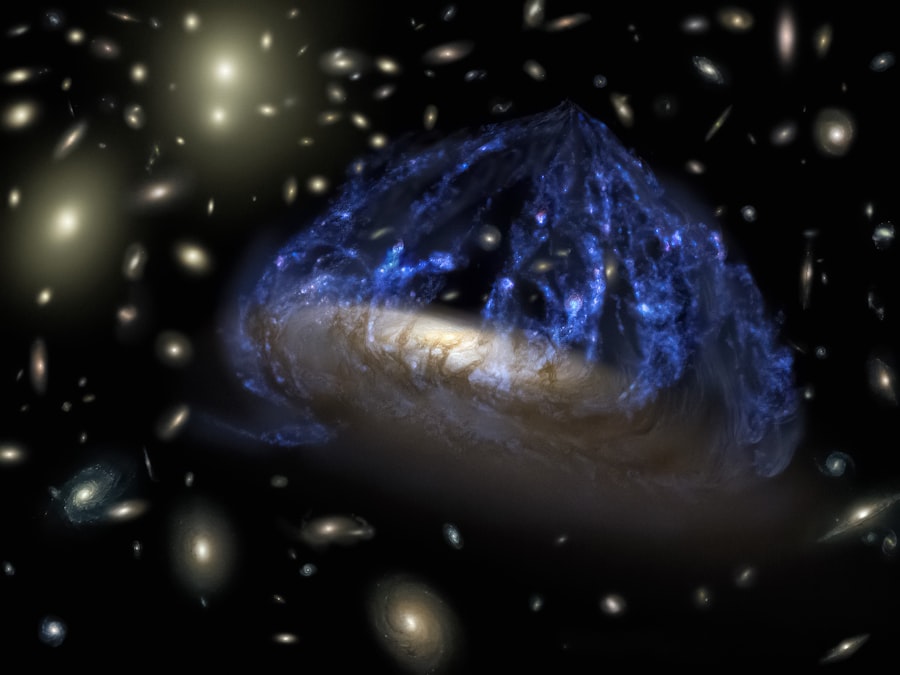
As cosmologists strive to revise the Standard Model, addressing dark matter and dark energy remains paramount. Various hypotheses have been proposed regarding dark matter’s composition, ranging from weakly interacting massive particles (WIMPs) to axions and sterile neutrinos. Each candidate presents unique challenges for detection and validation through experiments on Earth or through astronomical observations.
The revised models aim to incorporate these candidates while also considering alternative explanations for gravitational phenomena currently attributed to dark matter. Dark energy poses an equally perplexing challenge. The revised cosmological models must account for its role in driving the accelerated expansion of the universe while reconciling it with observations from supernovae and galaxy clusters.
Some researchers propose modifications to general relativity itself or explore dynamic models of dark energy that evolve over time. By integrating these concepts into a cohesive framework, scientists hope to shed light on one of cosmology’s most profound mysteries.
Implications for the Big Bang Theory
The ongoing exploration of new cosmological models has significant implications for our understanding of the Big Bang theory. While this theory has long been regarded as a cornerstone of modern cosmology, emerging evidence may necessitate revisions or extensions to its original formulation. For instance, if new models successfully incorporate quantum effects or alternative explanations for dark matter and dark energy, they could reshape our understanding of cosmic inflation and the conditions present during the early universe.
As researchers continue to refine their models based on new data, they may uncover previously unrecognized phases or transitions in cosmic history that could alter our perception of how the universe evolved from its initial singularity.
Testing and Validating the Revised Cosmological Model
The process of testing and validating revised cosmological models is crucial for establishing their credibility within the scientific community. Researchers employ a variety of methods to assess these models against observational data. For instance, simulations based on new theoretical frameworks can be compared with large-scale galaxy surveys to determine their accuracy in predicting cosmic structures.
Additionally, ongoing observations from telescopes and satellites provide critical data points that can either support or challenge these emerging models. Peer review plays an essential role in this validation process as well. As scientists publish their findings regarding new models or modifications to existing theories, their work undergoes rigorous scrutiny by experts in the field.
This collaborative effort ensures that only robust theories gain acceptance within cosmology while fostering an environment conducive to innovation and discovery.
Potential Applications and Technologies Arising from the New Model
The implications of revised cosmological models extend beyond theoretical physics; they also hold promise for practical applications and technological advancements. For instance, insights gained from understanding dark matter could lead to breakthroughs in particle physics or materials science. Similarly, advancements in gravitational wave detection technology may pave the way for new methods of communication or navigation based on principles derived from space-time manipulation.
Moreover, as researchers develop more sophisticated observational techniques informed by new cosmological models, they may uncover novel phenomena with potential applications across various fields. The interplay between fundamental research and technological innovation underscores how advancements in cosmology can ripple through society, influencing everything from energy production to information technology.
Collaborative Efforts and International Research in Cosmology
The complexity of cosmological research necessitates collaboration across disciplines and borders. International partnerships among universities, research institutions, and observatories have become increasingly common as scientists pool resources and expertise to tackle shared challenges. Initiatives such as global telescope networks enable researchers to coordinate observations across different wavelengths while sharing data in real time.
Furthermore, collaborative efforts extend beyond observational astronomy; theoretical physicists often work together across institutions to refine models and develop simulations that can be tested against empirical data.
Future Directions and Open Questions in Cosmological Research
As cosmology continues to evolve, numerous open questions remain at the forefront of research efforts. The nature of dark matter and dark energy persists as a central enigma; resolving these mysteries will likely require innovative approaches that challenge existing paradigms. Additionally, understanding how quantum mechanics interacts with gravity at cosmic scales remains an area ripe for exploration.
Future directions in cosmological research may also involve interdisciplinary approaches that integrate insights from fields such as astrophysics, particle physics, and even philosophy. As scientists strive to unravel the complexities of our universe, they will undoubtedly encounter new challenges that push the boundaries of human knowledge further than ever before. In conclusion, cosmology stands at a pivotal juncture as researchers grapple with both established theories and emerging discoveries that challenge conventional wisdom.
The journey toward a revised cosmological model promises not only to deepen humanity’s understanding of existence but also to inspire future generations of scientists seeking answers to some of life’s most profound questions.
In recent developments within the field of cosmology, a major revision of the standard cosmological model has been proposed, sparking widespread discussion and analysis among scientists. This revision aims to address discrepancies in the current understanding of the universe’s expansion and the distribution of dark matter. For those interested in exploring this topic further, an insightful article discussing the implications of these changes can be found on My Cosmic Ventures. This article delves into the potential impacts on our understanding of cosmic phenomena and the future direction of cosmological research. To read more about these groundbreaking changes, visit the article on My Cosmic Ventures.
WATCH THIS!🚀 The DESI Shockwave: Dark Energy is NOT Constant🚀🚀
FAQs
What is the standard cosmological model?
The standard cosmological model is the prevailing theory that describes the large-scale structure and evolution of the universe. It is based on the Big Bang theory and includes concepts such as dark matter, dark energy, and the expansion of the universe.
What is a major revision of the standard cosmological model?
A major revision of the standard cosmological model refers to a significant update or change to the fundamental principles and parameters that govern our understanding of the universe’s evolution. This could involve re-evaluating the role of dark matter and dark energy, refining the measurements of cosmic expansion, or incorporating new observational data.
What are some reasons for a major revision of the standard cosmological model?
Reasons for a major revision of the standard cosmological model could include discrepancies between theoretical predictions and observational data, the discovery of new phenomena or particles that challenge existing theories, or advancements in technology that allow for more precise measurements of cosmic phenomena.
How does a major revision of the standard cosmological model impact our understanding of the universe?
A major revision of the standard cosmological model can lead to a deeper and more accurate understanding of the universe’s origins, evolution, and ultimate fate. It may also have implications for other areas of physics and cosmology, such as the nature of dark matter and dark energy, the formation of galaxies and large-scale structure, and the overall composition of the universe.