
Cosmology, the scientific study of the universe’s origin, evolution, and eventual fate, has captivated human curiosity for centuries. It seeks to unravel the mysteries of the cosmos, from the Big Bang that birthed it to the intricate structures that populate it today. As a branch of astronomy, cosmology combines observational data with theoretical frameworks to understand the universe’s vastness and complexity.
The quest to comprehend the cosmos has led to groundbreaking discoveries, revealing not only the existence of galaxies and stars but also the enigmatic components that govern their behavior, such as dark matter and dark energy. In recent years, advancements in technology and observational techniques have propelled cosmological research into new realms. Instruments like the Dark Energy Spectroscopic Instrument (DESI) have emerged as pivotal tools in this exploration.
By harnessing the power of spectroscopy, DESI aims to map the universe with unprecedented precision, providing insights into its structure and the forces that shape it. As researchers delve deeper into the cosmos, they are not only piecing together the history of the universe but also addressing fundamental questions about its nature and destiny.
Key Takeaways
- Cosmology is the study of the origin, evolution, and eventual fate of the universe.
- DESI, the Dark Energy Spectroscopic Instrument, plays a crucial role in advancing cosmological research by mapping the universe in unprecedented detail.
- By using DESI, scientists can gain a better understanding of dark energy and dark matter, two mysterious components that make up the majority of the universe.
- DESI’s ability to probe the evolution of galaxies and explore the cosmic web provides valuable insights into the structure and dynamics of the universe.
- The collaborative efforts in cosmological research, combined with DESI’s advancements in spectroscopic surveys, promise to expand our understanding of the cosmos and unlock new cosmological discoveries.
The Role of DESI in Cosmological Research
The Dark Energy Spectroscopic Instrument (DESI) represents a significant leap forward in cosmological research. Designed to conduct a comprehensive survey of the universe, DESI’s primary objective is to understand the role of dark energy in cosmic expansion. Dark energy, a mysterious force believed to be responsible for the accelerated expansion of the universe, remains one of the most profound enigmas in modern astrophysics.
By utilizing DESI’s advanced spectroscopic capabilities, scientists can gather extensive data on millions of galaxies, quasars, and other celestial objects, enabling them to probe the effects of dark energy on cosmic evolution. DESI’s innovative design incorporates a wide-field camera and an array of fiber optic cables that can simultaneously capture light from thousands of celestial objects. This capability allows researchers to conduct large-scale surveys efficiently, significantly reducing the time required to gather data compared to previous methods.
As a result, DESI is poised to transform our understanding of cosmic phenomena, providing a wealth of information that will inform theoretical models and enhance our grasp of the universe’s fundamental properties.
Mapping the Universe with DESI
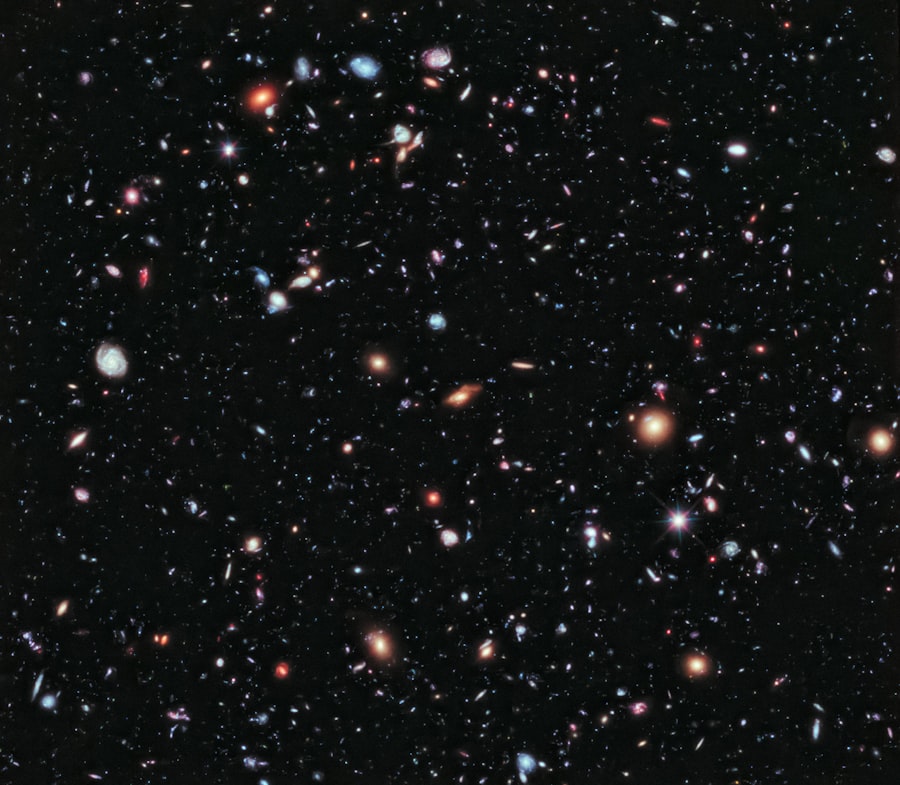
Mapping the universe is a monumental task that requires precision and accuracy. DESI’s ability to create detailed three-dimensional maps of cosmic structures is a game-changer in this endeavor. By measuring the redshift of galaxies—an effect caused by the expansion of the universe—DESI can determine their distances and velocities.
This information is crucial for understanding how galaxies are distributed across vast cosmic scales and how they interact with one another. The data collected by DESI will allow researchers to visualize the large-scale structure of the universe, revealing patterns and distributions that were previously obscured. By analyzing these maps, scientists can investigate how galaxies cluster together and how these clusters evolve over time.
This knowledge is essential for testing cosmological models and refining our understanding of gravitational forces at play in the universe. As DESI continues its mission, it promises to unveil new insights into the cosmic tapestry that shapes our existence.
Understanding Dark Energy and Dark Matter
| Topic | Metrics |
|---|---|
| Dark Energy | Expansion of the universe |
| Acceleration of cosmic expansion | |
| Estimated to contribute 68% of the universe’s total energy density | |
| Dark Matter | Gravitational effects on galaxies and galaxy clusters |
| Estimated to contribute 27% of the universe’s total energy density | |
| Does not emit or interact with electromagnetic radiation |
Dark energy and dark matter are two of the most significant components of the universe, yet they remain largely mysterious. Dark matter, which makes up about 27% of the universe’s total mass-energy content, does not emit light or interact with electromagnetic forces, making it invisible to traditional observational techniques. Its presence is inferred through gravitational effects on visible matter, such as stars and galaxies.
Understanding dark matter is crucial for explaining how galaxies form and evolve over time. On the other hand, dark energy accounts for approximately 68% of the universe’s energy density and is thought to be responsible for its accelerated expansion. The nature of dark energy is one of cosmology’s greatest puzzles, as it challenges our understanding of fundamental physics.
DESI plays a vital role in investigating both dark matter and dark energy by providing high-precision measurements that can help distinguish between various theoretical models. By analyzing galaxy distributions and their dynamics, researchers can gain insights into how these elusive components influence cosmic evolution.
Probing the Evolution of Galaxies
Galaxies are not static entities; they evolve over billions of years through complex processes influenced by various factors, including gravitational interactions and environmental conditions.
By examining a vast number of galaxies across different epochs, scientists can track their formation and growth patterns, shedding light on how they have changed over time.
One key aspect of galaxy evolution is understanding star formation rates and how they are affected by environmental factors such as gas availability and interactions with neighboring galaxies. DESI’s spectroscopic data allows researchers to measure stellar populations within galaxies, providing insights into their ages and chemical compositions. This information is crucial for constructing models that explain how galaxies transition from one stage of evolution to another, ultimately contributing to a more comprehensive understanding of cosmic history.
Exploring the Cosmic Web

The universe is not a uniform expanse; rather, it is structured like a vast web composed of filaments and voids known as the cosmic web. This intricate arrangement results from gravitational forces acting on matter over billions of years. DESI’s ability to map galaxies across large scales enables researchers to explore this cosmic web in detail, revealing how matter is distributed throughout the universe.
By studying the cosmic web, scientists can gain insights into fundamental questions about galaxy formation and evolution. For instance, they can investigate how galaxies are influenced by their surroundings and how interactions within this web lead to phenomena such as galaxy mergers or starburst events. Understanding these processes is essential for developing accurate cosmological models that account for the complex interplay between galaxies and their environment.
Advancements in Spectroscopic Surveys
Spectroscopy has long been a cornerstone of astronomical research, allowing scientists to analyze light from celestial objects to glean information about their composition, temperature, distance, and motion. DESI represents a significant advancement in spectroscopic surveys due to its ability to capture spectra from thousands of objects simultaneously. This capability not only accelerates data collection but also enhances the quality and depth of information obtained.
The advancements brought by DESI extend beyond mere efficiency; they also enable researchers to explore previously inaccessible regions of parameter space. With its wide-field survey capabilities, DESI can target faint objects that were challenging to study with earlier instruments. This opens up new avenues for research, allowing scientists to investigate distant galaxies and quasars that provide critical insights into the early universe’s conditions.
DESI’s Impact on Cosmological Models
The data generated by DESI has far-reaching implications for cosmological models that describe the universe’s behavior and evolution. By providing high-precision measurements of galaxy distributions and their dynamics, DESI allows researchers to test existing theories against observational evidence rigorously. This process is essential for refining models that explain phenomena such as cosmic acceleration and structure formation.
As researchers analyze DESI’s findings, they may uncover discrepancies between theoretical predictions and observed data. Such discrepancies can lead to new insights or even paradigm shifts in cosmology. For instance, if certain models fail to account for observed galaxy clustering patterns or dark energy effects accurately, scientists may need to reconsider fundamental assumptions about gravity or explore alternative theories that better align with empirical evidence.
The Future of Cosmological Discoveries with DESI
The future holds immense promise for cosmological discoveries facilitated by DESI’s ongoing survey efforts. As it continues to collect data over its planned five-year mission, researchers anticipate uncovering new phenomena that could reshape our understanding of the universe. The sheer volume of data generated will enable scientists to conduct analyses at an unprecedented scale, leading to discoveries that may have been previously unimaginable.
Moreover, as technology advances further, there may be opportunities for integrating DESI’s findings with other observational programs or theoretical frameworks.
The potential for interdisciplinary approaches will likely accelerate progress in addressing some of cosmology’s most pressing questions.
Collaborative Efforts in Cosmological Research
Collaboration has always been a hallmark of scientific progress, and cosmology is no exception. The success of projects like DESI relies on contributions from diverse teams comprising astronomers, physicists, engineers, and data scientists from around the world. These collaborative efforts foster an environment where ideas can flourish and innovative solutions can emerge.
Furthermore, partnerships with other observatories and research institutions amplify DESI’s impact on cosmological research. By sharing data and expertise across platforms, scientists can build comprehensive datasets that enhance their analyses’ robustness. Such collaborations not only enrich individual projects but also contribute to a collective understanding of the universe that transcends disciplinary boundaries.
The Promise of DESI in Expanding Cosmological Horizons
In conclusion, the Dark Energy Spectroscopic Instrument (DESI) stands at the forefront of cosmological research, poised to revolutionize our understanding of the universe. Through its advanced spectroscopic capabilities and large-scale mapping efforts, DESI promises to shed light on some of cosmology’s most profound mysteries—dark energy, dark matter, galaxy evolution, and the cosmic web itself. As researchers harness its potential over the coming years, they will undoubtedly uncover new insights that challenge existing paradigms and expand our horizons.
The collaborative nature of cosmological research ensures that DESI’s impact will resonate far beyond its immediate findings. By fostering partnerships among scientists worldwide, DESI contributes to a collective endeavor aimed at unraveling the complexities of our universe. As we stand on the brink of new discoveries facilitated by this remarkable instrument, there is an undeniable sense of excitement about what lies ahead in humanity’s quest to understand its place within the cosmos.
The future of cosmology is poised for groundbreaking discoveries, especially with the advancements brought forth by the Dark Energy Spectroscopic Instrument (DESI). As DESI continues to map the universe with unprecedented precision, it opens new avenues for understanding the cosmos, from the distribution of galaxies to the nature of dark energy. For those interested in exploring more about the implications of these advancements, a related article on the future of cosmology can be found on My Cosmic Ventures. This article delves into the potential discoveries and technological innovations that DESI and similar projects may bring. To read more, visit My Cosmic Ventures.
WATCH THIS!🚀 The DESI Shockwave: Dark Energy is NOT Constant🚀🚀
FAQs
What is DESI?
DESI stands for Dark Energy Spectroscopic Instrument. It is an advanced instrument designed to map the large-scale structure of the universe with unprecedented detail.
How will DESI impact the future of cosmology?
DESI is expected to revolutionize our understanding of dark energy, the mysterious force driving the accelerated expansion of the universe. By mapping the distribution of galaxies and quasars in the universe, DESI will provide crucial data for studying the nature of dark energy and the evolution of the cosmos.
What are the key goals of DESI in the field of cosmology?
DESI aims to measure the expansion history of the universe and the growth of cosmic structures with high precision. It will also investigate the properties of dark energy and test theories of gravity on cosmic scales.
How does DESI work?
DESI uses a robotic fiber optic positioning system to gather light from distant galaxies and quasars. This light is then analyzed to determine the redshift of each object, providing information about its distance and velocity.
When will DESI start its observations?
DESI began its 5-year survey in 2020 and is expected to collect data on millions of galaxies and quasars during this time.
What are the potential implications of DESI’s findings for cosmology?
The data collected by DESI could lead to a major breakthrough in our understanding of the fundamental properties of the universe, including the nature of dark energy and the validity of Einstein’s theory of general relativity on cosmic scales.