Dark energy is a mysterious force that is believed to be responsible for the accelerating expansion of the universe. While its exact nature remains unknown, scientists have proposed various theories and continue to conduct research to unravel its secrets.
What is Dark Energy?
Dark energy is a hypothetical form of energy that permeates all of space and tends to accelerate the expansion of the universe. It is estimated to constitute about 68% of the total energy content of the universe. Unlike matter or dark matter, which exert gravitational pull, dark energy appears to have a repulsive effect, pushing galaxies and cosmic structures further apart.
Evidence for Dark Energy
The existence of dark energy is inferred from observations of the universe’s expansion. In the late 1990s, two independent teams of astronomers studied distant supernovae, which are exploding stars that serve as standard candles for measuring cosmic distances. These observations revealed that the expansion of the universe is not slowing down as expected due to gravity, but is instead speeding up. This acceleration implies the presence of a force counteracting gravity, which was dubbed dark energy.
Cosmic Microwave Background (CMB)
Another crucial piece of evidence comes from the cosmic microwave background (CMB) radiation, the afterglow of the Big Bang. The patterns of temperature fluctuations in the CMB provide insights into the early universe’s composition and evolution. These patterns are consistent with a universe dominated by dark energy, which played a significant role in shaping the large-scale structure of the cosmos.
Recent discussions on the implications of dark energy in the context of cosmic expansion have led to intriguing insights, particularly regarding the concept of table stretching in cosmological models. For a deeper understanding of these phenomena and their interconnectedness, you can explore the article available at My Cosmic Ventures, which delves into the latest research and theories surrounding dark energy and its role in the accelerating expansion of the universe.
The Accelerating Expansion: A Cosmic Tug-of-War
The Role of Gravity
For a long time, it was assumed that the expansion of the universe, initiated by the Big Bang, would gradually slow down due to the gravitational pull of all the matter within it. Imagine throwing a ball into the air; gravity pulls it back down, slowing its ascent until it eventually falls. In the same way, scientists expected the universe’s expansion to decelerate.
The Surprising Discovery
However, observations of distant supernovae in the late 1990s painted a different picture. These supernovae act as “standard candles” – objects with a known intrinsic brightness. By comparing their apparent brightness to their known intrinsic brightness, astronomers can determine their distance. When researchers measured the distances to these supernovae and their recession velocities (how fast they are moving away from us), they found that the universe’s expansion is not only continuing but is actually accelerating. This was akin to observing the ball you threw into the air suddenly speeding up as it rose.
The Implication of Acceleration
This accelerating expansion demands an explanation. The standard model of cosmology, which incorporates gravity as the dominant force on large scales, could not account for this phenomenon. It suggested that some form of energy must be acting in opposition to gravity, pushing spacetime itself apart at an ever-increasing rate. This mysterious entity was christened “dark energy.”
Dark Energy’s Influence on Spacetime
The Stretching Fabric of Reality
Imagine the universe as a vast, interconnected fabric. The presence of matter and energy warps this fabric, creating the force of gravity that causes objects to clump together. Dark energy, however, behaves in the opposite way. Instead of warping the fabric, it actively stretches it. This stretching is not a movement of objects through space, but rather an expansion of space itself.
Analogy: The Expanding Tablecloth
To visualize this, consider an expanding tablecloth with points drawn on it. If you were to stretch the tablecloth uniformly in all directions, the distance between any two points would increase. Galaxies are like these points. As the fabric of spacetime stretches due to dark energy, the distances between galaxies increase. If you were standing on one of these points, you would observe all other points moving away from you, and the further away a point is, the faster it would appear to recede. This is precisely what astronomers observe in the universe – a phenomenon known as Hubble’s Law, which describes the relationship between a galaxy’s distance and its recession velocity.
The Cosmological Constant
One of the leading candidates for dark energy is the cosmological constant, denoted by the Greek letter lambda ($\Lambda$). This concept was first introduced by Albert Einstein in his theory of general relativity as a term to balance the gravitational attraction and keep the universe static. However, when Edwin Hubble discovered the universe was expanding, Einstein reportedly called the cosmological constant his “biggest blunder.” Ironically, it has resurfaced as the most plausible explanation for the accelerated expansion. The cosmological constant represents a constant energy density inherent to spacetime itself. As the universe expands, more spacetime is created, and thus more of this energy becomes present, leading to an ever-increasing outward pressure.
Quintessence: A Dynamic Alternative
Another theoretical possibility for dark energy is “quintessence,” a hypothetical dynamic energy field that permeates the universe. Unlike the cosmological constant, which has a fixed energy density, quintessence’s energy density can change over time and space. This offers more flexibility in explaining the observed acceleration and could potentially lead to different future scenarios for the universe compared to a constant $\Lambda$. However, there is currently no direct observational evidence to favor quintessence over the cosmological constant.
Cosmological Models and Dark Energy
The Lambda-CDM Model
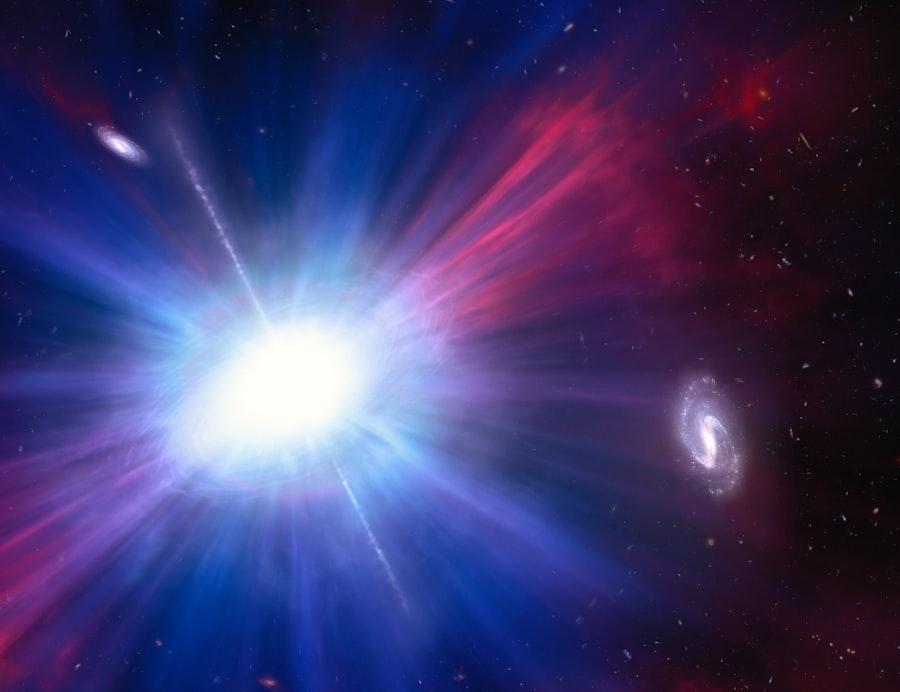
The Standard Model of Cosmology, often referred to as the Lambda-CDM (Cold Dark Matter) model, is the prevailing framework used to describe the universe. In this model, dark energy, represented by the cosmological constant ($\Lambda$), plays a crucial role alongside cold dark matter (CDM). CDM refers to non-luminous matter that interacts gravitationally but does not emit, absorb, or reflect light.
Understanding Cosmic Structure Formation
The Lambda-CDM model successfully explains a wide range of cosmological observations, including the cosmic microwave background radiation, the large-scale structure of galaxies, and the observed accelerated expansion. The interplay between dark energy and dark matter is fundamental to this model’s success. While dark matter provides the gravitational scaffolding for galaxies and galaxy clusters to form, dark energy’s repulsive force counteracts this gravitational pull on the largest scales, driving the accelerated expansion. The model suggests that in the early universe, matter and dark matter dominated, leading to structure formation. However, as the universe expanded and matter density decreased, dark energy’s influence became more prominent, leading to the current era of accelerated expansion.
Alternative Cosmological Models
While the Lambda-CDM model is highly successful, scientists are also exploring alternative cosmological models to address any potential shortcomings or to probe different theoretical possibilities. These models might propose different forms of dark energy, variations in the fundamental laws of gravity, or even different initial conditions for the universe. However, any new model must be able to reconcile the existing wealth of observational data that the Lambda-CDM model so effectively explains. For instance, some models explore the idea that the observed acceleration might not be due to dark energy but rather to a modification of general relativity on cosmic scales, or perhaps due to the specific location of our solar system and galaxy within an under-dense region of the universe. These alternatives are continuously tested against new observational data.
Recent studies on dark energy have shed light on the mysterious expansion of the universe, suggesting that the fabric of space itself is stretching. This phenomenon has sparked interest in various scientific communities, leading to discussions about its implications for cosmology. For a deeper understanding of this topic, you can explore a related article that delves into the intricacies of dark energy and its role in cosmic expansion. Check it out here to learn more about how these concepts are interconnected.
The Future of the Universe and Dark Energy’s Role
| Metric | Description | Value | Units | Notes |
|---|---|---|---|---|
| Hubble Constant (H₀) | Current rate of expansion of the universe | 70 | km/s/Mpc | Approximate average from recent measurements |
| Dark Energy Density (ΩΛ) | Fraction of total energy density attributed to dark energy | 0.68 | Dimensionless | Based on Planck satellite data |
| Scale Factor (a) | Relative expansion of the universe compared to present | 1.0 (present) | Dimensionless | Normalized to current epoch |
| Equation of State Parameter (w) | Ratio of dark energy pressure to its energy density | -1 | Dimensionless | Consistent with cosmological constant |
| Age of Universe | Time since Big Bang | 13.8 | Billion years | Estimated from cosmic microwave background |
| Expansion Rate at z=1 | Expansion rate when universe was half its current size | 140 | km/s/Mpc | Approximately double the current rate |
| Stretching Factor (1+z) | Factor by which wavelengths are stretched due to expansion | 2.0 | Dimensionless | At redshift z=1 |
The Big Freeze or Heat Death
One of the most widely discussed scenarios for the universe’s ultimate fate, assuming dark energy continues to dominate and its density remains constant, is the “Big Freeze” or “Heat Death.” In this scenario, the accelerated expansion will continue indefinitely. Galaxies will move further and further apart, eventually receding beyond the observable horizon of each other. Stars will exhaust their fuel, and the universe will become increasingly cold, dark, and dispersed. There will be no more star formation, no more galaxies to observe, and eventually, even black holes will evaporate through Hawking radiation. The universe will approach a state of maximum entropy, where no further thermodynamic work is possible.
The Big Rip
A more dramatic, though less favored by current data, possibility is the “Big Rip.” This scenario hinges on the nature of dark energy being something called “phantom energy,” where its density increases over time. If this were the case, the outward repulsive force of dark energy would grow stronger. Eventually, it would become so powerful that it would overcome all other forces, including gravity, electromagnetic forces, and even the strong nuclear force. First, galaxy clusters would be torn apart, then individual galaxies, then solar systems, planets, and ultimately, even atoms themselves would be ripped apart. Spacetime itself would be torn asunder. Current observations, however, suggest that the equation of state for dark energy is very close to that of a cosmological constant, making the Big Rip less likely.
A Cyclic Universe?
Some speculative theories propose a cyclic or oscillating universe. In such models, the universe might expand for a period, then collapse back on itself in a “Big Crunch,” only to rebound and begin a new cycle of expansion. The presence and behavior of dark energy, however, complicate such straightforward cyclic models as we currently understand them. If dark energy’s repulsive force is indeed constant and dominant, it may prevent such a collapse from occurring. However, if dark energy’s properties were to change dramatically in the future, or if alternative physics were at play, a cyclic scenario could remain a theoretical possibility. The precise nature of dark energy is the key determinant in these future scenarios.
Ongoing Research and Unanswered Questions
The Quest for an Explanation
Despite decades of research and significant progress, the fundamental nature of dark energy remains one of the biggest mysteries in modern physics. Scientists are employing a variety of observational strategies and theoretical approaches to shed light on this enigmatic force. The vastness of the universe and the subtle influence of dark energy make direct detection incredibly challenging. Therefore, much of the current understanding is derived from observing its gravitational effects on cosmic scales.
Observational Efforts
Future astronomical surveys, such as the Vera C. Rubin Observatory and the Nancy Grace Roman Space Telescope, are designed to map the universe with unprecedented precision. These instruments will gather vast amounts of data on supernovae, galaxy distributions, and the bending of light by gravity (gravitational lensing). By meticulously analyzing this data, cosmologists hope to constrain the properties of dark energy more tightly, potentially distinguishing between the cosmological constant and other models. The goal is to understand how dark energy has evolved over cosmic history and whether its density has remained constant or changed over time.
Theoretical Challenges
The theoretical implications of dark energy are profound. If it is indeed a cosmological constant, its observed value is vastly smaller than theoretical predictions based on quantum field theory, a discrepancy known as the cosmological constant problem. This enormous gap suggests that our current understanding of fundamental physics may be incomplete. New theoretical frameworks, such as string theory or quantum gravity, are being explored in the hope of resolving this puzzle. Scientists are actively searching for new particles or fields that might mediate this repulsive force or for modifications to Einstein’s theory of gravity that could explain the observed acceleration. The very fabric of spacetime and the fundamental forces governing the universe are being re-examined in light of dark energy’s mysterious dominance.
FAQs
What is dark energy?
Dark energy is a mysterious form of energy that makes up about 68% of the universe. It is believed to be responsible for the accelerated expansion of the universe by exerting a repulsive force that counteracts gravity.
How does dark energy affect the expansion of the universe?
Dark energy causes the expansion of the universe to accelerate over time. Instead of slowing down due to gravitational attraction, the universe’s expansion rate increases, leading to galaxies moving away from each other at an ever-faster pace.
What is meant by the “expansion table” in the context of dark energy?
An expansion table typically refers to a data set or chart that tracks the rate of the universe’s expansion over time. It may include measurements such as the Hubble constant at different epochs, showing how the expansion rate changes, influenced by dark energy.
What does “stretching” refer to in the context of dark energy and cosmic expansion?
“Stretching” refers to the increase in the scale of the universe as space itself expands. This causes wavelengths of light traveling through space to stretch, leading to redshift, which is a key observational evidence for the universe’s expansion driven by dark energy.
How do scientists measure the effects of dark energy on cosmic expansion?
Scientists measure the effects of dark energy by observing distant supernovae, the cosmic microwave background radiation, and large-scale structures in the universe. These observations help determine the rate of expansion and how it changes over time, providing insights into the properties of dark energy.