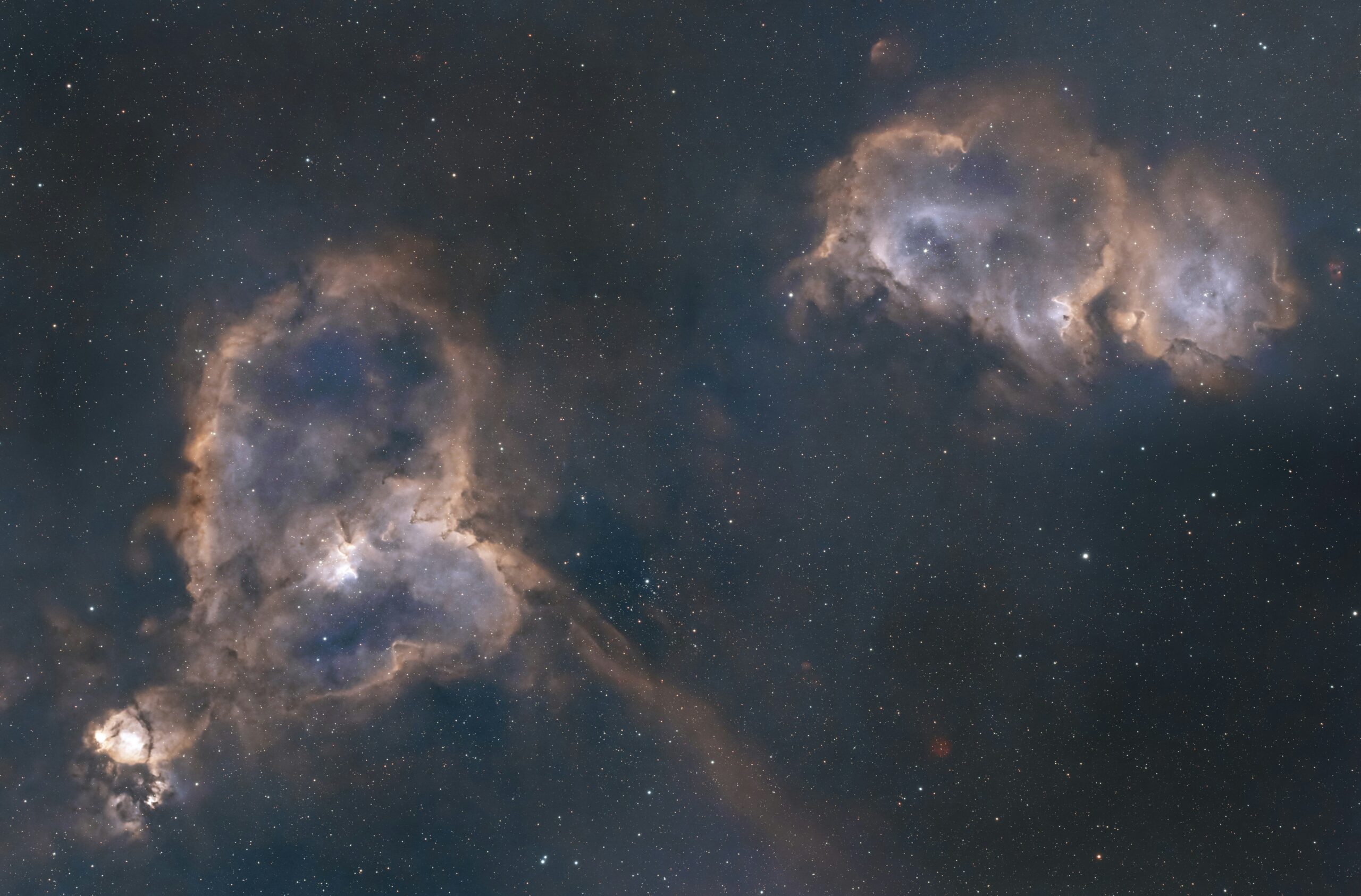
The cosmos, vast and enigmatic, harbors a myriad of celestial phenomena, among which molecular clouds stand as crucibles of creation. These immense, cold, and dense regions of space are primarily composed of molecular hydrogen, alongside helium and trace amounts of heavier elements in molecular form. Their significance in astrophysics is paramount, serving as the foundational sites for star and planetary formation. Understanding molecular clouds is akin to deciphering the birth pangs of cosmic entities, providing crucial insights into the evolutionary pathways of galaxies.
Molecular clouds are not static entities but dynamic structures that evolve under the influence of gravity, stellar winds, and supernova shockwaves. Their formation is a complex process, often initiated by the compression of diffuse interstellar medium (ISM) through various astrophysical mechanisms.
Compression and Contraction
The initial step in molecular cloud formation often involves the compression of diffuse atomic gas. This compression can be triggered by several factors:
- Spiral Density Waves: Within spiral galaxies, regions of enhanced gravitational potential, known as spiral arms, can compress the ISM. As gas passes through these density waves, it slows down and accumulates, increasing its density and facilitating gravitational collapse.
- Supernova Shockwaves: The explosive demise of massive stars, supernovae, generates powerful shockwaves that propagate through the ISM. These shockwaves can sweep up and compress surrounding gas, creating dense shells that can then cool and contract.
- Cloud Collisions: The collision of two or more less-dense interstellar clouds can lead to sufficient compression to initiate molecular cloud formation. The kinetic energy of the collision is thermalized, leading to higher densities in the interaction region.
The Domination of Molecular Hydrogen
Once sufficiently compressed, the gas cools, and hydrogen atoms begin to combine to form molecular hydrogen (H₂). This transition is crucial because H₂ is much more efficient at cooling than atomic hydrogen. The formation of H₂ is primarily facilitated by dust grains, which act as catalysts by providing surfaces where two hydrogen atoms can meet and bond.
Tracing the Unseen: Molecular Tracers
Molecular hydrogen is difficult to observe directly due to its lack of a permanent dipole moment, meaning it does not readily emit or absorb radiation at typical molecular cloud temperatures. Consequently, astronomers rely on other molecules, known as molecular tracers, to study these regions.
- Carbon Monoxide (CO): Carbon monoxide is the most commonly used molecular tracer. Its rotational transitions occur at millimeter and submillimeter wavelengths, which can penetrate the dust and gas of molecular clouds, making it observable from Earth. The abundance of CO is directly correlated with that of H₂, though a conversion factor (X_CO) is required to infer H₂ mass from CO observations.
- Other Trace Molecules: Other molecules, such as ammonia (NH₃), cyanogen (CN), formaldehyde (H₂CO), and various isotopes of CO (e.g., ¹³CO, C¹⁸O), provide additional insights into the temperature, density, and kinematic properties of different regions within molecular clouds. Each molecule probes specific density and temperature regimes, offering a layered understanding of the cloud’s internal structure.
Molecular clouds are fascinating astronomical structures that play a crucial role in the formation of stars and planetary systems. For those interested in exploring this topic further, a related article can be found at My Cosmic Ventures, which delves into the characteristics and significance of these dense regions of gas and dust in the universe.
Classifications and Structures within Molecular Clouds
Molecular clouds are not uniform entities; they exhibit a hierarchical structure, ranging from vast complexes to dense cores, each with distinct properties and evolutionary stages.
Giant Molecular Clouds (GMCs)
Giant Molecular Clouds are the largest and most massive molecular clouds, spanning tens to hundreds of parsecs and containing masses of 10⁴ to 10⁶ solar masses or more. These colossal structures are the primary sites of massive star formation in galaxies.
- Internal Dynamics: GMCs are characterized by turbulent motions, often supersonic, which are thought to play a role in supporting the cloud against global gravitational collapse. However, this turbulence also contributes to the fragmentation of the cloud.
- Filaments and Clumps: Within GMCs, gas and dust are organized into intricate networks of filaments and clumps. Filaments are elongated structures, often hundreds of times longer than they are wide, that appear to funnel material towards denser regions. Clumps are denser, self-gravitating regions within filaments, representing the direct precursors to stellar nurseries.
Dark Clouds and Bok Globules
Smaller, more isolated molecular clouds are often referred to as dark clouds or Bok globules. These objects are usually identified by their opaque appearance against the background starlight, caused by the high concentration of dust grains.
- Bok Globules: These are relatively small, isolated, and dense patches within molecular clouds, typically a few parsecs in diameter and containing a few tens to hundreds of solar masses. They are often round or irregular in shape and are considered potential sites for the formation of single or small groups of stars.
- Opacity and Extinction: The high dust content in these objects leads to significant extinction of visible light, making them appear “dark.” This dust also shields the interior of the cloud from harmful ultraviolet radiation, allowing for molecules to form and persist.
Molecular Cloud Cores
At the heart of the most active star-forming regions are molecular cloud cores, which are the densest and coldest parts of molecular clouds. These cores are the direct progenitors of individual stars or small star clusters.
- Pre-stellar Cores: These are dense, gravitationally bound cores that have not yet begun to form stars. They are slowly contracting and accumulating mass, eventually becoming unstable and collapsing to form protostars.
- Protostellar Cores: Once a pre-stellar core collapses and forms a protostar, it becomes a protostellar core. These cores are characterized by an embedded protostar, which heats the surrounding gas and dust, and often by the presence of outflows and jets.
The Star Formation Process within Molecular Clouds

The primary role of molecular clouds is to provide the raw material and conditions necessary for star formation. This process is a cascade of gravitational collapse, heating, and energetic outflows.
Gravitational Instability and Collapse
The formation of stars begins when a dense core within a molecular cloud becomes gravitationally unstable. This instability, often described by the Jeans criterion, occurs when the internal pressure of the gas can no longer support it against its own gravity.
- Jeans Mass: The Jeans mass is the minimum mass a cloud must have at a given temperature and density to overcome thermal pressure and initiate gravitational collapse. If a region’s mass exceeds its Jeans mass, collapse will ensue.
- Fragmentation: As a large cloud collapses, it often fragments into smaller, denser cores. This fragmentation is crucial for the formation of multiple star systems and star clusters, as an entire GMC would not typically collapse into a single massive star.
Protostars and Accretion Disks
Once a core collapses, a protostar begins to form at its center. This infant star rapidly accretes material from the surrounding envelope of gas and dust.
- Accretion Disks: As material falls towards the protostar, it conserves angular momentum, forming a rotating disk—an accretion disk—around the central object. This disk is the birthplace of planets and provides the fuel for the growing protostar.
- Outflows and Jets: A significant fraction of the accreting material is ejected from the protostar and disk system in the form of powerful outflows and collimated jets. These outflows are crucial for removing angular momentum from the system, allowing further accretion, and they also sculpt the surrounding molecular gas, creating impressive bipolar nebulae.
The Role of Stellar Feedback
Star formation is not a solitary process. The birth of massive stars within a molecular cloud profoundly impacts the surrounding gas and can either trigger further star formation or disperse the cloud.
- Ionizing Radiation: Massive stars emit intense ultraviolet radiation that ionizes the surrounding hydrogen gas, creating H II regions. These regions expand, compressing nearby molecular gas and potentially triggering new star formation.
- Stellar Winds: Powerful winds from young, massive stars can also sweep up and compress interstellar material, contributing to the formation of new molecular clouds or triggering collapse in existing ones.
- Supernovae: The ultimate death of massive stars in supernova explosions can be a double-edged sword. While they can compress gas and trigger star formation, particularly at the edges of their expanding remnants, they can also disperse molecular clouds entirely, ending star formation in that region.
The Chemistry of Molecular Clouds
Molecular clouds are not just inert reservoirs of gas; they are active chemical laboratories where a vast array of molecules are synthesized and destroyed. This rich chemistry provides a unique window into the physical conditions and processes within these environments.
Low-Temperature Chemistry
The extremely low temperatures within molecular clouds (typically 10-50 K) favor specific chemical reaction pathways. Gas-phase reactions proceed slowly at these temperatures.
- Grain Surface Chemistry: Dust grains play a critical role in the chemical evolution of molecular clouds. They provide surfaces for atoms to meet and react, overcoming the energy barriers that would prevent reactions in the gas phase. The formation of molecular hydrogen is a prime example, but more complex molecules like water (H₂O), methanol (CH₃OH), and even pre-biotic molecules can form on grain surfaces.
- Ion-Molecule Reactions: Cosmic rays penetrate molecular clouds, ionizing atomic and molecular hydrogen. These resulting ions (e.g., H₃⁺) then initiate a chain of ion-molecule reactions, which are efficient at low temperatures and can lead to the formation of many different molecular species.
Molecular Abundances and Evolution
The relative abundances of different molecules within a cloud can reveal its age, density, and evolutionary stage.
- Time-Dependent Chemistry: Chemical models show that molecular abundances change over time as a cloud evolves. For instance, the ratio of certain molecules like N₂H⁺ to CO can be used as an indicator of core evolution, as N₂H⁺ is less depleted from the gas phase onto dust grains than CO in very dense, cold regions.
- Complex Organic Molecules (COMs): Observations of molecular clouds have revealed the presence of complex organic molecules, including alcohols, aldehydes, and even simple sugars. These molecules are not necessarily a direct link to life but demonstrate that the basic building blocks for biological chemistry are abundant in star-forming regions, suggesting that the initial conditions for habitability might be widespread.
Molecular clouds are fascinating regions in space where gas and dust come together to form the building blocks of stars and planets. These dense areas of interstellar matter play a crucial role in the life cycle of galaxies. For those interested in exploring this topic further, a related article can be found at My Cosmic Ventures, which delves into the formation and evolution of molecular clouds and their significance in the universe. Understanding these clouds helps astronomers piece together the complex processes that govern star formation and the dynamics of our cosmos.
Observing Molecular Clouds: Tools and Techniques
| Property | Description | Typical Range | Units |
|---|---|---|---|
| Size | Diameter of molecular clouds | 1 to 100 | parsecs |
| Mass | Total mass contained in the cloud | 10 to 10^6 | solar masses |
| Temperature | Typical kinetic temperature of the gas | 10 to 30 | Kelvin |
| Density | Number density of molecular hydrogen | 10^2 to 10^6 | particles per cm³ |
| Composition | Main molecular components | H2, CO, He, other molecules | – |
| Magnetic Field Strength | Typical magnetic field intensity | 5 to 50 | microgauss |
| Velocity Dispersion | Internal velocity spread of gas | 1 to 10 | km/s |
The study of molecular clouds relies on specialized astronomical instruments capable of detecting the faint emission from cold gas and dust over vast cosmic distances.
Radio Astronomy
Radio telescopes are the primary tool for observing molecular clouds, as most molecular line emission falls within the radio and submillimeter wavelength ranges.
- Single-Dish Telescopes: Large single-dish telescopes, such as the IRAM 30-meter Telescope or the Green Bank Telescope, are used to map the large-scale distribution of molecular gas and to study the spectral lines of various molecules.
- Interferometers: Radio interferometers, like the Atacama Large Millimeter/submillimeter Array (ALMA) or the Very Large Array (VLA), combine signals from multiple antennas to achieve much higher angular resolution. This allows astronomers to image fine details within molecular clouds, such as accretion disks, protostellar outflows, and dense cores.
Infrared and Submillimeter Astronomy
Infrared and submillimeter telescopes are crucial for studying the dust within molecular clouds and for observing embedded protostars that are obscured at visible wavelengths.
- Dust Emission: Dust grains in molecular clouds absorb starlight and re-emit it at infrared and submillimeter wavelengths due to their low temperatures. This emission provides a way to trace the distribution and temperature of dust, which is intimately mixed with the gas.
- Embedded Protostars: Young protostars are often deeply embedded within their natal clouds, making them invisible at optical wavelengths. Infrared observations can penetrate the surrounding dust, allowing astronomers to detect the thermal emission from the protostar and its accretion disk.
In conclusion, molecular clouds are not merely diffuse collections of gas and dust; they are dynamic, chemically active ecosystems that serve as the engines of galactic evolution. From their sprawling, turbulent expanse to the densest, most quiescent cores, these cosmic nurseries orchestrate the birth of stars and planetary systems, providing the raw materials and conditions necessary for the ongoing cycle of creation in the universe. By continuing to unravel their mysteries, humanity gains deeper insights into its own cosmic origins and the intricate processes that shape the galaxies we inhabit.
FAQs
What are molecular clouds?
Molecular clouds are dense regions of gas and dust in space where molecules, primarily molecular hydrogen (H2), are found. They are the coldest and densest parts of the interstellar medium and serve as the primary sites for star formation.
How are molecular clouds detected?
Molecular clouds are typically detected through their emission of radio waves, especially from molecules like carbon monoxide (CO), which is easier to observe than molecular hydrogen. Infrared observations can also reveal the presence of dust within these clouds.
What is the typical size and mass of a molecular cloud?
Molecular clouds vary widely in size and mass. They can range from small clouds a few light-years across with masses of a few hundred solar masses to giant molecular clouds spanning hundreds of light-years and containing up to several million solar masses.
Why are molecular clouds important for star formation?
Molecular clouds provide the cold, dense environments necessary for gravity to overcome internal pressure, allowing regions within the cloud to collapse and form new stars. The presence of molecules helps cool the cloud, facilitating this collapse.
What factors influence the stability of molecular clouds?
The stability of molecular clouds depends on a balance between gravitational forces, thermal pressure, magnetic fields, and turbulence within the cloud. External factors like shock waves from supernovae or nearby stellar winds can also trigger collapse or disrupt the cloud.