
Transformers are pivotal components in the realm of electrical engineering, serving as the backbone of power systems worldwide. These devices facilitate the efficient transmission and distribution of electrical energy by altering voltage levels to meet the demands of various applications. The fundamental principle behind transformers is electromagnetic induction, which allows them to transfer electrical energy between circuits while maintaining the same frequency.
As societies increasingly rely on electricity for daily activities, the significance of transformers in ensuring a stable and reliable power supply cannot be overstated. In the context of modern power systems, transformers play a crucial role in connecting generation sources, such as power plants, to end-users, including homes and businesses. Their ability to step up or step down voltage levels ensures that electricity can be transmitted over long distances with minimal losses.
This capability not only enhances the efficiency of power distribution but also contributes to the overall stability of the electrical grid. As the demand for electricity continues to rise, understanding the function and importance of transformers becomes essential for both engineers and consumers alike.
Key Takeaways
- Transformers play a crucial role in power systems by facilitating the efficient transmission and distribution of electricity.
- Different types of transformers are used in power systems, including distribution transformers, power transformers, and instrument transformers.
- Transformers are essential for voltage regulation and control, ensuring that electricity is delivered at the right voltage levels.
- Maintenance and monitoring of transformers are vital to ensure their reliable and efficient operation in power systems.
- Advancements in transformer technology have a significant impact on power systems, improving efficiency and reliability.
The Function and Importance of Transformers in Power Distribution
Transformers serve a fundamental function in power distribution by enabling the safe and efficient transfer of electrical energy from generation points to consumption sites. By stepping up voltage levels at generation stations, transformers allow electricity to travel long distances with reduced losses due to resistance in transmission lines. This process is critical for minimizing energy waste and ensuring that consumers receive a reliable supply of electricity.
Conversely, at substations closer to end-users, transformers step down the voltage to safer levels suitable for residential and commercial use. The importance of transformers extends beyond mere voltage adjustment; they also enhance the overall reliability of power systems. By isolating different sections of the grid, transformers help protect against faults and disturbances that could lead to widespread outages.
This isolation capability is vital for maintaining system stability, especially in large interconnected networks where a single failure can have cascading effects. Thus, transformers not only facilitate efficient energy transfer but also contribute significantly to the resilience of power distribution systems.
The Different Types of Transformers Used in Power Systems
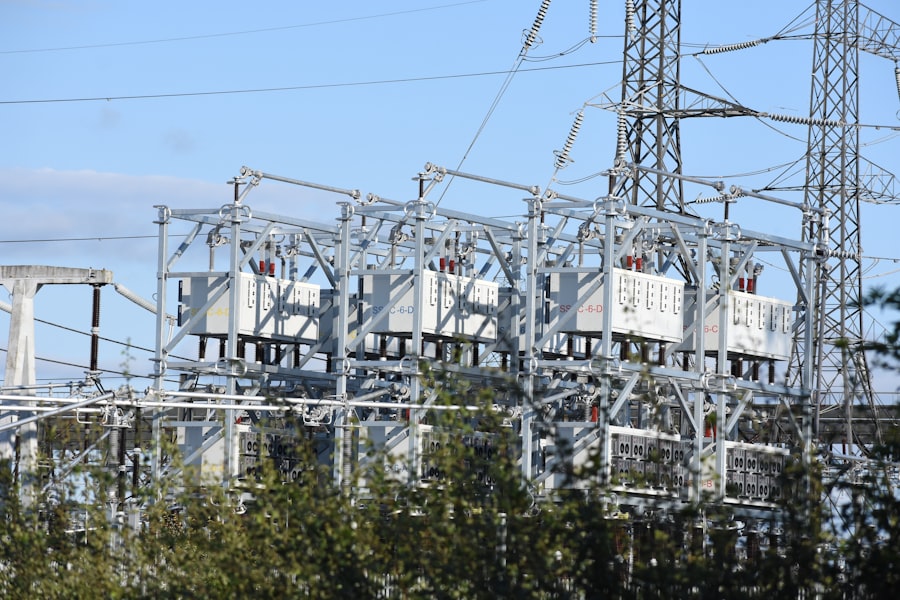
In power systems, various types of transformers are employed, each designed for specific applications and operational requirements. The most common types include step-up transformers, step-down transformers, isolation transformers, and autotransformers. Step-up transformers increase voltage levels for efficient long-distance transmission, while step-down transformers reduce voltage levels for safe consumption by end-users.
Isolation transformers, on the other hand, provide electrical isolation between circuits, enhancing safety and reducing noise in sensitive applications. Autotransformers are another type that combines features of both step-up and step-down transformers. They utilize a single winding that acts as both the primary and secondary winding, allowing for a more compact design and improved efficiency.
Each type of transformer has its unique advantages and is selected based on factors such as load requirements, distance between generation and consumption points, and safety considerations. Understanding these different types is essential for engineers tasked with designing and maintaining effective power systems.
The Role of Transformers in Voltage Regulation and Control
| Transformer Type | Role | Advantages | Disadvantages |
|---|---|---|---|
| Step-Up Transformer | Increases voltage from primary to secondary side | Efficient voltage transmission over long distances | Large size and weight |
| Step-Down Transformer | Decreases voltage from primary to secondary side | Safe voltage levels for household use | Energy losses due to heat |
| Auto-Transformer | Adjusts voltage levels with a single winding | Compact and lightweight | Less isolation between primary and secondary side |
Voltage regulation is a critical aspect of power system management, ensuring that voltage levels remain within acceptable limits to prevent damage to equipment and maintain service quality. Transformers play a vital role in this process by adjusting voltage levels as needed based on real-time demand fluctuations. Through the use of tap changers—mechanisms that allow for adjustments in transformer winding connections—transformers can dynamically regulate output voltage to match load conditions.
This capability is particularly important during peak demand periods when electricity consumption surges. By maintaining stable voltage levels, transformers help prevent issues such as voltage sags or surges that can lead to equipment malfunction or failure. Furthermore, effective voltage regulation contributes to overall system efficiency by minimizing losses associated with overvoltage or undervoltage conditions.
Thus, transformers are indispensable tools in ensuring that power systems operate smoothly and reliably.
The Impact of Transformers on Power Quality and Efficiency
The quality of electrical power delivered to consumers is paramount for both operational efficiency and user satisfaction. Transformers significantly influence power quality by mitigating issues such as harmonics, voltage fluctuations, and phase imbalances. By providing isolation between different parts of the grid and enabling proper voltage regulation, transformers help maintain a clean and stable power supply that meets stringent quality standards.
Moreover, the efficiency of power systems is closely tied to transformer performance. High-efficiency transformers minimize energy losses during operation, contributing to lower operational costs and reduced environmental impact. Advances in transformer design, such as the use of amorphous steel cores and improved insulation materials, have further enhanced efficiency levels.
As energy demands grow and sustainability becomes a priority, the role of transformers in optimizing power quality and efficiency will continue to be a focal point for engineers and policymakers alike.
The Role of Transformers in Transmission and Distribution Networks

Transformers are integral components within both transmission and distribution networks, facilitating the seamless flow of electricity from generation sources to end-users. In transmission networks, high-voltage transformers are employed to step up voltages for long-distance transport across vast geographical areas. This high-voltage transmission minimizes energy losses due to resistance in conductors, making it possible to deliver electricity efficiently over hundreds or even thousands of miles.
Once electricity reaches substations closer to urban centers or industrial areas, distribution transformers step down the voltage to levels suitable for local consumption. These transformers ensure that residential homes receive safe voltage levels while also accommodating varying load demands throughout the day. The strategic placement of transformers within these networks is crucial for maintaining system reliability and ensuring that electricity is delivered efficiently to meet consumer needs.
The Importance of Maintenance and Monitoring of Transformers in Power Systems
The reliability of transformers is heavily dependent on regular maintenance and monitoring practices. Over time, wear and tear can lead to insulation degradation, overheating, or other issues that may compromise transformer performance. Implementing a proactive maintenance strategy helps identify potential problems before they escalate into costly failures or outages.
Routine inspections, testing insulation resistance, and monitoring temperature levels are essential practices that contribute to the longevity and reliability of transformers. Advancements in technology have also facilitated more sophisticated monitoring techniques, such as online condition monitoring systems that provide real-time data on transformer health. These systems can detect anomalies early on, allowing operators to take corrective actions before significant issues arise.
By prioritizing maintenance and monitoring efforts, utilities can ensure that their transformer assets operate efficiently while minimizing downtime and maintenance costs.
The Advancements in Transformer Technology and their Impact on Power Systems
The field of transformer technology has witnessed significant advancements over recent years, driven by the need for greater efficiency, reliability, and sustainability in power systems. Innovations such as high-temperature superconducting (HTS) transformers have emerged as promising solutions capable of reducing energy losses dramatically while enhancing performance under high load conditions. These advanced transformers offer substantial benefits over traditional designs but also come with challenges related to cost and material availability.
Additionally, developments in smart transformer technology have paved the way for more intelligent grid management solutions. Smart transformers equipped with digital sensors can communicate with other grid components, enabling real-time data exchange that enhances operational efficiency and reliability. These advancements not only improve transformer performance but also contribute to the overall modernization of power systems as they adapt to changing energy demands and integrate renewable energy sources.
The Future of Transformers in Power Systems: Challenges and Opportunities
As power systems evolve in response to growing energy demands and environmental concerns, transformers will face both challenges and opportunities in the coming years. One significant challenge lies in adapting existing infrastructure to accommodate renewable energy sources such as wind and solar power. These sources often require specialized transformer designs capable of handling variable output while maintaining grid stability.
On the other hand, opportunities abound for innovation within transformer technology as utilities seek solutions that enhance efficiency and reduce environmental impact. The integration of digital technologies into transformer design presents avenues for improved monitoring, predictive maintenance, and enhanced grid resilience. As the industry moves toward more sustainable practices, the role of transformers will be pivotal in shaping a reliable energy future.
The Role of Transformers in Renewable Energy Integration and Smart Grids
The integration of renewable energy sources into existing power systems presents unique challenges that transformers are well-equipped to address. As renewable generation often fluctuates based on environmental conditions, transformers must be capable of managing these variations while ensuring grid stability. Advanced transformer designs can facilitate this integration by providing necessary voltage regulation and isolation between renewable sources and traditional grid components.
Moreover, smart grids leverage transformer technology to enhance overall system performance through real-time data analytics and communication capabilities. Smart transformers can interact with other grid elements to optimize energy flow based on demand patterns while accommodating distributed generation sources like solar panels or wind turbines. This synergy between transformer technology and smart grid initiatives is essential for creating a resilient energy infrastructure capable of meeting future demands.
The Indispensable Role of Transformers in Ensuring Reliable and Stable Power Systems
In conclusion, transformers are indispensable components within modern power systems, playing a critical role in ensuring reliable electricity delivery across vast networks. Their ability to adjust voltage levels facilitates efficient transmission and distribution while enhancing overall system stability through effective voltage regulation and control. As technology continues to advance, so too does the potential for transformers to contribute positively to power quality, efficiency, and renewable energy integration.
The future landscape of power systems will undoubtedly present challenges; however, with ongoing innovations in transformer technology and a focus on sustainability, these devices will remain central to achieving reliable and stable electrical infrastructure.
Transformers have revolutionized the field of natural language processing and are considered irreplaceable due to their ability to handle vast amounts of data and learn contextual relationships within text. Their architecture, which includes mechanisms like self-attention, allows them to understand and generate human-like text with remarkable accuracy.
For a deeper understanding, you can read more about it in this related article.
WATCH THIS ☀️The Sun as Software: Why Top Scientists Now Say a Solar Flare Could Wipe Everything
FAQs
What are transformers and what do they do?
Transformers are electrical devices that transfer electrical energy between two or more circuits through electromagnetic induction. They are used to increase or decrease the voltage of an alternating current (AC) in electrical power applications.
Why are transformers considered irreplaceable in electrical power systems?
Transformers are irreplaceable in electrical power systems because they play a crucial role in transmitting and distributing electricity at different voltage levels. They allow for efficient transmission of electricity over long distances and enable voltage to be stepped up for transmission and stepped down for distribution to end users.
What are the key benefits of transformers in electrical power systems?
The key benefits of transformers in electrical power systems include voltage regulation, power transmission efficiency, and the ability to match the voltage levels of different electrical devices and equipment. They also provide isolation between the input and output circuits, which enhances safety and protects equipment from electrical disturbances.
Can transformers be replaced by other technologies in electrical power systems?
While there are alternative technologies such as solid-state transformers and voltage regulators, traditional transformers remain irreplaceable in many electrical power applications due to their reliability, cost-effectiveness, and proven performance over many decades. Solid-state transformers are still in the early stages of development and may not yet offer the same level of reliability and cost-effectiveness as traditional transformers.
What are the potential challenges of replacing transformers in electrical power systems?
Replacing transformers in electrical power systems can pose challenges related to cost, compatibility with existing infrastructure, and the need for extensive testing and validation of alternative technologies. Additionally, traditional transformers have a proven track record of reliability and performance, making it difficult to justify the replacement of these established devices.