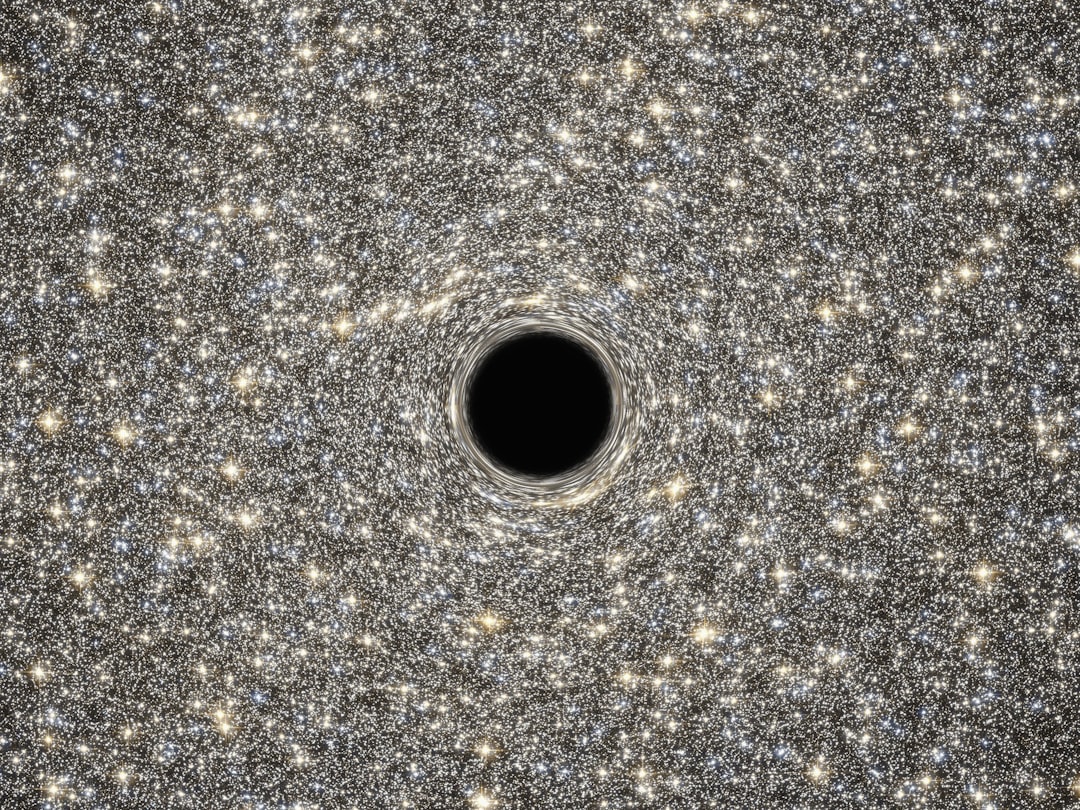
The black hole information paradox represents one of the most profound unresolved questions in theoretical physics, challenging the very foundations of quantum mechanics and general relativity. At its heart lies a fundamental disagreement between these two pillars of modern physics concerning the fate of information that enters a black hole. This article will explore the nature of this paradox, its historical development, proposed solutions, and its implications for our understanding of the universe.
The paradox emerged from Stephen Hawking’s groundbreaking work in the 1970s, which predicted that black holes are not entirely black but emit thermal radiation, now known as Hawking radiation. This prediction, derived from applying quantum field theory in curved spacetime, suggested a catastrophic consequence for information.
What is Hawking Radiation?
Hawking radiation is a theoretical phenomenon where black holes are predicted to emit particles due to quantum effects near the event horizon.
- Virtual Particle Pairs: Near the event horizon, virtual particle-antiparticle pairs constantly pop into and out of existence. Normally, these pairs annihilate each other almost immediately.
- Event Horizon’s Role: If one particle from the pair falls into the black hole and the other escapes to infinity, the escaping particle carries away energy. This process effectively reduces the black hole’s mass.
- Thermal Spectrum: The emitted radiation has a thermal spectrum, meaning it is random and carries no information about the matter that formed the black hole or subsequently fell into it. It is akin to the heat radiated by a black body, which depends only on its temperature, not its internal composition.
Implications for Information: The No-Hair Theorem
The “no-hair” theorem, formulated by Werner Israel, Stephen Hawking, and Roger Penrose, states that a stationary black hole can be completely characterized by only three externally observable classical parameters: its mass, angular momentum, and electric charge.
- Loss of Specifics: This theorem implies that any other information about the matter that collapsed to form the black hole, such as its exact composition, shape, or internal structure, is effectively lost once it crosses the event horizon. For instance, whether the black hole formed from a star composed primarily of hydrogen or helium, or even a collection of old textbooks, becomes irrelevant to its external properties.
- Information Smearing: As matter falls into a black hole, its quantum information is believed to be smeared across the event horizon, effectively becoming inaccessible to outside observers.
Conflict with Quantum Mechanics: Unitariy
The thermal nature of Hawking radiation and the black hole’s eventual evaporation present a direct conflict with a fundamental principle of quantum mechanics: unitarity.
- Unitary Evolution: In quantum mechanics, the evolution of a system is described by a unitary operator, meaning that information is always conserved. The initial state of a system can always, in principle, be uniquely reconstructed from its final state. It’s like having a perfectly reversible process; you can always rewind the tape and see what happened before.
- Irreversible Loss: If black holes evaporate completely by emitting thermal, featureless radiation, then the unique quantum information of the matter that formed them appears to be irretrievably lost. This would be a non-unitary process, analogous to burning a unique book and only being left with generic ash, from which the original content cannot be recovered.
- Paradoxical Nature: The paradox lies in this stark contradiction: general relativity, through Hawking radiation, predicts information loss, while quantum mechanics insists on information preservation.
The Black Hole Information Paradox raises intriguing questions about the nature of information and its preservation in the universe. A related article that delves deeper into this topic is available at My Cosmic Ventures, where it explores various theories and perspectives surrounding black holes and their implications for quantum mechanics and general relativity. This article provides valuable insights into the ongoing debate among physicists regarding whether information that falls into a black hole is lost forever or can be recovered in some form.
The Problem’s Escalation: Firewall Paradox and Complementarity
As physicists grappled with the information paradox, new facets emerged, further complicating the picture and leading to more radical proposals.
The Firewall Paradox
In 2012, a team of physicists known as AMPS (Almheiri, Marolf, Polchinski, and Sully) proposed the “firewall paradox,” a thought experiment that amplified the information paradox and challenged some of its proposed resolutions.
- Entanglement and Monogamy: The firewall paradox hinges on the principle of entanglement. According to the equivalence principle, an observer falling into a black hole should not experience anything unusual at the event horizon. This implies that the quantum vacuum should remain smooth across the horizon, meaning that an outgoing Hawking particle (call it B) should be maximally entangled with its incoming partner (call it A) inside the black hole.
- Entanglement with Early Radiation: However, for information to be preserved, the outgoing Hawking radiation must be entangled with the early Hawking radiation that has already escaped (call it C). This is essential for the system’s unitarity.
- The Contradiction: The “monogamy of entanglement” principle states that a quantum system cannot be maximally entangled with two independent systems simultaneously. Therefore, if B is maximally entangled with A (smooth horizon), it cannot also be maximally entangled with C (unitarity). Alternatively, if B is maximally entangled with C, it cannot be maximally entangled with A, implying a broken entanglement at the horizon. This break would manifest as a “firewall” – a high-energy region that would burn up anyone attempting to cross the event horizon, directly violating the equivalence principle.
Black Hole Complementarity
One of the earlier proposals to resolve the paradox was “black hole complementarity,” put forward by Leonard Susskind and Kip Thorne.
- Observer-Dependent Reality: This concept suggests that the information about matter falling into a black hole is not simultaneously lost inside and preserved outside. Instead, its fate is dependent on the observer’s frame of reference.
- Infalling Observer’s View: For an observer falling into a black hole, information appears to cross the event horizon smoothly and be absorbed, as predicted by general relativity. There is no firewall.
- Distant Observer’s View: For a distant observer, the information of the infalling matter appears to be “scrambled” and “etched” onto the event horizon, eventually emerging as Hawking radiation. From this perspective, the information is never truly lost inside the black hole.
- No Contradiction (Proposed): The key idea is that these two descriptions are complementary, meaning that they can never be simultaneously verified by a single observer. An infalling observer is destroyed before they can communicate with a distant observer, and vice-versa. Therefore, the seemingly contradictory observations do not lead to a logical inconsistency.
Proposed Resolutions: A Spectrum of Ideas

The information paradox has spurred a vigorous debate and the development of numerous theoretical frameworks attempting to reconcile quantum mechanics and general relativity.
Remnants and Information Preservation
Some theories propose that black holes do not evaporate completely but leave behind “remnants” that contain all the missing information.
- Planck-Sized Remnants: These remnants would be incredibly dense, super-massive objects at the Planck scale (the smallest theoretical length scale in physics). The idea is that these tiny, exotic objects would store an enormous amount of information.
- Problems with Remnants: This approach faces significant challenges. If black holes can leave behind such remnants, there would be an infinite number of possible remnant states, each corresponding to a different initial configuration of matter. This scenario would dramatically increase the entropy of the universe and lead to other theoretical inconsistencies, such as producing an infinite number of these remnants during black hole formation.
Information Escape: Quantum Teleportation and H-theorem
Other solutions suggest that information actually escapes the black hole, albeit in a highly scrambled and subtle way.
- Quantum Teleportation (in a broader sense): This is not the Star Trek kind of teleportation but refers to the idea that information could be “teleported” or effectively transmitted from the interior of the black hole to the Hawking radiation in a highly non-local manner. This often involves highly entangled quantum channels.
- “Hair” on the Horizon: Some theories propose that black holes are not truly “hairless.” Instead, subtle quantum “hair” or imprints of the infalling information might exist on the event horizon itself or in the emitted Hawking radiation. This “hair” would be incredibly delicate and difficult to detect but would carry the seemingly lost information.
- Soft Hair (Strominger & Hawking): One specific proposal, originating from Strominger and Hawking, posits the existence of “soft hair” on black holes. These are essentially zero-energy gravitons and photons that reside at the event horizon and could be imprinted with information about the infalling matter.
String Theory and the AdS/CFT Correspondence

String theory, a leading candidate for a theory of quantum gravity, provides some of the most compelling insights and potential resolutions to the information paradox.
D-Branes and Fuzzballs
In string theory, black holes are not point-like singularities but are instead described as extended objects called “fuzzballs” or configurations of D-branes.
- Fuzzball Theory: Developed by Samir Mathur, the fuzzball model suggests that the interior of a black hole is not an empty spacetime region ending in a singularity, but rather a “hairy”, extended object composed of strings and D-branes.
- No Event Horizon (Technically): In the fuzzball picture, there is no sharp event horizon in the traditional sense. Instead, the infalling matter never actually crosses a point of no return. It gets absorbed into the fuzzball structure, and its information is encoded in the intricate quantum state of this fuzzball.
- Information Storage: The fuzzball’s surface, or its equivalent, acts like a holographic plate, storing all the information of the matter that formed it. As Hawking radiation is emitted, it carries away this information, which is encoded in the complex correlations within the radiation.
The Holographic Principle and AdS/CFT Correspondence
Perhaps the most significant contribution from string theory to the information paradox comes from the holographic principle and its explicit realization in the Anti-de Sitter/Conformal Field Theory (AdS/CFT) correspondence.
- The Holographic Principle: This principle suggests that all the information contained within a volume of space can be encoded on a lower-dimensional boundary surrounding that volume. Think of it like a hologram, where a 3D image is encoded on a 2D surface.
- AdS/CFT Correspondence: This is a specific conjecture that states that a theory of quantum gravity in a certain type of curved spacetime (Anti-de Sitter space, AdS) is mathematically equivalent to a conventional quantum field theory without gravity (Conformal Field Theory, CFT) living on the boundary of that spacetime.
- Black Holes as Thermal States: Within the AdS/CFT framework, black holes in the AdS bulk correspond to thermal states in the boundary CFT. Since the CFT is a conventional quantum field theory, it is inherently unitary, meaning information is always conserved.
- Information Preservation through Duality: Therefore, if a black hole forms and evaporates in the AdS bulk, its corresponding process in the boundary CFT must also be unitary and information-preserving. This strongly suggests that information is not lost in black hole evaporation, at least in this specific theoretical setting. The entanglement structure of the boundary theory would encode details of the bulk spacetime, including the black hole’s contents.
The Black Hole Information Paradox has intrigued physicists for decades, raising fundamental questions about the nature of information and the fabric of spacetime. A related article that delves deeper into this captivating topic can be found on My Cosmic Ventures, where the complexities of black holes and their implications for quantum mechanics are explored. For those interested in expanding their understanding of this paradox, you can read more about it in the insightful piece available here.
The Path Forward: Ongoing Research and Future Directions
| Metric | Description | Value / Status | Notes |
|---|---|---|---|
| Black Hole Entropy (S) | Measure of information content related to the event horizon area | Proportional to horizon area (A/4 in Planck units) | Derived from Bekenstein-Hawking formula |
| Hawking Radiation Temperature (T) | Temperature of black hole radiation due to quantum effects | Inverse proportional to black hole mass (T ∝ 1/M) | Causes black hole evaporation over time |
| Information Loss | Whether information that falls into a black hole is lost or preserved | Debated; currently believed to be preserved (unitarity) | Central to the paradox |
| Page Time | Time at which half the black hole’s entropy has been radiated away | Approximately half of black hole evaporation time | Important in information retrieval models |
| Evaporation Time | Time for a black hole to completely evaporate via Hawking radiation | ~10^67 years for a solar mass black hole | Extremely long compared to universe age |
| Firewall Hypothesis | Proposed solution suggesting a high-energy zone at the event horizon | Controversial; no experimental evidence | Challenges equivalence principle |
| Holographic Principle | Concept that all information in a volume can be represented on its boundary | Widely accepted theoretical framework | Supports information preservation |
The black hole information paradox remains an active and vibrant area of research, with physicists constantly exploring new avenues and refining existing ideas.
Entanglement Wedges and Quantum Information Theory
Recent advancements in quantum information theory have provided new tools and perspectives for addressing the paradox.
- Entanglement Wedges: The concept of “entanglement wedges” suggests that regions of spacetime in the bulk (like the interior of a black hole) can be reconstructed from the entanglement structure of the boundary theory. This provides a concrete mechanism for how information about the black hole’s interior could be encoded in the seemingly external Hawking radiation.
- Quantum Extremal Surfaces: The Ryu-Takayanagi formula and its generalization, the HRT formula, relate the entanglement entropy of regions in the boundary CFT to the area of “quantum extremal surfaces” in the bulk. These geometric constructs offer a powerful way to understand how information is encoded holographically.
Wormholes and ER=EPR
Another intriguing development is the “ER=EPR” conjecture, proposed by Juan Maldacena and Leonard Susskind.
- Einstein-Rosen Bridge = Einstein-Podolsky-Rosen Pair: This conjecture posits a deep connection between entangled quantum particles (EPR pairs) and wormholes (Einstein-Rosen bridges). Specifically, it suggests that the entangled particles are connected by a microscopic wormhole.
- Black Hole Interior Connectivity: If this conjecture holds true, it could imply that the interior of a black hole might be connected to the outgoing Hawking radiation through a network of microscopic wormholes. This would provide a channel for information to escape, maintaining unitarity.
Experimental Verification Challenges
Despite decades of theoretical progress, directly observing or experimentally verifying any of these proposed solutions remains an immense challenge.
- Extreme Environments: Black holes represent the most extreme environments in the universe, making direct measurements of quantum effects near their event horizons virtually impossible with current technology.
- Theoretical Models: Current understanding relies heavily on theoretical models and thought experiments due to the inaccessibility of direct observation.
- Analog Gravity Systems: Scientists are exploring “analog gravity” systems, such as superfluid helium or Bose-Einstein condensates, which can mimic certain aspects of black hole physics (like event horizons and Hawking radiation). While not actual black holes, these systems could potentially offer experimental insights into the predictions of quantum field theory in curved spacetime and the behavior of information.
The black hole information paradox stands as a testament to the incompleteness of our current understanding of the universe. Its resolution promises not only to unify general relativity and quantum mechanics but also to unveil deeper truths about the nature of spacetime, gravity, and the fundamental principles governing information itself. For the reader interested in the frontiers of theoretical physics, this paradox offers a compelling glimpse into the ongoing intellectual struggle to comprehend the cosmos’s most enigmatic objects.
FAQs
What is the Black Hole Information Paradox?
The Black Hole Information Paradox is a puzzle resulting from the conflict between quantum mechanics and general relativity. It questions whether information that falls into a black hole is permanently lost, which would violate the principles of quantum theory that state information must be conserved.
Why does the paradox arise in black hole physics?
The paradox arises because, according to classical general relativity, anything that crosses a black hole’s event horizon cannot escape, implying information is lost. However, quantum mechanics suggests that information cannot be destroyed, leading to a contradiction when black holes evaporate via Hawking radiation.
What role does Hawking radiation play in the paradox?
Hawking radiation is theoretical radiation emitted by black holes due to quantum effects near the event horizon. It causes black holes to lose mass and eventually evaporate. The paradox centers on whether this radiation carries away the information about the matter that fell into the black hole or if the information is lost forever.
Have there been any proposed solutions to the paradox?
Several solutions have been proposed, including the idea that information is encoded in Hawking radiation, the holographic principle suggesting information is stored on the black hole’s surface, and the concept of black hole complementarity. However, a definitive resolution remains an active area of research in theoretical physics.
Why is resolving the Black Hole Information Paradox important?
Resolving the paradox is crucial because it touches on fundamental principles of physics, including the nature of quantum mechanics, gravity, and the structure of spacetime. A solution could lead to a deeper understanding of quantum gravity and unify the currently incompatible theories of quantum mechanics and general relativity.