Dwarf galaxies, though diminutive in stature when compared to the grandeur of their spiral and elliptical counterparts, offer a profound and invaluable glimpse into the fundamental workings of the cosmos. These faint, star-poor stellar systems, often overlooked in the celestial tapestry, are akin to ancient artifacts, preserving clues about the early universe, galaxy formation, and the elusive nature of dark matter. Their study is not merely an academic pursuit; it is a journey into the very origins and evolution of the cosmic structures that surround us.
To understand what dwarf galaxies are, one must first grasp how astronomers identify and categorize them. Their small size and low luminosity make them challenging targets, often necessitating sensitive instrumentation and advanced observational techniques.
What Defines a Dwarf Galaxy?
The classification of a galaxy as “dwarf” is not based on a single, rigid criterion, but rather on a combination of properties, primarily their stellar mass and luminosity.
Stellar Mass Thresholds
While there is no universally agreed-upon upper limit, dwarf galaxies generally possess stellar masses ranging from a few million to a few billion solar masses. This stands in stark contrast to massive galaxies like our own Milky Way, which harbor hundreds of billions of stars and have stellar masses on the order of $10^{11}$ to $10^{12}$ solar masses. Think of it like comparing a single candle to a sprawling city lit by millions of lights; the difference in brightness and the sheer number of light sources are immense.
Luminosity and Size
Correspondingly, their luminosities are significantly lower. They emit far less light, making them appear faint and diffuse to even powerful telescopes. Their physical extent is also generally smaller, typically spanning a few thousand to tens of thousands of light-years in diameter, whereas large galaxies can stretch for hundreds of thousands of light-years.
Types of Dwarf Galaxies
Dwarf galaxies are not a monolithic group. They exhibit a variety of morphological types, each offering distinct insights.
Dwarf Elliptical Galaxies (dE)
These are among the most common types of dwarf galaxies. They are characterized by their smooth, featureless ellipsoidal shape and the absence of significant gas and dust, which limits ongoing star formation. Their stellar populations are typically old and red. They are often found in clusters of galaxies, where they may have been stripped of their gas by the cluster environment.
Dwarf Spheroidal Galaxies (dSph)
Even fainter and less massive than dwarf ellipticals, dwarf spheroidals are similarly devoid of gas and show little evidence of current star formation. They are more diffuse and less centrally concentrated than dEs. Their low surface brightness makes them particularly difficult to detect.
Dwarf Irregular Galaxies (dIrr)
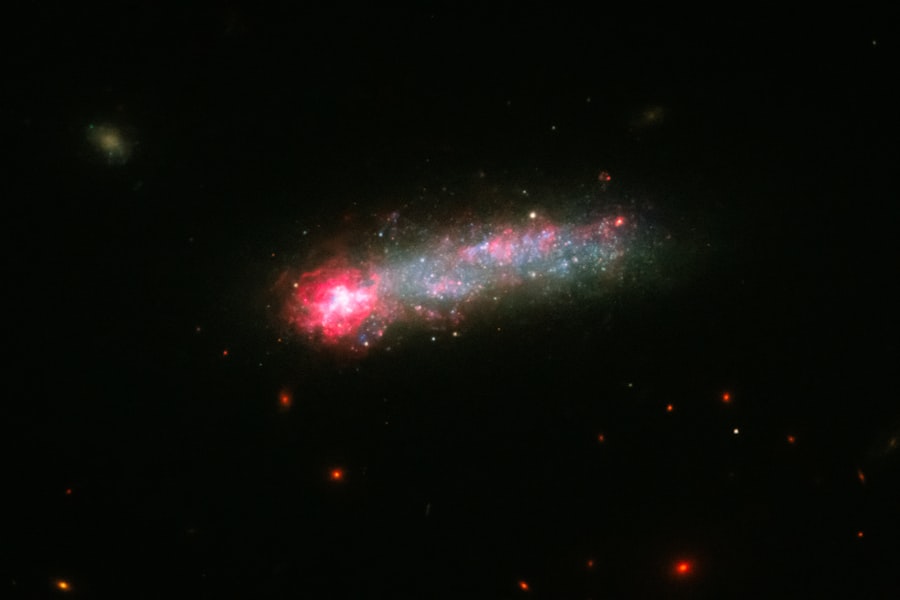
In contrast to their elliptical and spheroidal cousins, dwarf irregular galaxies possess significant amounts of gas and dust, and consequently, exhibit active star formation. Their irregular shapes are often attributed to tidal interactions with larger galaxies. These galaxies are like nascent star factories, buzzing with the energy of newly born stars. Examples include the Magellanic Clouds, which are satellites of the Milky Way.
Ultra-Compact Dwarf Galaxies (UCDs)
A more recently recognized class, UCDs are extremely dense and compact objects, similar in size to globular clusters but containing stellar masses comparable to small dwarf galaxies. Their origin is still a subject of active research, with theories suggesting they may be the tidally stripped nuclei of larger galaxies.
Dwarf galaxies, often considered the building blocks of larger galaxies, play a crucial role in our understanding of the universe’s evolution. A related article that delves deeper into the significance of these small yet fascinating structures can be found at My Cosmic Ventures. This article explores the formation, characteristics, and the vital role dwarf galaxies play in cosmic history, shedding light on their contribution to the overall structure of the universe.
Dwarf Galaxies as Cosmic Fossils: Clues to the Early Universe
One of the most compelling reasons for studying dwarf galaxies lies in their ability to act as temporal capsules, preserving conditions that existed during the early epochs of the universe.
Preserving Primordial Conditions
Due to their low stellar mass and the limited resources available for gravitational perturbations, dwarf galaxies are thought to have undergone less violent evolutionary histories compared to larger galaxies.
Less Merging and Accretion History
Massive galaxies have experienced numerous mergers with other galaxies throughout cosmic history. These dramatic events can significantly alter their structure, chemical composition, and star formation rates. Dwarf galaxies, being less gravitationally dominant, are less prone to such disruptive mergers, allowing them to retain a more pristine record of their formation. They are like quiet observers in a universe characterized by celestial collisions.
Low Metallicity Stars
Metallicity, in astronomical terms, refers to the abundance of elements heavier than hydrogen and helium within a star or galaxy. These heavier elements, often referred to as “metals,” are forged in the cores of stars and dispersed into the interstellar medium through supernova explosions. Dwarf galaxies, having experienced less widespread enrichment from generations of massive stars, often exhibit low metallicities. Studying these low-metallicity stars allows astronomers to probe the composition of the universe before extensive stellar evolution had occurred.
Understanding the Reionization Epoch
The Epoch of Reionization, a pivotal period in cosmic history, saw the universe transition from a neutral, opaque state to the ionized, transparent state we observe today. This transformation was driven by the ultraviolet radiation emitted by the first stars and galaxies.
The Role of Small Galaxies in Reionization
Recent cosmological models suggest that it was not just the massive galaxies that played a crucial role in reionization, but also a significant contribution from the collective ultraviolet output of numerous dwarf galaxies. Their abundance and distributed nature made them effective at showering the early universe with the ionizing photons needed to break apart neutral hydrogen atoms. Dwarf galaxies, in this context, are like a thousand tiny lighthouses illuminating the nascent cosmos.
Dwarf Galaxies and the Elusive Dark Matter
The study of dwarf galaxies has become instrumental in our quest to understand dark matter, the invisible scaffolding upon which the visible universe is built.
Dark Matter Halos of Dwarf Galaxies
Dwarf galaxies are embedded within much larger halos of dark matter. The visible matter of the dwarf galaxy – its stars and gas – constitutes only a small fraction of the total mass within these halos.
Gravitational Dominance of Dark Matter
The dynamics of dwarf galaxies reveal a significant discrepancy between their observed mass (from visible stars and gas) and the mass inferred from their gravitational effects. The stars within dwarf galaxies orbit at surprisingly high speeds, suggesting the presence of a much larger, unseen mass component holding them together. This unseen mass is attributed to dark matter. They are like a tiny, brightly lit boat being towed by an enormous, invisible leviathan.
Testing Dark Matter Models
The relative simplicity and isolation of many dwarf galaxies make them ideal laboratories for testing different models of dark matter. By analyzing the distribution of dark matter within their halos, astronomers can constrain the properties of dark matter particles. For instance, the observed density profiles of dark matter in dwarf galaxies can rule out certain theoretical dark matter candidates.
The Ultra-Faint Dwarf Galaxies
The discovery of ultra-faint dwarf galaxies (UFDs) has provided some of the most compelling evidence for the existence and nature of dark matter. These are the faintest and least massive known galaxies, containing only a few thousand stars.
Detecting the Undetectable
Their extreme faintness means they are only detectable in very close proximity to the Milky Way and Andromeda galaxies, often appearing as diffuse overdensities of stars in deep surveys. Their discovery was a testament to the increasing sensitivity of astronomical instruments.
Dark Matter Dominated Structures
The overwhelming majority of the mass in UFDs is dark matter. Their low star counts mean that the gravitational influence of their stars is minimal, making them highly susceptible to the gravitational pull of the surrounding dark matter halo. This makes their internal dynamics a direct probe of the dark matter distribution.
Dwarf Galaxies as Cosmic Neighbors: Satellites of the Milky Way and Andromeda
The Local Group of galaxies, the gravitational neighborhood of our Milky Way and the Andromeda galaxy, teems with dwarf galaxies. These satellite galaxies are crucial for understanding how larger galaxies grow and evolve.
The Milky Way’s Extent of Companions
The Milky Way galaxy is surrounded by a retinue of dwarf galaxies, ranging from the well-known Large and Small Magellanic Clouds to numerous fainter and more elusive dwarf spheroidals and ultra-faint dwarfs.
Tidal Interaction and Evolution
These satellite galaxies are not static entities. They are constantly interacting gravitationally with the Milky Way, experiencing tidal forces that can stretch and distort them, and in some cases, strip them of their stars and gas. Studying these interactions provides direct observational evidence of galaxy evolution driven by gravitational forces. It’s like observing the gentle tug-of-war between celestial bodies.
Probing Galactic Structure
The spatial distribution and kinematics of these satellite galaxies provide valuable information about the structure and gravitational potential of the Milky Way itself, including its dark matter halo. Their orbits reveal the underlying gravitational landscape of our home galaxy.
Andromeda’s Galactic Zoo
Similarly, the Andromeda galaxy (M31) hosts its own collection of dwarf satellite galaxies. The study of these satellites in conjunction with the Milky Way’s companions allows for comparative studies of galaxy formation and evolution within the Local Group. The similarities and differences in their satellite populations can shed light on universal processes.
Dwarf galaxies are fascinating celestial objects that provide valuable insights into the formation and evolution of the universe. Recent studies have highlighted their role in understanding dark matter and galaxy formation. For those interested in exploring this topic further, you can read a related article that delves into the significance of these small galaxies and their impact on cosmic structures. Check it out here to learn more about the intriguing world of dwarf galaxies.
Dwarf Galaxies as Laboratories for Stellar Evolution
| Metric | Value | Notes |
|---|---|---|
| Typical Diameter | 1,000 to 10,000 light years | Much smaller than the Milky Way (~100,000 light years) |
| Stellar Mass | 10^7 to 10^9 solar masses | Significantly less massive than large galaxies |
| Number of Stars | 10 million to 1 billion | Varies widely among dwarf galaxies |
| Dark Matter Content | High | Dwarf galaxies are often dark matter dominated |
| Typical Metallicity | 0.1 to 0.5 solar metallicity | Lower than larger galaxies, indicating older stellar populations |
| Star Formation Rate | 0.001 to 0.1 solar masses per year | Generally low but can vary |
| Distance from Milky Way | Up to 1 million light years | Includes satellite galaxies like the Large and Small Magellanic Clouds |
Beyond their cosmological significance, dwarf galaxies also serve as unique environments for studying stellar populations and their evolution.
Studying Pristine Stellar Populations
The low metallicity of many dwarf galaxies means that their stars formed from material that was less processed by previous generations of stars. This makes them effective laboratories for studying stars with compositions closer to the primordial abundance of the universe.
Early Stellar Populations
By observing stars in dwarf galaxies, astronomers can gain insights into the properties of the very first stars that formed after the Big Bang, known as Population III stars, although direct observation of Population III stars is currently beyond our capabilities. Dwarf galaxies provide a proxy for understanding the conditions under which these early stars emerged.
Exploring Stellar Fusion Processes
The study of stellar evolution in low-metallicity environments can also reveal subtle differences in stellar nucleosynthesis and energy generation processes compared to stars in more metal-rich galaxies. This can help refine our models of how stars burn and evolve.
Ongoing Star Formation in Dwarf Irregulars
While many dwarf galaxies are quiescent, dwarf irregulars are vibrant sites of ongoing star formation. Their lower gravitational potential means that star formation can proceed more dynamically, influenced by interactions with their environment and internal feedback processes.
Stellar Feedback Mechanisms
Studying the star-forming regions within dwarf irregulars allows astronomers to observe the interplay between massive stars, supernova explosions, and the interstellar medium. These “feedback” mechanisms play a critical role in regulating star formation and shaping the structure of galaxies. They are like miniature cosmic laboratories where the raw ingredients for new stars are churned and reformed.
In conclusion, dwarf galaxies, despite their modest size, are incredibly important celestial objects. They are not simply smaller versions of larger galaxies; they are distinct entities that offer unique perspectives on the fundamental processes governing the universe. Their study is crucial for unraveling the mysteries of dark matter, understanding the early universe, and appreciating the intricate tapestry of galaxy evolution. Each faint glow from a dwarf galaxy is a whisper from the past, a clue to the future, and a testament to the vast and complex nature of the cosmos.
FAQs
What are dwarf galaxies?
Dwarf galaxies are small galaxies composed of up to several billion stars, which is significantly fewer than the hundreds of billions found in larger galaxies like the Milky Way. They often have irregular shapes and can be found orbiting larger galaxies.
How do dwarf galaxies differ from larger galaxies?
Dwarf galaxies are much smaller in size and mass compared to larger galaxies. They typically contain fewer stars, less gas and dust, and have simpler structures. Their gravitational pull is weaker, which affects their ability to retain gas and form new stars.
Where are dwarf galaxies commonly found?
Dwarf galaxies are commonly found in galaxy clusters and groups, often orbiting larger galaxies. For example, the Milky Way has several known dwarf galaxy satellites, such as the Large and Small Magellanic Clouds.
Why are dwarf galaxies important to study?
Studying dwarf galaxies helps astronomers understand galaxy formation and evolution, as they are considered the building blocks of larger galaxies. They also provide insights into dark matter distribution and the conditions of the early universe.
Can dwarf galaxies form stars?
Yes, many dwarf galaxies are capable of forming new stars, although their star formation rates are generally lower than those of larger galaxies. Some dwarf galaxies are actively forming stars, while others may be more quiescent or have ceased star formation altogether.