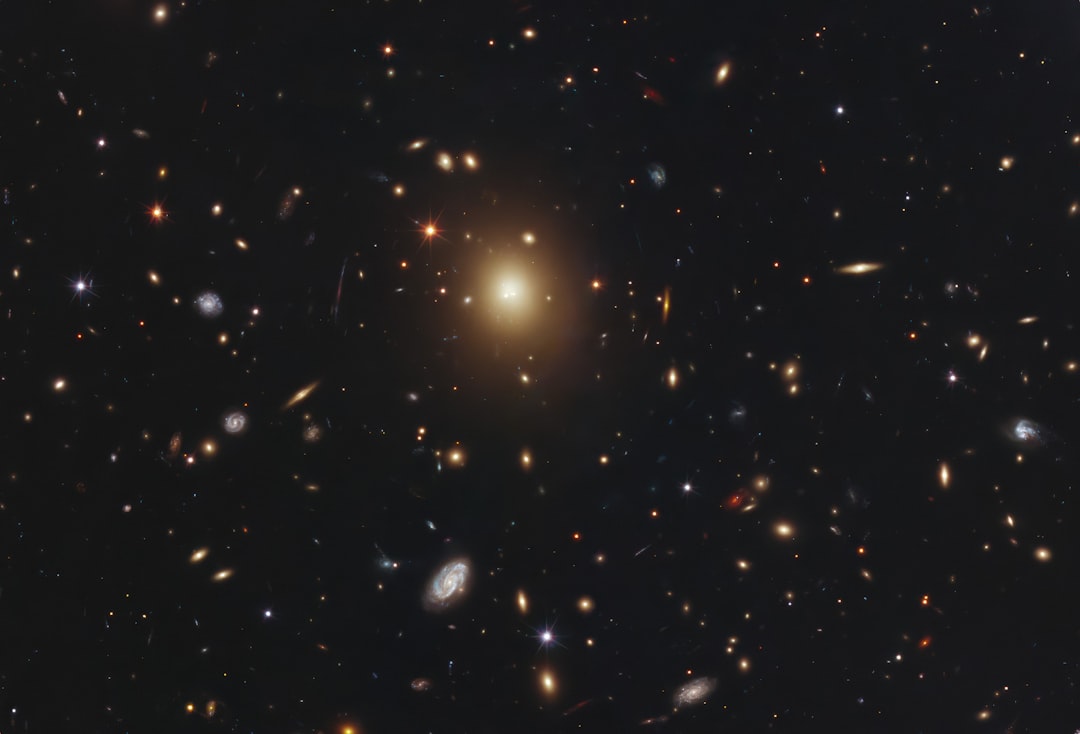
The observable universe, a term frequently encountered in scientific discourse, represents the portion of the cosmos that is, in principle, detectable from Earth at the present time. This boundary is not a physical edge to the universe itself, but rather a horizon defined by the finite speed of light and the finite age of the universe. Within this vast expanse, an astounding array of cosmic structures, from galaxies to galaxy clusters, are observed, each offering clues to the universe’s origin, evolution, and ultimate fate. Understanding the observable universe necessitates an appreciation for fundamental cosmological principles and the technological advancements that have allowed humanity to gaze ever further into its depths.
Defining the Observable Universe
The concept of the observable universe is inherently tied to the propagation of light. Light, despite its immense speed, travels at a finite velocity ($c \approx 299,792,458 \text{ meters/second}$). Since the Big Bang, the presumed origin of the universe, a finite amount of time has elapsed (approximately 13.8 billion years). Therefore, light from objects beyond a certain distance simply has not had enough time to reach us. This defines a spherical boundary around the observer, with Earth typically considered as the center for discussions pertaining to our observable universe.
The Light Travel Distance
The light travel distance is a straightforward calculation: the speed of light multiplied by the age of the universe. This yields a distance of roughly 13.8 billion light-years. However, due to the expansion of the universe, this is not the current distance to the most distant observable objects. Imagine a ship emitting a signal while sailing away from you; by the time the signal reaches you, the ship is much further away than its position when it emitted the signal. Similarly, while we observe light emitted 13.8 billion years ago, the source of that light has since receded significantly due to cosmic expansion.
The Comoving Distance
To account for cosmic expansion, cosmologists use the concept of comoving distance. This is the distance between two objects in an expanding universe that removes the effect of expansion. It represents the distance if the universe were to stop expanding at the present cosmic time, and we could instantaneously measure distances. The comoving distance to the edge of the observable universe is estimated to be approximately 46.5 billion light-years in all directions, yielding an observable universe diameter of around 93 billion light-years. This figure is significantly larger than the light travel distance due to the ongoing expansion that has stretched the spacetime fabric.
The Particle Horizon
The edge of the observable universe is formally known as the particle horizon. It represents the maximum distance from which particles could have traveled to reach the observer since the beginning of the cosmological expansion. Essentially, it is the boundary beyond which information cannot have propagated to us within the age of the universe. It is a constantly expanding horizon, as more light from increasingly distant objects eventually reaches Earth over time.
Contents of the Observable Universe
Within this immense sphere, the observable universe hosts a staggering array of celestial bodies and cosmic structures, organized hierarchically from individual stars to vast galaxy filaments. The composition and distribution of matter and energy within this region provide crucial data for cosmological models.
Galaxies and Clusterings
Galaxies are the fundamental building blocks of the large-scale structure of the observable universe. They are gravitationally bound systems of stars, stellar remnants, interstellar gas, dust, and dark matter. The Milky Way, our own galaxy, is but one of an estimated 2 trillion galaxies within the observable cosmos. These galaxies are not uniformly distributed; they tend to cluster together under the influence of gravity.
Galaxy Types
Galaxies are broadly classified into several morphological types: spiral, elliptical, and irregular. Spiral galaxies, like the Milky Way, are characterized by a disk-like shape with prominent spiral arms. Elliptical galaxies are more spherical or egg-shaped, often containing older stellar populations. Irregular galaxies lack a distinct regular shape, often resulting from gravitational interactions or mergers.
Galaxy Clusters and Superclusters
Galaxies themselves are organized into larger structures. Smaller groupings are known as galaxy groups, such as the Local Group (which includes the Milky Way and Andromeda). Larger collections, containing hundreds or even thousands of galaxies, are called galaxy clusters, for instance, the Virgo Cluster. These clusters, in turn, are part of even vaster structures known as superclusters, which can span hundreds of millions of light-years and contain tens of thousands of galaxies. The Laniakea Supercluster is an example of our own cosmic neighborhood’s supercluster.
Dark Matter and Dark Energy
Observations of galactic rotation curves, gravitational lensing, and the distribution of galaxy clusters have revealed that the visible matter in the universe accounts for only a small fraction of its total mass-energy content. The vast majority – approximately 27% – is attributed to dark matter, a mysterious, non-luminous substance that interacts gravitationally but not electromagnetically. Even more enigmatic is dark energy, which constitutes about 68% of the universe’s mass-energy and is responsible for the observed accelerating expansion of the universe.
Evidence for Dark Matter
The primary evidence for dark matter comes from its gravitational effects. For instance, stars in the outer regions of galaxies orbit at speeds that are too high to be explained by the visible matter alone, suggesting an unseen gravitational influence. Similarly, gravitational lensing, where the gravity of massive objects bends light, indicates a much greater mass than can be accounted for by luminous matter in galaxy clusters.
The Enigma of Dark Energy
Dark energy remains one of the most significant puzzles in modern cosmology. Its existence was inferred from the observation that distant supernovae appear fainter than expected, implying that the universe’s expansion is accelerating. This acceleration cannot be explained by standard gravitational models and suggests an unknown form of energy with repulsive gravitational properties.
Major Cosmological Theories and Models
The study of the observable universe is deeply intertwined with established cosmological theories that attempt to explain its origin, evolution, and underlying physical laws. The standard model of cosmology, known as the Lambda-CDM model, provides the current best description.
The Big Bang Theory
The Big Bang theory is the prevailing cosmological model for the observable universe from its earliest known periods through its subsequent large-scale evolution. It posits that the universe began as an extremely hot, dense point (singularity) approximately 13.8 billion years ago and has been expanding and cooling ever since.
Cosmic Microwave Background Radiation (CMB)
One of the strongest pieces of evidence for the Big Bang is the Cosmic Microwave Background (CMB) radiation. This faint glow of microwaves uniformly spread across the sky is interpreted as the residual heat from the Big Bang, a snapshot of the universe when it was only about 380,000 years old and sufficiently cool for neutral atoms to form, allowing photons to travel freely.
Nucleosynthesis of Light Elements
The Big Bang theory also successfully predicts the observed abundance of light elements in the universe, such as hydrogen, helium, and lithium. During the first few minutes after the Big Bang, the universe was hot enough for nuclear fusion to occur, forming these elements in specific ratios that are consistent with astronomical observations.
Inflationary Cosmology
While the Big Bang theory successfully explains many aspects of the universe, it faces certain challenges, such as the flatness problem and the horizon problem. Inflationary cosmology, developed by Alan Guth and others, proposes a period of extremely rapid, exponential expansion in the first fraction of a second after the Big Bang.
The Horizon Problem
The horizon problem asks why regions of the CMB that were causally disconnected in the early universe seem to have the same temperature. Inflation solves this by positing that these regions were once causally connected before inflation stretched them far apart.
The Flatness Problem
The flatness problem refers to the precise balance between the universe’s expansion and gravitational collapse, resulting in a nearly flat spacetime geometry. Inflation naturally drives the universe towards flatness, regardless of its initial curvature.
Observing the Observable Universe
Our understanding of the observable universe relies heavily on technological advancements in astronomy, allowing us to capture and analyze light and other forms of electromagnetic radiation from distant sources.
Telescopes and Observatories
Telescopes, ranging from ground-based optical and radio telescopes to space-based observatories, are the primary tools for exploring the cosmos. Each type of telescope is designed to detect specific wavelengths of the electromagnetic spectrum, revealing different aspects of celestial objects.
Ground-Based Telescopes
Large observatories like the Keck Observatory (optical/infrared) and the Arecibo Observatory (radio, though now decommissioned) have provided invaluable data from Earth’s surface. Adaptive optics and interferometry are techniques employed to overcome atmospheric distortion and improve resolution.
Space-Based Telescopes
Space telescopes, such as the Hubble Space Telescope and the James Webb Space Telescope (JWST), offer unparalleled views of the universe by operating above the Earth’s atmosphere, which absorbs or distorts certain wavelengths. JWST, with its infrared capabilities, is particularly adept at peering through cosmic dust and observing the very first galaxies.
Multi-messenger Astronomy
Beyond electromagnetic radiation, astronomers are increasingly utilizing multi-messenger astronomy, combining observations from gravitational waves, neutrinos, and cosmic rays. This approach provides a more complete picture of energetic cosmic events and phenomena that are otherwise difficult or impossible to detect.
Gravitational Wave Astronomy
Detectors like LIGO and Virgo have opened a new window into the universe by directly observing gravitational waves, ripples in spacetime caused by massive accelerating objects like merging black holes and neutron stars. This allows us to study phenomena that do not emit significant electromagnetic radiation.
Neutrino Astronomy
Neutrino observatories, such as IceCube, detect neutrinos, elusive subatomic particles that interact very weakly with matter. These neutrinos can carry information directly from the hearts of supernovae and other energetic processes, providing insights into their extreme environments.
The Limits of Observation and Speculation
Despite the immense progress in understanding the observable universe, inherent limitations persist, fostering ongoing scientific inquiry and speculation about what lies beyond our current perception.
The Edge of the Observable
It is crucial to reiterate that the boundary of the observable universe is not a physical wall but a horizon of information. The universe itself is likely much, much larger than our observable portion, possibly infinite. The “edge” merely represents the farthest point from which light has had time to reach us.
Beyond the Particle Horizon
What lies beyond the particle horizon remains a matter of theoretical extrapolation. It is plausible that the universe continues in a similar fashion, with galaxies, clusters, and voids, governed by the same physical laws. However, without communication from these regions, their exact nature remains unknown.
The Multiverse Hypothesis
The multiverse hypothesis suggests that our universe is just one of many, perhaps an infinite number, of universes. While highly speculative and currently untestable, some cosmological theories, like chaotic inflation, naturally lead to the concept of a multiverse, with different universes potentially having different physical constants or even different dimensions.
The Ultimate Fate of the Universe
The ultimate fate of the observable universe is an active area of research, with several competing scenarios dependent on the properties of dark energy and the overall geometry of spacetime.
The Big Freeze (Heat Death)
The current standard model favors the Big Freeze, or heat death, as the most likely ultimate fate. In this scenario, the universe continues to expand, becoming increasingly cold and dilute. Stars eventually burn out, black holes evaporate, and the universe becomes a cold, dark, and empty void, reaching a state of maximum entropy.
The Big Rip
If dark energy strengthens over time, it could lead to the “Big Rip.” In this extreme scenario, the accelerating expansion would eventually become so powerful that it overwhelms all fundamental forces, tearing apart galaxies, stars, planets, and eventually even atoms themselves.
The Big Crunch (Less Likely)
The Big Crunch, where the universe’s expansion eventually reverses and collapses back into a singularity, is considered less likely given current observations of dark energy driving accelerated expansion. However, if dark energy were to dissipate or gravity were stronger than currently estimated, this scenario could still be plausible.
In conclusion, the observable universe, while representing a finite portion of a potentially infinite cosmos, offers an awe-inspiring vista of cosmic evolution. Its study, driven by increasingly sophisticated instruments and theoretical frameworks, continuously pushes the boundaries of human knowledge. From the faint echoes of the Big Bang to the enigmatic nature of dark matter and dark energy, this “limitless frontier” challenges our perception and invites endless exploration, reminding us of the profound mysteries that still await unraveling within the vast expanse of space and time.

WATCH NOW ▶️ Dark energy is deleting the universe proof
FAQs

What is the observable universe?
The observable universe refers to the portion of the entire universe that we can see or detect from Earth, limited by the speed of light and the age of the universe. It includes all matter and energy from which light has had time to reach us since the Big Bang.
How large is the observable universe?
The observable universe is approximately 93 billion light-years in diameter. This size accounts for the expansion of space since the Big Bang, meaning we can observe objects whose light has traveled up to about 46.5 billion light-years in any direction.
Why can’t we see beyond the observable universe?
We cannot see beyond the observable universe because light from regions farther away has not had enough time to reach us since the beginning of the universe. The finite speed of light and the universe’s age limit the distance we can observe.
Does the observable universe represent the entire universe?
No, the observable universe is only a portion of the entire universe. The full universe may be much larger, possibly infinite, but regions beyond the observable universe are currently inaccessible to observation.
What determines the boundary of the observable universe?
The boundary of the observable universe is determined by the cosmic light horizon, which is the maximum distance from which light has traveled to Earth since the Big Bang, considering the expansion of space over time. This horizon defines the limit of what we can observe.