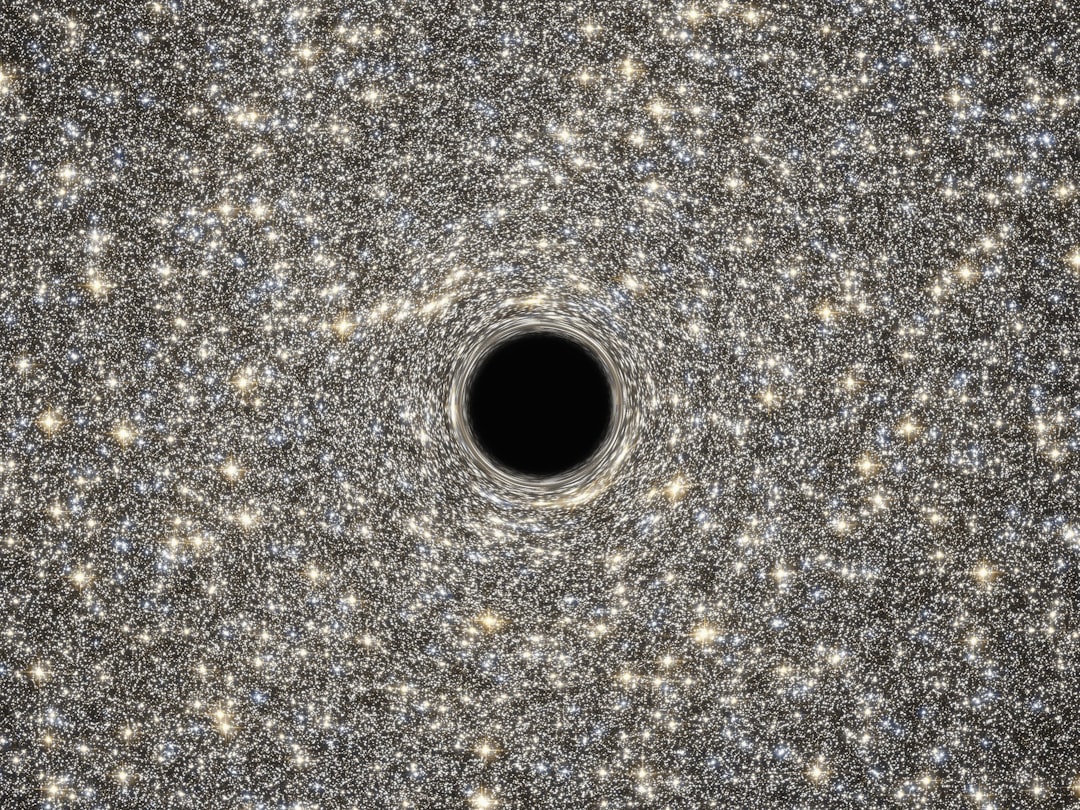
Exploring Black Holes and Event Horizons
This article delves into the enigmatic world of black holes, celestial objects of immense gravitational pull that dominate modern astrophysics. It aims to provide a comprehensive understanding of their formation, properties, and the theoretical concepts surrounding their boundaries, particularly the event horizon. The discussion will navigate complex scientific theories, offering explanations in a clear and factual manner, much like an encyclopedia entry. Readers will be guided through the theoretical constructs and observational evidence that underpin our current knowledge of these cosmic behemoths.
The journey into understanding black holes begins with their formation. These ultradense objects are primarily the end states of massive stars, but they can also arise through other, more exotic mechanisms. The process of stellar collapse is central to the birth of what are known as stellar-mass black holes.
Stellar Evolution and Gravitational Collapse
Stars, throughout their active lives, maintain a delicate balance between the outward pressure generated by nuclear fusion in their cores and the inward pull of their own gravity. The fusion of lighter elements into heavier ones releases vast amounts of energy, counteracting gravity’s relentless embrace. However, this fuel supply is not infinite.
The Role of Stellar Mass in Destiny
A star’s ultimate fate is largely determined by its initial mass. Stars with masses similar to our Sun will eventually exhaust their hydrogen fuel, swell into red giants, shed their outer layers, and ultimately cool into white dwarfs. These white dwarfs are supported against further collapse by electron degeneracy pressure, a quantum mechanical effect that prevents electrons from occupying the same quantum state.
Supernovae and Residual Cores
For stars significantly more massive than the Sun, typically exceeding eight solar masses, their demise is far more dramatic. Once these massive stars exhaust their nuclear fuel, the outward pressure from fusion can no longer counteract gravity. The star’s core collapses catastrophically, imploding in a matter of milliseconds. This rapid inward collapse creates an immense shockwave that rebounds outwards, resulting in a spectacular explosion known as a supernova. For a brief period, a supernova can outshine an entire galaxy, scattering heavy elements forged within the star across the cosmos.
The Birth of a Black Hole
If the remaining core of the supernova progenitor star is sufficiently massive – typically exceeding two to three solar masses (the Chandrasekhar limit for white dwarfs and the Tolman-Oppenheimer-Volkoff limit for neutron stars) – even the neutron degeneracy pressure that supports neutron stars cannot withstand the overwhelming gravitational forces. The core collapses further, compressing matter infinitely into an infinitesimally small point known as a singularity. At this point, a black hole is formed.
Supermassive Black Holes: Guardians of Galaxies
Beyond stellar-mass black holes, which typically range from a few to a few tens of solar masses, exist supermassive black holes. These gargantuan objects can possess masses millions, or even billions, of times that of the Sun. Unlike their stellar counterparts, their formation mechanisms are less precisely understood, though several hypotheses exist.
Theories of Supermassive Black Hole Formation
One prominent theory suggests that supermassive black holes grow from smaller “seed” black holes, which accrete vast quantities of gas and dust from their surroundings over cosmic timescales. These seed black holes could be remnants of the first stars, formed in the early universe, or even the direct collapse of massive gas clouds. Another hypothesis proposes that these behemoths arose from the direct collapse of immense primordial gas clouds, bypassing the formation of individual stars altogether. Mergers of smaller black holes and even entire galaxies are also thought to contribute to their growth. These cosmic collisions provide ample material for the central black hole to consume, increasing its mass over eons.
Observational Evidence from Galactic Centers
Evidence for supermassive black holes is compelling. Nearly every large galaxy observed, including our own Milky Way, appears to harbor a supermassive black hole at its center. The highly energetic processes observed in the nuclei of active galaxies, known as Active Galactic Nuclei (AGN), are widely attributed to gas falling into these central black holes, forming superheated accretion disks that emit intense radiation across the electromagnetic spectrum. The motion of stars orbiting these galactic centers provides direct kinematic evidence of their immense gravitational pull.
Black holes and their enigmatic event horizons continue to captivate the scientific community and the public alike. For those interested in delving deeper into the mysteries of these cosmic phenomena, a related article can be found at this link, which explores the latest discoveries and theories surrounding black holes and their impact on our understanding of the universe.
Decoding the Anatomy of a Black Hole: Beyond the Event Horizon
While the singularity represents the black hole’s core, it is not the most observable or directly relevant feature for understanding its interaction with the wider universe. The concept of the event horizon is paramount in defining the boundaries and properties of a black hole.
The Singularity: A Point of Infinite Density
At the very heart of a black hole lies the singularity, a theoretical point where matter is compressed to infinite density and spacetime curvature becomes infinite. While mathematically precise, the physical reality of a singularity remains a significant challenge for existing theoretical frameworks, particularly general relativity, which breaks down at such extreme conditions.
Limitations of General Relativity
General relativity, our most successful theory of gravity, describes gravity as the curvature of spacetime caused by mass and energy. However, at the singularity, the equations of general relativity yield infinite values, indicating that the theory is incomplete and a more comprehensive theory, perhaps one that incorporates quantum mechanics, is needed to accurately describe this region. This is where the quest for a theory of quantum gravity becomes crucial.
The Event Horizon: The Point of No Return
The event horizon is often described as the “point of no return” for a black hole. It is a boundary in spacetime beyond which events cannot affect an outside observer. More precisely, it is the boundary around a black hole beyond which neither light nor any other form of information can escape and reach an external observer.
Spacetime Curvature and Light Cones
To understand the event horizon, one must grasp the concept of spacetime curvature and light cones. In general relativity, massive objects curve spacetime around them. Close to a black hole, this curvature becomes so extreme that all future light cones — the paths that light can take — are tilted inward, pointing towards the singularity.
The Escape Velocity Analogy
A common analogy used to explain the event horizon is that of escape velocity. For any celestial body, there is a certain speed (escape velocity) that an object must attain to break free from its gravitational pull. For the Earth, this is approximately 11.2 kilometers per second. As one approaches a black hole, the escape velocity increases, eventually reaching the speed of light at the event horizon. Since nothing can travel faster than the speed of light, anything crossing this boundary is trapped forever.
The Schwarzschild Radius: Defining the Horizon
For a non-rotating, uncharged black hole (a Schwarzschild black hole), the event horizon is a perfectly spherical boundary whose radius is known as the Schwarzschild radius. This radius is directly proportional to the mass of the black hole.
Calculating the Schwarzschild Radius
The Schwarzschild radius ($R_s$) is given by the formula:
$R_s = (2GM) / c^2$
where:
- $G$ is the gravitational constant
- $M$ is the mass of the black hole
- $c$ is the speed of light
This formula demonstrates that a more massive black hole will have a larger event horizon. For example, a black hole with the mass of our Sun would have a Schwarzschild radius of approximately 3 kilometers.
Journey to Oblivion: Crossing the Event Horizon
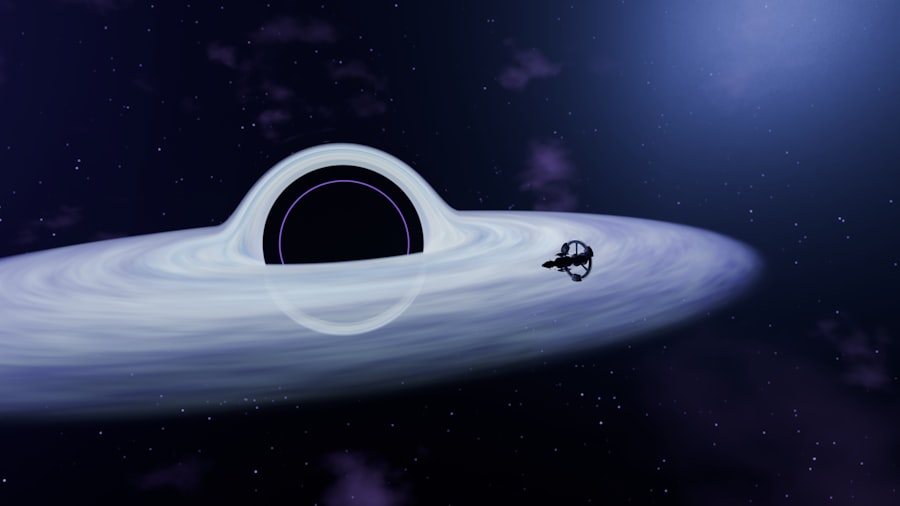
What happens as an object approaches and ultimately crosses the event horizon? The experience would be profoundly different depending on the observer’s perspective, highlighting the relativistic nature of spacetime.
Relativistic Effects on an Infalling Observer
From the perspective of an observer falling into a black hole, nothing fundamentally unusual would be experienced at the moment of crossing the event horizon. There would be no physical barrier or sudden jolt. Physics as we understand it would continue to apply locally.
Spaghettification: Tidal Forces and Deformation
However, as the infalling observer approaches the singularity, they would experience extreme tidal forces. Because the gravitational pull is stronger on the parts of their body closer to the black hole than on the parts farther away, the observer would be stretched vertically and compressed horizontally, a phenomenon dramatically dubbed “spaghettification.” For a stellar-mass black hole, this process would occur well before crossing the event horizon, tearing apart any object. For a supermassive black hole, whose event horizon is vastly larger, the tidal forces at the horizon would be much weaker, allowing an object to cross the horizon intact, at least initially.
The Irreversible Journey Inward
Once an object crosses the event horizon, its path inevitably leads towards the singularity. All possible future trajectories for anything inside the event horizon point towards the singularity. There are no escape routes, no sidesteps; the trajectory is fixed. This is because the spacetime curvature is so extreme that even traveling at the speed of light cannot overcome the inward pull.
The View from Afar: An External Observer’s Perspective
For an external observer watching an object fall into a black hole, the experience would be entirely different, illustrating the profound effects of gravitational time dilation.
Gravitational Time Dilation and Redshift
As the infalling object approaches the event horizon, gravitational time dilation comes into play. Time for the infalling object would appear to slow down from the perspective of the external observer. The light emitted by the infalling object would also be stretched to longer wavelengths, experiencing a phenomenon called gravitational redshift. This means that the light would become redder and fainter.
The “Frozen” Image at the Horizon
As the infalling object gets infinitesimally close to the event horizon, the time dilation becomes infinite, and the redshift becomes extreme. To the external observer, the object would appear to slow down asymptotically, never truly crossing the event horizon but instead becoming “frozen” in time and vanishing from sight as its light becomes infinitely redshifted and too faint to detect. This means that from an external perspective, you would never truly see an object cross the event horizon; it would simply fade away at the edge.
Hawking Radiation: A Glimmer of Escape?
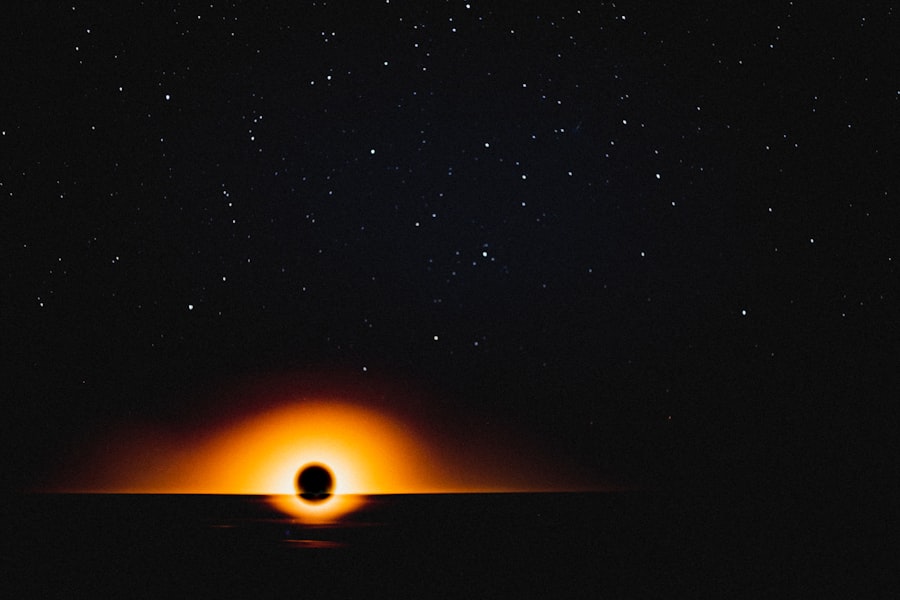
While black holes are often described as objects from which nothing can escape, quantum mechanics introduces a fascinating twist: black holes are not entirely black. This concept, known as Hawking radiation, suggests that black holes can slowly evaporate over immense timescales.
Quantum Fluctuations Near the Event Horizon
Hawking radiation arises from quantum fluctuations in the vacuum of space near the event horizon. According to quantum field theory, the vacuum is not truly empty but is constantly teeming with “virtual” particle-antiparticle pairs that spontaneously pop into existence and annihilate each other in incredibly short durations.
Pair Production and Hawking Radiation
Near the event horizon, sometimes one particle from a virtual pair falls into the black hole while its partner escapes. The particle that escapes carries away positive energy, effectively reducing the black hole’s mass. The energy for this spontaneous emission comes from the mass-energy of the black hole itself. Thus, the black hole emits a faint thermal radiation, known as Hawking radiation.
Black Hole Evaporation and Thermodynamics
The emission of Hawking radiation implies that black holes are not eternal objects. They slowly lose mass and energy over time, eventually evaporating completely, though this process is incredibly slow for astrophysical black holes.
The Information Paradox
Hawking radiation also gives rise to one of the most profound puzzles in theoretical physics: the “information paradox.” If black holes evaporate, what happens to the information about the particles that fell into them? Quantum mechanics states that information cannot be truly destroyed. Does the information encoded in the matter swallowed by a black hole somehow escape with the Hawking radiation, or is it truly lost, violating a fundamental principle of quantum theory? This remains an active area of research and debate.
Black Hole Temperature
Black holes, despite their chilling reputation, possess a temperature due to Hawking radiation. This temperature is inversely proportional to their mass. Smaller black holes are hotter and evaporate faster than larger ones. For a stellar-mass black hole, the temperature is incredibly low, far below that of the cosmic microwave background, meaning they would absorb more radiation than they emit. However, tiny, primordial black holes (if they exist) could be hot enough to emit detectable radiation bursts as they finally evaporate.
Black holes and their enigmatic event horizons continue to captivate scientists and enthusiasts alike, sparking numerous discussions about the nature of the universe. For those interested in delving deeper into this fascinating topic, a related article can be found at My Cosmic Ventures, which explores the latest theories and discoveries surrounding these cosmic phenomena. Understanding the implications of event horizons not only enhances our grasp of black holes but also challenges our perceptions of space and time.
Observational Evidence and Future Prospects
| Metric | Description | Typical Values | Units |
|---|---|---|---|
| Mass | Mass of the black hole | 3 to 10 billion (supermassive), 5 to 30 (stellar) | Solar masses (M☉) |
| Event Horizon Radius (Schwarzschild Radius) | Radius of the event horizon for a non-rotating black hole | ~3 km per solar mass | Kilometers (km) |
| Spin (Dimensionless Spin Parameter) | Angular momentum per unit mass, ranges from 0 (non-rotating) to 1 (maximally rotating) | 0 to 0.998 (typical astrophysical black holes) | Dimensionless |
| Hawking Temperature | Temperature of black hole radiation due to quantum effects | ~10^-8 (for stellar mass black holes) | Kelvin (K) |
| Escape Velocity at Event Horizon | Velocity needed to escape the gravitational pull at the event horizon | Speed of light (c) | m/s |
| Gravitational Time Dilation | Time dilation factor near the event horizon compared to far away | Approaches infinity at event horizon | Dimensionless ratio |
| Accretion Disk Temperature | Temperature of matter in the accretion disk near the event horizon | 10^5 to 10^7 | Kelvin (K) |
While black holes present immense theoretical challenges, their existence is supported by a wealth of observational evidence from across the electromagnetic spectrum and through gravitational waves.
Direct and Indirect Detection Methods
Scientists employ various methods to detect black holes, most of which rely on observing their gravitational influence on surrounding matter.
Accretion Disks and X-Ray Emission
One of the most prominent indirect methods involves observing accretion disks around black holes. As gas and dust spiral inward towards a black hole, they form a superheated disk that emits intense X-rays, gamma rays, and other forms of electromagnetic radiation. These emissions serve as a powerful beacon, revealing the presence of an otherwise invisible black hole.
Stellar Orbits and Kinematics
In galactic centers, the motion of stars orbiting a concentrated, invisible mass provides compelling evidence for supermassive black holes. By analyzing the orbital mechanics of these stars, astronomers can deduce the mass and location of the central black hole. The prime example is Sagittarius A (Sgr A), the supermassive black hole at the center of the Milky Way, whose mass has been precisely measured by tracking the orbits of stars like S2.
Gravitational Lensing
Black holes, like any massive object, can bend the path of light, a phenomenon known as gravitational lensing. While observing the lensing effects of individual black holes is challenging due to their small size, the collective lensing effects of dark matter (which may include a component of primordial black holes) are observed in galaxy clusters.
Gravitational Wave Astronomy: Hearing Black Holes Collide
The advent of gravitational wave astronomy has revolutionized our ability to observe black holes, offering an entirely new window into the universe.
LIGO and Virgo Detections
Detectors like LIGO (Laser Interferometer Gravitational-Wave Observatory) and Virgo have successfully detected gravitational waves emanating from the mergers of black holes. These events involve two black holes spiraling inward and coalescing, releasing enormous amounts of energy in the form of ripples in spacetime.
Unveiling the Dynamics of Mergers
The gravitational wave signals carry information about the masses, spins, and orbital dynamics of the merging black holes, providing crucial data that corroborates theoretical predictions of general relativity in extreme gravitational environments. These detections have confirmed the existence of binary black hole systems and offered unprecedented insights into the universe’s most violent cosmic collisions.
The Event Horizon Telescope (EHT): Imaging the Unimaginable
The Event Horizon Telescope (EHT) collaboration has achieved a monumental feat: capturing the first direct images of the shadows of black holes.
Imaging M87 and Sagittarius A
In 2019, the EHT released the first image of a black hole, specifically the supermassive black hole M87 at the center of the Messier 87 galaxy. This image revealed a bright ring of emission surrounding a dark central region, precisely matching the theoretical predictions for a black hole shadow. This was followed by the imaging of our own galaxy’s supermassive black hole, Sagittarius A, in 2022.
Confirming General Relativity
These groundbreaking images serve as powerful direct observational evidence of black holes and their event horizons, providing strong confirmation of Einstein’s theory of general relativity in the strongest gravitational fields imaginable. The EHT’s future observations promise to further refine our understanding of black hole physics and the dynamics of matter in their extreme environments.
In conclusion, black holes represent frontiers of both theoretical physics and observational astronomy. From their violent stellar origins to the subtle quantum whispers of Hawking radiation, these cosmic leviathans continue to challenge our understanding of space, time, and gravity, pushing the boundaries of scientific inquiry. The ongoing exploration of black holes and their event horizons promises to unlock profound secrets about the universe we inhabit.
WATCH NOW ▶️ Why the speed of light is a limit
FAQs
What is a black hole?
A black hole is a region in space where gravity is so strong that nothing, not even light, can escape from it. It forms when a massive star collapses under its own gravity at the end of its life cycle.
What is an event horizon?
The event horizon is the boundary surrounding a black hole beyond which nothing can escape. It marks the point of no return; once an object crosses this boundary, it inevitably falls into the black hole.
How are black holes detected if they emit no light?
Black holes are detected by observing their effects on nearby matter and light. For example, astronomers look for stars orbiting invisible objects, X-ray emissions from hot gas falling into a black hole, or gravitational waves from black hole mergers.
Can anything escape from inside a black hole?
According to current scientific understanding, nothing can escape from inside a black hole once it passes the event horizon. This includes light, matter, and information.
Do all black holes have the same size?
No, black holes vary greatly in size. They can range from a few times the mass of our Sun (stellar black holes) to millions or billions of times the Sun’s mass (supermassive black holes found at the centers of galaxies).