
Time is an enigmatic and multifaceted concept that has intrigued humanity for centuries. It serves as a framework within which events unfold, allowing individuals to organize their experiences and understand the sequence of occurrences. Time is often perceived as a linear progression, moving from the past through the present and into the future.
However, this seemingly straightforward understanding belies the complexity of time as it is experienced and measured. The exploration of time encompasses various disciplines, including physics, philosophy, and psychology, each contributing unique insights into its nature. As individuals navigate their daily lives, they rely on clocks and calendars to structure their activities, yet the essence of time remains elusive.
It is not merely a tool for scheduling but a fundamental aspect of existence that shapes human experience. The quest to comprehend time has led to profound questions about its nature: Is it an absolute entity, or is it relative? How does it influence perception and reality?
These inquiries have spurred countless theories and discussions, revealing that time is not just a backdrop for events but an integral part of the universe’s fabric.
Key Takeaways
- The concept of time is a fundamental aspect of human existence, shaping our understanding of the world and our place within it.
- The history of the perception of time has evolved over centuries, from ancient civilizations to modern scientific theories.
- The theory of relativity, proposed by Albert Einstein, revolutionized our understanding of time and space, challenging traditional notions of absolute time.
- Time dilation, a key concept in the theory of relativity, has profound implications for our perception of time and its relationship to motion and gravity.
- Gravity plays a significant role in shaping our perception of time, as demonstrated by experiments and observations in the field of physics.
The history of the perception of time
The perception of time has evolved significantly throughout history, influenced by cultural, scientific, and philosophical developments. In ancient civilizations, time was often viewed through the lens of natural cycles, such as the changing seasons or the phases of the moon. Early societies relied on these rhythms to guide agricultural practices and communal activities.
The invention of sundials and water clocks marked a pivotal moment in humanity’s relationship with time, allowing for more precise measurements and a shift towards a more structured understanding. As societies progressed, so did their conceptualization of time. The advent of mechanical clocks in the Middle Ages revolutionized timekeeping, leading to a more standardized approach to measuring hours and minutes.
This shift not only transformed daily life but also influenced philosophical thought. Thinkers like Immanuel Kant began to explore the nature of time as a mental construct rather than an objective reality. This philosophical inquiry laid the groundwork for later scientific advancements that would challenge traditional notions of time.
The theory of relativity and its impact on our understanding of time
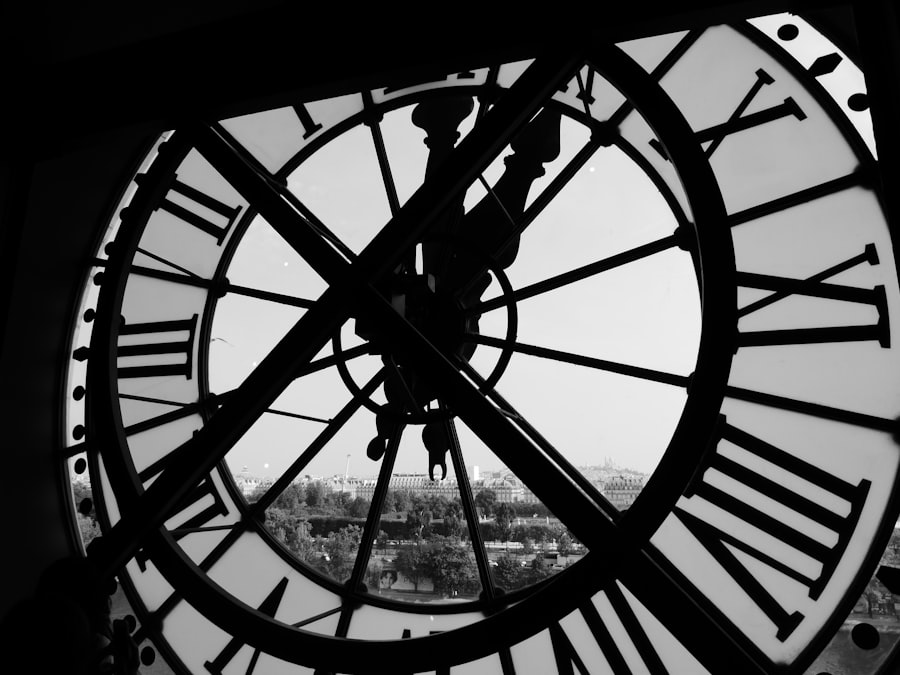
Albert Einstein’s theory of relativity fundamentally altered humanity’s understanding of time and space. Introduced in the early 20th century, this groundbreaking theory posited that time is not a constant but rather a variable that can be affected by speed and gravity. According to relativity, two observers moving at different velocities may experience time differently, leading to what is known as time dilation.
This revelation challenged long-held beliefs about the universality of time and opened new avenues for scientific exploration. The implications of relativity extend beyond theoretical physics; they have practical consequences in various fields, including astronomy and technology. For instance, GPS satellites must account for relativistic effects to provide accurate positioning data.
The realization that time is intertwined with the fabric of space has prompted scientists to reconsider fundamental questions about the universe’s structure and the nature of reality itself. Einstein’s work not only reshaped physics but also sparked philosophical debates about the nature of existence and the human experience of time.
Time dilation and its implications
| Concept | Definition |
|---|---|
| Time Dilation | The phenomenon predicted by the theory of relativity where time passes at different rates for observers who are moving relative to one another. |
| Implications | 1. Time dilation has been confirmed through experiments with atomic clocks on fast-moving airplanes and satellites. 2. It has implications for GPS systems, as the clocks on satellites experience time dilation, which must be corrected for accurate positioning. 3. Time dilation also plays a role in the concept of time travel, as it suggests that time can pass at different rates in different reference frames. |
Time dilation is one of the most fascinating consequences of Einstein’s theory of relativity. It refers to the phenomenon where time passes at different rates for observers in varying states of motion or gravitational fields. For example, an astronaut traveling at high speeds in space will age more slowly than someone remaining on Earth.
This counterintuitive concept challenges conventional notions of time as a uniform experience shared by all. The implications of time dilation extend beyond theoretical musings; they have practical applications in modern technology. For instance, high-speed particles in accelerators exhibit measurable differences in decay rates due to their velocities, confirming predictions made by relativity.
Additionally, GPS systems must incorporate corrections for both special and general relativity to ensure accurate navigation. These real-world applications underscore the importance of understanding time dilation in both scientific research and everyday life.
The influence of gravity on the perception of time
Gravity plays a crucial role in shaping the perception of time, as described by Einstein’s general theory of relativity. According to this theory, massive objects like planets and stars warp the fabric of spacetime around them, causing time to pass more slowly in stronger gravitational fields. This phenomenon has been experimentally verified through various studies, including observations made near black holes and precise measurements conducted with atomic clocks at different altitudes.
The implications of gravity on time perception are profound. For instance, individuals living at higher altitudes experience slightly faster passage of time compared to those at sea level due to weaker gravitational forces. This subtle difference may seem negligible in everyday life but becomes significant when considering long-term effects or high-precision technologies.
Understanding how gravity influences time perception not only enhances scientific knowledge but also invites contemplation about the interconnectedness of physical forces and human experience.
The concept of spacetime and its role in understanding the relativity of time

The concept of spacetime is central to understanding the relativity of time as proposed by Einstein. Rather than viewing space and time as separate entities, spacetime combines them into a single four-dimensional continuum where events occur. This framework allows for a more comprehensive understanding of how objects move through both space and time, revealing that they are intrinsically linked.
In this model, the curvature of spacetime caused by mass influences how objects travel through it, affecting their experience of time. For example, light travels along curved paths in gravitational fields, leading to phenomena such as gravitational lensing. The integration of space and time into a unified concept has profound implications for physics, cosmology, and even philosophy.
It challenges traditional views and encourages a reevaluation of how individuals perceive their place within the universe.
The role of perception and experience in shaping our understanding of time
Perception plays a pivotal role in shaping individual experiences of time. While scientific measurements provide objective data about temporal intervals, subjective experiences can vary widely based on context, emotions, and cultural backgrounds. For instance, moments of joy may seem to fly by, while periods of discomfort can feel interminable.
This subjective nature highlights that time is not merely a quantitative measure but also a qualitative experience influenced by psychological factors. Cognitive psychology has explored how attention and memory affect perceptions of time. When individuals are fully engaged in an activity, they often lose track of time—a phenomenon known as “flow.” Conversely, when one is bored or anxious, every second can feel elongated.
These insights reveal that human experiences are deeply intertwined with temporal perception, suggesting that understanding time requires consideration not only of its scientific aspects but also its psychological dimensions.
Cultural and societal influences on the perception of time
Cultural contexts significantly shape how societies perceive and value time.
For example, Western cultures often emphasize efficiency and strict adherence to schedules, while many Indigenous cultures may adopt a more cyclical view of time that prioritizes relationships and natural rhythms over rigid timelines.
These cultural differences can lead to misunderstandings in cross-cultural interactions.
Additionally, societal changes—such as the rise of digital technology—have further transformed perceptions of time by creating an environment where instant communication and rapid responses are expected.
As globalization continues to blur cultural boundaries, individuals must navigate these diverse perceptions while developing their own understanding of time.
The philosophical implications of the relativity of time
The relativity of time raises profound philosophical questions about existence and reality. If time is not an absolute entity but rather a relative experience shaped by motion and gravity, what does this mean for concepts such as free will and determinism? Philosophers have long debated whether human actions are predetermined by external forces or if individuals possess agency within the temporal framework.
Moreover, the idea that different observers can experience different temporal realities challenges traditional notions of truth and objectivity. If two people perceive events differently based on their relative positions or velocities, how can one ascertain an objective account of reality? These philosophical inquiries invite deeper reflection on the nature of existence itself and encourage individuals to consider how their understanding of time influences their worldview.
Practical applications of understanding the relativity of time
Understanding the relativity of time has practical applications across various fields beyond theoretical physics. In technology, advancements in telecommunications rely on precise timing mechanisms that account for relativistic effects to ensure synchronization across networks. Similarly, financial markets utilize high-frequency trading algorithms that depend on accurate timing to capitalize on fleeting opportunities.
In medicine, knowledge about relativistic effects can enhance imaging techniques such as MRI scans or particle therapy for cancer treatment. By incorporating principles from relativity into these technologies, practitioners can improve outcomes for patients while advancing scientific research. As society continues to grapple with complex challenges, embracing an understanding of the relativity of time can lead to innovative solutions that enhance quality of life.
Embracing the relativity of time in our lives
In conclusion, embracing the relativity of time offers individuals a richer perspective on their experiences and interactions with the world around them. Recognizing that time is not merely a linear progression but a complex interplay between physical forces, cultural contexts, and personal perceptions can lead to greater mindfulness in daily life. By acknowledging the subjective nature of temporal experiences, individuals can cultivate patience and empathy toward themselves and others.
As humanity continues to explore the mysteries surrounding time—through scientific inquiry, philosophical reflection, and cultural exchange—there lies an opportunity for growth and understanding. Embracing the relativity of time encourages individuals to appreciate each moment while recognizing that their experiences are part of a larger tapestry woven from diverse perspectives across space and history. In doing so, they can foster deeper connections with themselves and those around them while navigating the intricate dance between past, present, and future.
The concept of time not being absolute is a fundamental aspect of Einstein’s theory of relativity, which revolutionized our understanding of the universe. According to this theory, time can vary depending on the observer’s speed and gravitational field, leading to phenomena such as time dilation. For those interested in exploring this topic further, an insightful article on the subject can be found on My Cosmic Ventures. This article delves into the intricacies of how time is perceived differently across various frames of reference and the implications of these differences in our understanding of the cosmos. You can read more about it by visiting this article.
FAQs
What is the concept of absolute time?
Absolute time is the idea that time is the same for everyone and everywhere, regardless of their relative motion or gravitational fields. This concept was proposed by Sir Isaac Newton in the 17th century.
Why is time not absolute according to the theory of relativity?
According to Albert Einstein’s theory of relativity, time is not absolute because it is relative to the observer’s frame of reference. This means that time can appear to pass at different rates for different observers depending on their relative motion and gravitational fields.
How does the theory of relativity explain the relativity of time?
The theory of relativity explains the relativity of time by stating that time is a dimension that is intertwined with space to form spacetime. The passage of time is affected by the speed of an observer and the strength of the gravitational field they are in, leading to the concept of time dilation.
What is time dilation?
Time dilation is the phenomenon predicted by the theory of relativity where time appears to pass at different rates for different observers. This can occur due to differences in relative velocity or gravitational potential between the observers.
What are some practical implications of the relativity of time?
The relativity of time has practical implications in various fields such as GPS technology, where the accurate synchronization of time between satellites and receivers is essential for determining precise locations. It also has implications in particle accelerators and space travel, where the effects of time dilation need to be taken into account.