
Time is a fundamental aspect of human existence, shaping experiences and influencing the way individuals perceive the world around them. It serves as a framework within which events unfold, allowing for the organization of experiences into a coherent narrative. From the ticking of a clock to the changing of seasons, time is omnipresent, yet its true nature remains elusive.
The concept of time has intrigued philosophers, scientists, and thinkers throughout history, leading to a myriad of interpretations and theories that seek to explain its essence. As humanity has evolved, so too has its understanding of time. Ancient civilizations relied on celestial bodies to mark the passage of time, while modern society has developed intricate systems of measurement that govern daily life.
Despite these advancements, the question of what time truly is continues to provoke debate. Is it a linear progression from past to future, or is it cyclical, with events repeating in an endless loop? This article will explore various dimensions of time, delving into its nature, perception, and implications across different fields.
Key Takeaways
- Time is a fundamental concept that governs our existence and perception of the world.
- Theories about the nature of time range from it being a linear progression to a more complex, multidimensional concept.
- Our perception of time is subjective and can be influenced by various factors such as emotions and attention.
- Time plays a crucial role in physics, with theories like relativity and quantum mechanics shaping our understanding of the universe.
- The concept of time has profound philosophical implications, raising questions about free will, determinism, and the nature of reality.
Theories about the nature of time
Throughout history, various theories have emerged regarding the nature of time, each offering unique insights into its complexities. One prominent theory is the linear perspective, which posits that time flows in a straight line from past to present to future. This view aligns with the common experience of aging and the progression of events.
In contrast, some philosophical traditions advocate for a cyclical understanding of time, suggesting that events recur in a repetitive cycle, much like the seasons or the phases of the moon.
In the realm of physics, time has been examined through the lens of relativity.
Albert Einstein’s theory revolutionized the understanding of time by demonstrating that it is not an absolute entity but rather relative to the observer’s speed and gravitational field. This groundbreaking insight challenged conventional notions and introduced the idea that time can stretch and contract depending on various factors. Such theories have profound implications for how individuals understand their own experiences and the universe at large.
The perception of time
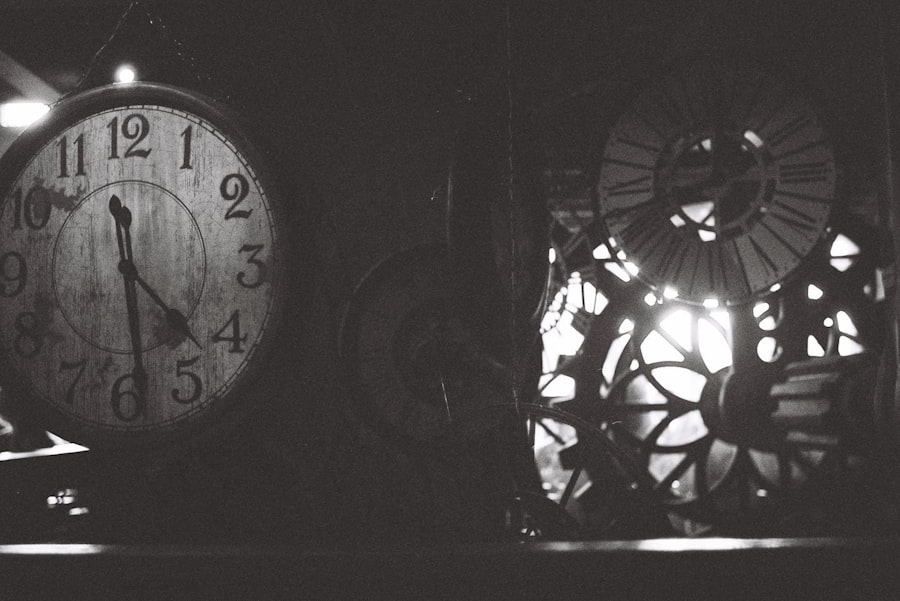
The perception of time is a deeply subjective experience that varies from person to person. While clocks provide a standardized measurement, individual experiences can differ dramatically based on context and emotional state. For instance, moments of joy may seem to fly by, while periods of discomfort can stretch endlessly.
This phenomenon highlights the psychological aspect of time perception, where emotions and cognitive processes play a significant role in how time is experienced. Cultural factors also influence the perception of time. In some cultures, a more relaxed approach to time may prevail, where punctuality is less emphasized than in others that prioritize strict adherence to schedules.
This cultural variability can lead to misunderstandings and conflicts in cross-cultural interactions. Ultimately, the perception of time is not merely a reflection of objective reality but is shaped by a complex interplay of psychological, emotional, and cultural factors.
The role of time in physics
| Concept | Description |
|---|---|
| Time | A fundamental dimension in physics that is used to sequence events, to compare the durations of events and the intervals between them, and to quantify the motions of objects. |
| Time dilation | A phenomenon predicted by the theory of relativity where time appears to pass more slowly in strong gravitational fields and at high velocities. |
| Entropy and the arrow of time | The concept of the arrow of time, which points in the direction of increasing entropy, or disorder, in the universe. |
| Quantum time | The concept of time in the context of quantum mechanics, where time is treated as an operator and is subject to uncertainty. |
In physics, time serves as a crucial variable that underpins many fundamental theories and equations.
Classical mechanics treats time as a constant backdrop against which events occur, allowing for precise calculations and predictions.
However, as previously mentioned, Einstein’s theory of relativity introduced a more nuanced understanding, revealing that time is intertwined with space in a four-dimensional continuum known as spacetime. This relationship between space and time has profound implications for our understanding of the universe. For example, black holes challenge conventional notions of time by creating regions where gravitational forces warp spacetime to such an extent that time may behave differently than it does elsewhere.
Such phenomena compel physicists to reconsider their definitions and measurements of time, leading to ongoing research and exploration in theoretical physics.
The philosophical implications of time
Philosophically, time raises profound questions about existence and reality. Thinkers such as Immanuel Kant argued that time is not an inherent property of the universe but rather a framework through which humans perceive reality. This perspective suggests that while events may occur independently of human consciousness, our understanding and experience of those events are filtered through our temporal perception.
Moreover, discussions about time often intersect with concepts such as free will and determinism. If time is linear and predetermined, does that imply that human choices are merely illusions? Conversely, if individuals possess agency within a cyclical or non-linear framework, what does that mean for their understanding of fate and destiny?
These philosophical inquiries continue to challenge scholars and thinkers as they grapple with the implications of time on human existence.
Time and consciousness

The relationship between time and consciousness is a fascinating area of exploration that delves into how individuals experience reality. Consciousness itself is often described as a continuous flow of thoughts and perceptions that unfold over time. This temporal aspect allows individuals to reflect on past experiences while anticipating future events, creating a sense of continuity in their lives.
Neuroscience has begun to uncover how the brain processes temporal information, revealing that different regions are activated when individuals perceive short versus long durations. This research suggests that consciousness is not merely passive but actively engages with temporal information to construct an understanding of reality. As individuals navigate their lives, their consciousness weaves together memories and anticipations into a cohesive narrative shaped by their unique experiences with time.
The psychological experience of time
The psychological experience of time encompasses various phenomena that illustrate how individuals relate to temporal concepts. One such phenomenon is “time dilation,” where individuals perceive time as moving more slowly or quickly based on their emotional state or level of engagement in an activity. For example, during moments of intense focus or excitement, individuals may feel as though hours have passed in mere minutes.
Conversely, during periods of boredom or anxiety, seconds can stretch into what feels like an eternity. Additionally, memory plays a crucial role in shaping one’s psychological experience of time. The way individuals recall past events can influence their perception of how much time has passed since those events occurred.
Nostalgic memories may create a sense of longing for the past while simultaneously altering one’s perception of present moments. This interplay between memory and perception highlights the complexity of how individuals experience and relate to time on a psychological level.
The cultural and societal impact of time
Time is not only a personal experience but also a cultural construct that shapes societal norms and practices. Different cultures have developed unique approaches to measuring and valuing time, influencing everything from work schedules to social interactions. In some cultures, punctuality is highly valued, while in others, flexibility may be more acceptable.
These cultural differences can lead to misunderstandings in global interactions and collaborations. Moreover, societal structures often dictate how individuals allocate their time. The rise of industrialization brought about rigid schedules and clock-based systems that transformed traditional ways of life.
As societies continue to evolve in response to technological advancements and globalization, the concept of time remains central to discussions about productivity, work-life balance, and social expectations.
Time as a human construct
The notion that time is a human construct challenges traditional views about its objective nature. While clocks and calendars provide standardized measurements, they are ultimately products of human invention designed to facilitate organization and communication. This perspective raises questions about whether time exists independently or if it is merely a framework created by humans to make sense of their experiences.
In this light, various cultures have developed distinct calendars and systems for measuring time based on their unique historical contexts and environmental factors. For instance, lunar calendars differ from solar calendars in their approach to marking the passage of time. Such variations underscore the idea that while humans may strive for uniformity in measuring time, their interpretations are inherently subjective and influenced by cultural narratives.
The illusion of time
The concept of time as an illusion invites contemplation about its true nature and existence. Some philosophical perspectives argue that past and future are constructs created by human consciousness; only the present moment truly exists. This view aligns with certain Eastern philosophies that emphasize mindfulness and living in the present as pathways to enlightenment.
Furthermore, advancements in physics have led some scientists to propose that time may not be as linear or absolute as previously thought. Quantum mechanics introduces ideas about superposition and entanglement that challenge conventional understandings of causality and temporal progression. As research continues to unfold in both philosophy and science, the notion that time may be an illusion rather than an objective reality remains an intriguing possibility.
Is time real or an illusion?
The exploration of time reveals its multifaceted nature as both a tangible measurement and an abstract concept shaped by human perception and cultural context. While clocks tick away seconds in an orderly fashion, individual experiences with time can vary dramatically based on emotional states, societal norms, and philosophical beliefs. As humanity continues to grapple with questions about existence and reality, the debate over whether time is real or merely an illusion persists.
Ultimately, this inquiry into the nature of time invites individuals to reflect on their own experiences and beliefs about its significance in their lives. Whether viewed as an objective reality or a subjective construct, time remains an integral part of human existence—an ever-present force that shapes experiences, influences choices, and connects individuals across generations. As society evolves and new discoveries emerge in both science and philosophy, the quest for understanding the true essence of time will undoubtedly continue to captivate minds for generations to come.
In the ongoing debate about whether time is an illusion or a tangible reality, various perspectives offer intriguing insights. One such perspective is explored in an article on My Cosmic Ventures, which delves into the philosophical and scientific dimensions of time. The article discusses how our perception of time might be influenced by both physical laws and human consciousness, challenging the conventional understanding of time as a linear progression. For a deeper exploration of these ideas, you can read the full article by visiting this link.
FAQs
What is the concept of time as an illusion or real?
The concept of time as an illusion or real refers to the philosophical and scientific debate about the nature of time. Some argue that time is a fundamental aspect of reality, while others propose that it is a subjective construct or illusion.
What are the arguments for time being an illusion?
Some philosophers and physicists argue that time is an illusion because it is a subjective experience and does not have a physical presence in the universe. They point to the relativity of time, the perception of time varying among individuals, and the concept of timelessness in certain theories of physics.
What are the arguments for time being real?
Others argue that time is real because it is a fundamental component of the universe and is essential for understanding the behavior of matter and energy. They point to the measurable and observable effects of time, such as the aging process, the motion of celestial bodies, and the progression of events.
What do scientific theories say about the nature of time?
Scientific theories, such as Einstein’s theory of relativity and quantum mechanics, provide different perspectives on the nature of time. These theories suggest that time is a complex and dynamic aspect of the universe, with properties that can vary depending on the conditions and scales of observation.
How does the concept of time impact our understanding of reality?
The concept of time as an illusion or real has profound implications for our understanding of reality, consciousness, and the nature of existence. It influences our perspectives on causality, free will, the nature of the universe, and the human experience of time.